


Resaltando la belleza de la madera: secado de chapa con control de humedad
La Punto de Rocío y Temperatura DMP5 Vaisala DRYCAP® está diseñada para la medición de humedad en línea en aplicaciones de secado industrial con…

Stainless steel, also known as waterproof steel, is popularly associated with higher resistance to external conditions and corrosion. In fact, the term „stainless steel” covers the whole family of quality steels differing from each other in chemical composition, degree of resistance and properties. In practice, this means that one type of stainless steel can have several times the corrosion resistance of another.
The degree of corrosion resistance is highly dependent on the quantity of chromium added to the steel. A protective passivation layer, i.e. a thin oxide film, forms on the surface of the steel, invisible to the naked eye. It is formed naturally as a result of a chemical reaction between the chromium contained in stainless steel and the oxygen contained in the air. It prevents corrosion of steel and influences its resistance. Increased chromium content and the addition of other alloying elements, such as nickel and molybdenum, further increase the resistance of steel.
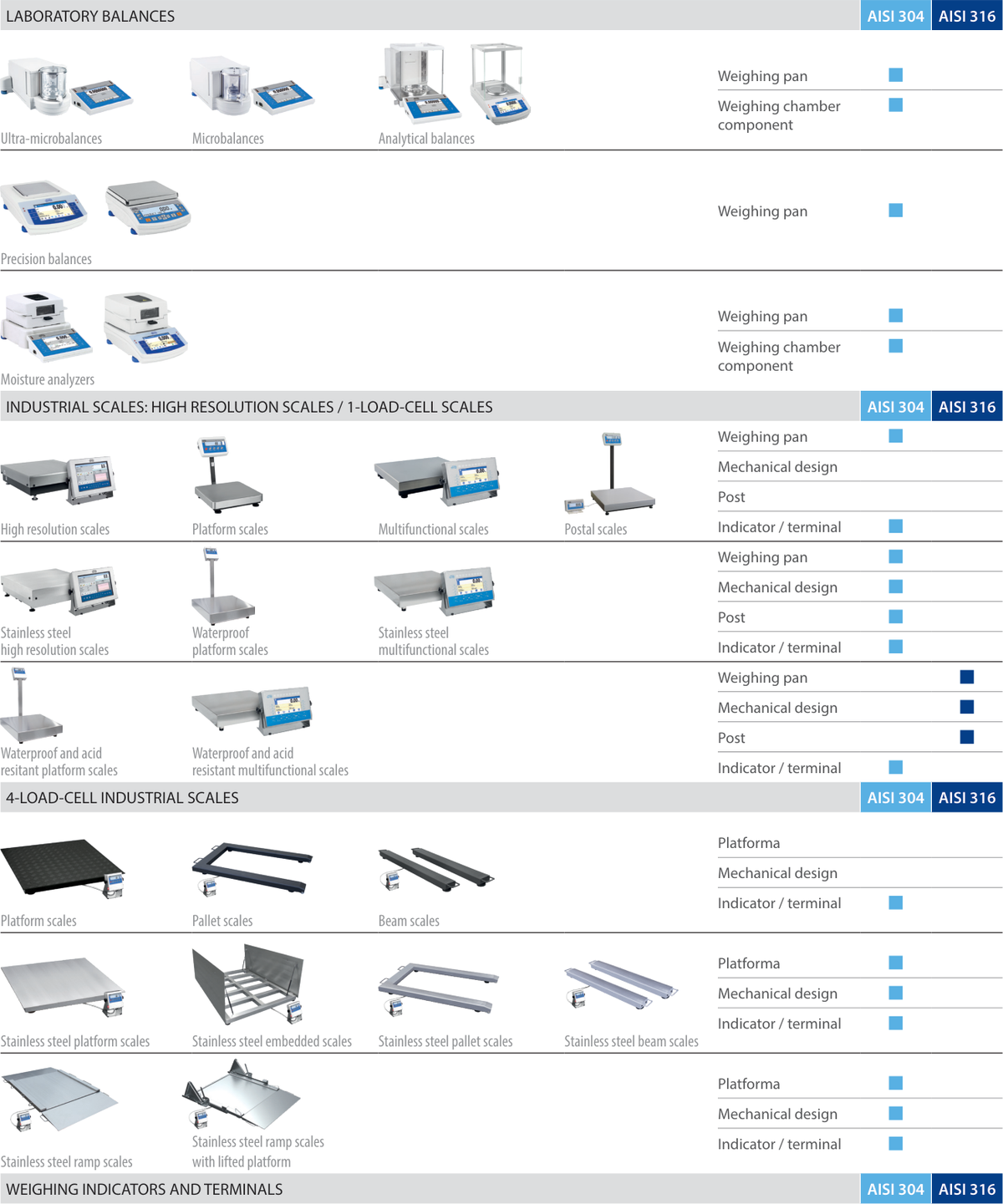
AISI 304 is the most commonly used steel grade in RADWAG products, mainly used for the majority of weighing panes. It is also used for the manufacture of structural elements in products marked ‚stainless’ or ‚waterproof’. AISI 304 steel is also used for indicators and weighing terminals housings.
AISI 316 steel is used to manufacture 1-load-cell platforms of increased resistance, marked as „HR”. It is used to design weighing pans and structural elements of HR platforms. AISI 316 steel is also used in some models of checkweighers.

Housing
Weighing indicators Weighing terminals
design and as such requires individual arrangements.
GRADE
Symbol AISI 304 AISI 316
1.4301 1.4401
0H18N9 0H17N12M2T
X5CrNi18-10 X5CrNiMo17-12-2
Intended use Corrosion neutral environment Highly corrosive environment
Food industry without direct contact with corrosive substances
Food industry with direct contact with corrosive substances
Meat industry without direct contact with brine and corrosive substances Meat industry with direct contact with brine and corrosive substances
Fish industry without direct contact with products with high salt content Fish industry with direct contact with products with high salt content Pharmaceutical industry without direct contact with aggressive substances Pharmaceutical industry with direct contact with aggressive substances Chemical industry without direct contact with aggressive substances
Chemical industry with direct contact with aggressive substances

The user of products made of stainless steel is obliged to observe the rules of their use, resulting from the characteristics of a given steel grade, and to keep them clean and systematically maintained.
For detailed warranty conditions read the warranty certificate that comes with the product. With regard to stainless steel components, the warranty does not cover mechanical damage, natural wear or misuse.
Do not use powders or other abrasive substances and agents containing chlorine, salt or bleach to clean stainless steel products. Even a small amount of chlorine in the cleaning products can cause permanent damage to the chromium oxide coating responsible for the anti-corrosion properties and lead to corrosion.
Dirty elements can be cleaned with a soft cloth slightly moistened with a solution of water and a mild detergent (e.g. soap or dishwashing liquid) and then rinsed with clean water and wiped dry
La Punto de Rocío y Temperatura DMP5 Vaisala DRYCAP® está diseñada para la medición de humedad en línea en aplicaciones de secado industrial con…

El Dr. Lauri Reuter es una experta en el futuro de los alimentos y la persona a quien preguntar si alguna vez te has preguntado qué vamos a comer en…

Las empresas industriales continúan tomando medidas para minimizar sus emisiones de carbono. Muchos están reduciendo el uso de combustibles fósiles y…

En el proceso de caustificación, los químicos pasivos se convierten en químicos de cocina activos para producir licor blanco. Se utiliza en el…
Un especialista responde con la solución, el instrumento y el servicio que corresponden.
Productos para cotizar
Todavía no hay productos. Se puede escribir igual: un especialista responde.