


Destacando a beleza da madeira: Secagem de chapa com controle de umidade
A sonda de temperatura e ponto de orvalho DMP5 Vaisala DRYCAP® foi desenvolvida para medição de umidade em linha em aplicações de secagem industrial…
Nota técnica
-------------------------------------------------------------------------------------------------------------------------------------------------------------
26.03.2019
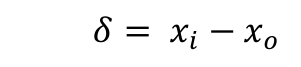
Each measurement (series of measurements) is characterised by accuracy and precision. Measurement accuracy is a rate of compliance between the water content determination result obtained using the moisture analyzer and a true value (ISO 5725-1:2002). The assessment of measurement accuracy requires information on the real value of the product water content. Such information can be obtained via validation of the testing method.
δ= x i −x o – error of water content determination x i – result of water content determination x o – real value of product water content Measurement precision is a rate of compliance between the water content determination results obtained using one and the same device, for one and the same product, carried out in specified conditions by one and the same operator. Precision of the measurements depend on distribution of random errors and does not refer to the real value or other specified value (ISO 5725-1:2002). It is important to realise that the values obtained within one measurement series may differ greatly due to product heterogeneity. The measure of distribution of results of water content determination is standard deviation.
s – standard deviation x i – successive results of water content determination x̅ – arithmetic average value of a measurement series of water content determination n – series measurement quantity
Concerns moisture analyzers of MA R, MA X2.A, MA X2.IC.A, MA 3Y series There are two methods for checking whether the moisture analyzer operation is correct or not. The first method consists in making sure that the set analysis temperature, e.g. 105 o C is really obtained by the heating system of the moisture analyzer. To check the above, it is necessary to compare indications of the control thermometer resting at the place of a disposable pan with the predetermined value.
δ T = T i −T o T – error of measurement of the drying temperature T i – value of the temperature measured using the GT105k-12/Z control thermometer T o – value of the predetermined temperature (the drying temperature) It must be assumed that the difference between the predetermined temperature value and the value measured using the control thermometer is ± 3 o C maximum. Positive result of the drying temperature control does not mean that the product analysis will be accurate and precise. Accuracy and precision is guaranteed by optimization of the drying parameters wherein the specific product features are referred to (structure type, colour, susceptibility to radiation absorption).
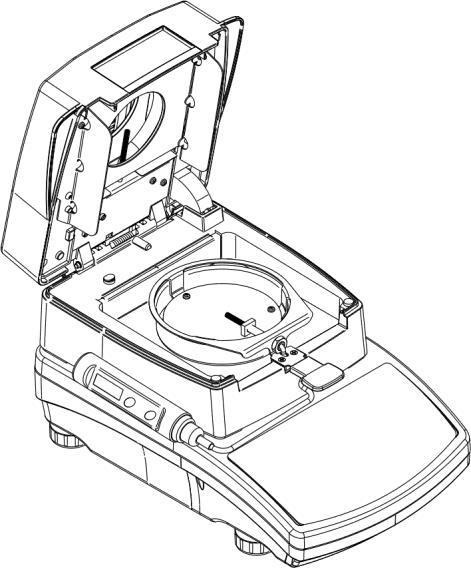
Procedure for verification of the drying temperature is to be found in the user manual of each moisture analyzer. The drawing presents control thermometer during the measurement.
Concerns moisture analyzers of MA R, MA X2.A, MA X2.IC.A, MA 3Y, PMV series The second method of verification of moisture analyzer operation consists in drying of substance of known moisture / dry mass content. Such substance is sodium chloride (NaCl) of concentration of 10 % ± 0.5 %. It is colourless, clear liquid with the density of 1.07 g/cm 3 .
It is assumed that if the heating component of a moisture analyzer operates correctly then as a result of drying of the reference substance (NaCl), it should be possible to provide dry mass content accordant with the certified value.
δ MC = MC i −MC REF δ DM = DM i −DM REF MC – moisture content measurement error DM – dry mass content measurement error MC i – moisture content result obtained during drying of the reference substance (moisture analyzer) MC REF – certified moisture content of the reference substance DM i – the result of dry mas content of the reference substance (moisture analyzer) DM REF – certified value of dry mass content of the reference substance
The reference substance (NaCl) may be used also for assessment of precision of measurement carried out using the moisture analyzer. Difference between the results of dry mass content of few measurements carried out at the same time and in the same conditions is the measure of the measurement precision. It may be expressed by standard deviation or maximum range between the measurements.
1. Prepare the moisture analyzer for operation and set the following drying parameters MA R, MA X2.A, MA X2.IC.A, MA 3Y PMV
a. Drying temperature: 105 o C b. Drying profile: Standard c. Finish mode: Auto 2 d. Unit: %D a. Product temperature: 100 o C b. Power: 100 % c. Drying profile: Standard d. Finish mode: Auto 2 e. Unit: %D
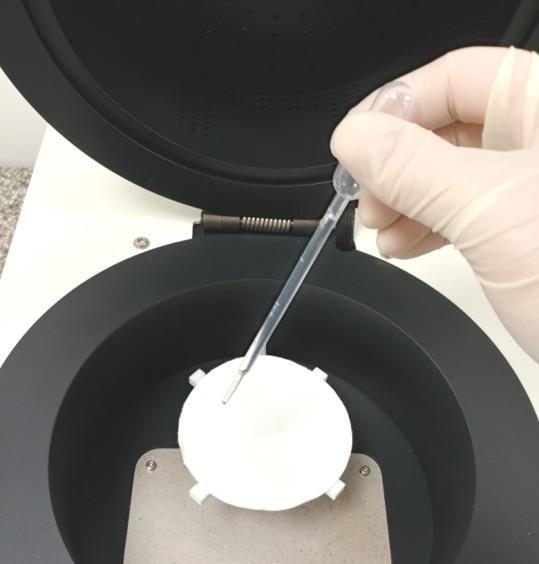
2. Mix the reference substance (NaCl) 3. Load the weighing pan with a glass fibre filter 4. Start the drying procedure (for detailed information read the user manual) 5. When the moisture analyzer displays message ,,Prepare sample” – take ca. 1 g of sodium chloride from the container and dose it onto the filter surface. Spread the sample drop by drop over the whole filter surface.
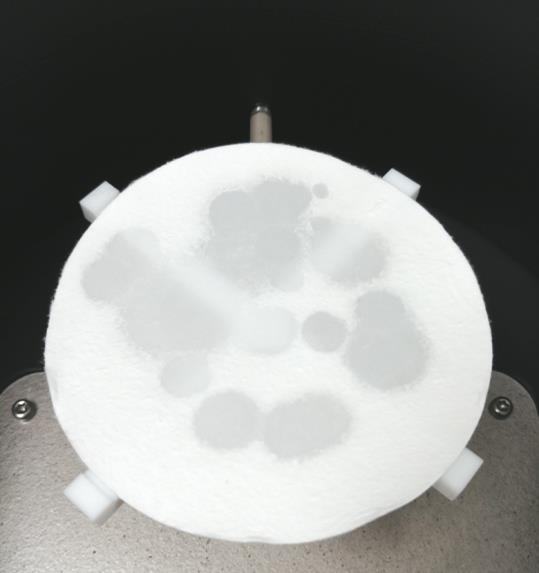
6. Close the drying chamber lid. The drying process starts automatically. 7. Upon drying process completion read the weighing result from the display of the moisture analyzer. If the analysis result is comprised within 10 % ± 0.5 % range then the moisture analyzer operates correctly. 8. In order to determine precision, repeat the drying procedure 6 times, each time apply a new glass fibre filter.
A sonda de temperatura e ponto de orvalho DMP5 Vaisala DRYCAP® foi desenvolvida para medição de umidade em linha em aplicações de secagem industrial…

Lauri Reuter é um especialista no futuro da alimentação e a pessoa certa para perguntar se você já se perguntou o que comeremos no futuro e como toda…

As empresas industriais continuam a tomar medidas para minimizar as suas emissões de carbono. Muitos estão a reduzir a utilização de combustíveis…

No processo de caustificação, os produtos químicos passivos são convertidos em produtos químicos ativos para cozinhar para produzir licor branco…
Um especialista responde com a solução, o instrumento e o serviço adequados.
Produtos para cotar
Ainda não há produtos. É possível escrever mesmo assim: um especialista responde.