Application
M3 test weights are commonly used together with commercial balances of class III and coarse balances of class IIII. They are also used in quality assurance, education and training, as well as for load testing in elevator, crane and vehicle construction.
Depending on the accuracy requirements, weights of classes M1, M2 and M3 can also be used as load bodies for tensile, compression or torsion measurements.
- Testing and adjustment of coarse balances of accuracy class IIII
- Use together with commercial balances of class III
- Quality assurance of balances with lower resolution
- Check weighing in industry, trade and production
- Learning aids for school and training.
- Load tests in elevator, crane and vehicle construction.
- Use as load bodies for tensile, compression or torsion measurements
Marking of M3 Weights
According to OIML R111-1:2004, weights of class M3 from 1 g upwards are marked with their nominal value, but without unit information. To identify class M3, the class M3 is additionally applied.
For cylindrical weights with an adjustment cavity, the class marking is usually located on the knob or on the top of the weight. For block-shaped or other designs, the marking may be applied depending on the design and available space.
For differentiation, weights of the same nominal value that occur more than once in weight sets can be marked with dots or stars.
In addition, customer-specific user markings, such as characters, letters or numbers, can be applied. This allows the weights to be clearly identified as test or measuring equipment and better integrated into internal test equipment management.
These user markings can be specified individually when ordering.
Labelling according to OIML R111:2004
Weights from 1 g to 500 g are marked with their nominal value and the unit symbol "g" (e.g. "10 g"). Weights from 1 kg and larger are marked with their nominal value and the unit symbol "kg" (e.g. "1 kg"). Additional marking of the class:
- Class M1: "M" or "M1"
- Class M2: "M2"
- Class M3: "M3" or "X"
are applied to the upper side. Weights according to DIN 1924 do not have class indicators. The manufacturer's mark may be applied to rectangular block weights of class M1 and to all weights of class M2 and M3. To distinguish them, multiple weights of the same denomination in set compositions are marked by dots or stars. In addition, a maximum of 5 user features (characters, letters and numbers) can be applied as a data matrix to clearly identify the weights as test or measuring equipment. These user features can be defined by the customer when ordering.
Weight sets and cases
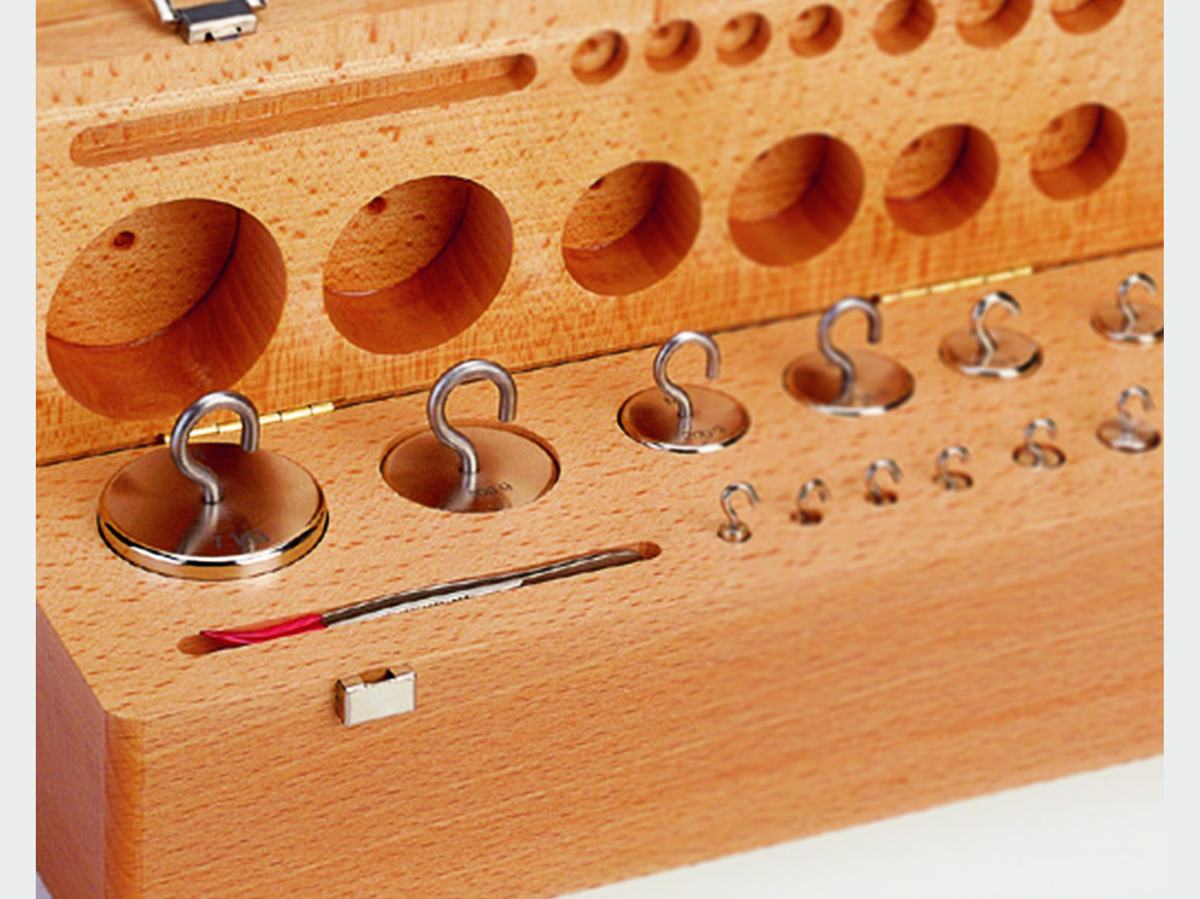
All weight sets include gloves, two brushes and two tweezers; sets up to 50 g come without the big tweezers, the big brush and the gloves.