


Medidor de ponto de orvalho DMT132
para secadores refrigerantes
Nota técnica
When you know how changes in temperature and pressure will affect humidity readings, you can measure and control more accurately – but only if you choose the right measurement instrument. This article aims to help you dive deeper into how humidity behaves in real-world conditions and explains how to choose the right humidity measurement instrument for your application.
As changes in temperature and pressure also change humidity relationships, to understand humidity you need to understand how water vapor behaves in changing conditions. Saturation pressure, partial pressure, and humidity values are all determined by the temperature and pressure.
Temperature: When the temperature rises, the saturation pressure will increase rapidly, as warm air can hold much more water vapor than cold air. This is why RH will fall as temperatures rise, and why falling temperatures bring the risk of saturation and condensation even if there is no additional water added to the air.
Pressure: The total pressure affects the partial pressure of all component gases because of Dalton’s law. When air is compressed, the partial pressure of the water vapor increases in proportion to the total pressure. This increases the risk of saturation and condensation.
Saturation occurs when the partial pressure of water vapor equals the saturation pressure at a given temperature. This is known as dew point. Any further cooling or increase in water vapor will cause condensation. When the temperature is below freezing, excess water vapor will cause ice to form – this is the frost point.
These facts can explain unusual real-world observations, including:
By understanding the physics behind how humidity behaves, you’ll find that changes in temperature and pressure create predictable changes in humidity readings – helping you to measure and control accurately.
Here are two simple scenarios to show how humidity parameters change and how to still measure accurately.
Scenario 1: Heating air from 20 °C to 30 °C
Imagine you have air at 20 °C with 50% RH. If you heat the air to 30 °C without adding or removing water:
Scenario 2: Compressed air dew point calculation
Suppose you compress air from 1 bar to 7 bar. If you do this without drying the air:
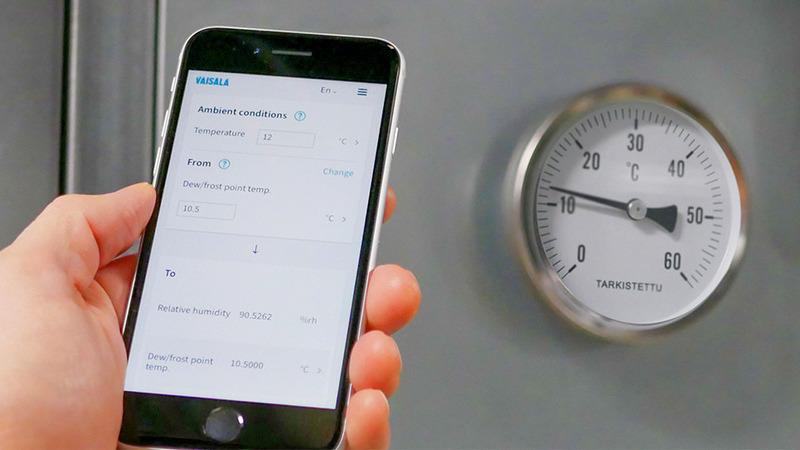
Instead of performing manual calculations, you can quickly understand and analyze these kinds of scenarios using the Vaisala Humidity Calculator – especially when there are multiple changing parameters.
Choosing the right equipment to measure humidity starts with some key considerations. Here’s a handy checklist:
Vaisala’s industrial-grade humidity and dew point transmitters have been designed for stable, long-term high performance in demanding applications such as industrial processes, cleanrooms, and environmental monitoring. Vaisala transmitters are built to perform reliably in environments where drift, downtime, or inaccurate readings can quickly become costly.
To find out more about how to choose the right humidity measurement instrument for your application, read the application note How to Choose the Right Instrument for Measuring Humidity in Your Application.
Humidity may seem simple, but you need to understand what you’re really measuring. Parameters such as relative humidity and dew point measure moisture in different ways – and react differently to changes in pressure and temperature.
When you understand these measurements and how water vapor behaves under changing conditions, you can make smarter control decisions that improve quality, reduce energy consumption, and increase the safety of your operations. Choosing the right instruments and sensors will also protect your processes and improve performance.
The Vaisala Humidity Calculator is a free, easy-to-use resource that helps you model humidity behaviors under different temperatures and pressures in real time – saving you from performing humidity calculations and conversions manually. It covers all the most commonly used parameters and helps you to calculate several humidity parameters based on only one known value. The calculator is scientifically verified and supports a wide range of parameters including RH, dew point, frost point, and enthalpy.
Try the Vaisala Humidity Calculator and explore how changing temperature or pressure affects different humidity parameters.
para secadores refrigerantes

para aplicações OEM

O mais novo integrante da linha Indigo de transmissores e sondas, o Indigo80 é um coletor de dados e indicador portátil e compacto. Ideal para…
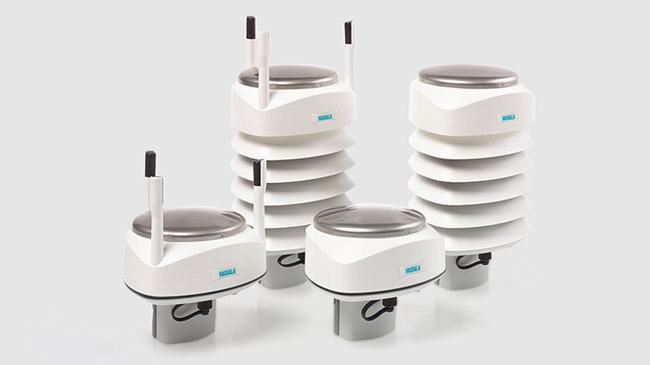
Vaisala Weather Transmitter WXT530 series is a unique collection of cost-effective sensors that accurately and reliably measure weather conditions…

for cleanrooms and industrial settings
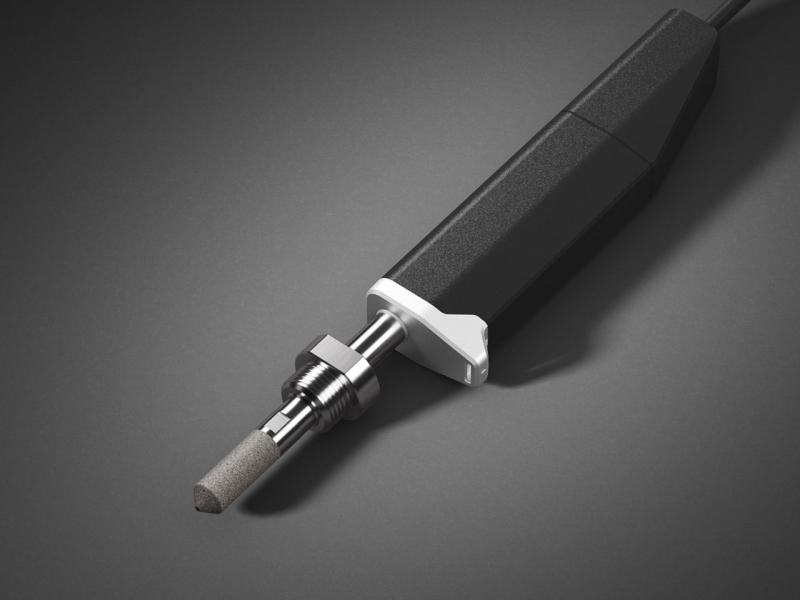
Para verificação pontual e calibração de medições de ponto de orvalho

O que são umidade relativa, ponto de orvalho, umidade absoluta e razão de mistura, como a temperatura e a pressão distorcem a leitura, e por que o…

Como a umidade se comporta em condições reais, os três problemas de medição mais frequentes, e dois cenários práticos —ar aquecido e ar comprimido—…

Quando medir umidade relativa e quando ponto de orvalho, o que exigem a alta e a baixa umidade, como influem temperatura e pressão, e quando convém…

A climatização representa até 40 % da demanda energética de um data center. Este guia da Vaisala explica como a exatidão de medição reduz custos e…
Um especialista responde com a solução, o instrumento e o serviço adequados.
Instrumentos para cotar
Ainda não há instrumentos. É possível escrever mesmo assim: um especialista responde.