

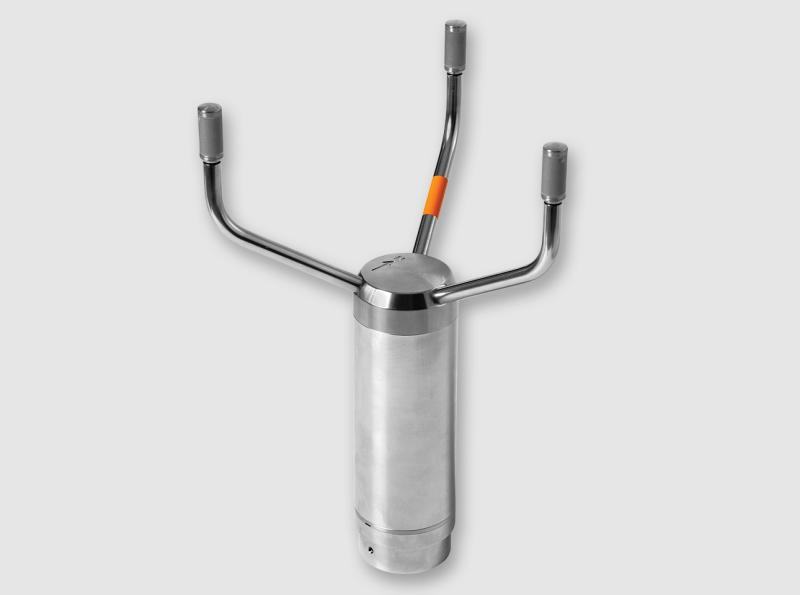
WINDCAP Ultrasonic Wind Sensor WMT700
Ultra-reliable, ultrasonic
Nota técnica
Q&A: Making standalone WindCube® lidar bankable with WindCube Pure TI™ and Availability Booster
This Q&A consolidates some of the technical questions raised by consultants, independent engineers and OEMs on WindCube Pure TI™ and the Availability Booster in our webinar "Improving WindCube® data quality, availability and TI accuracy with Availability Booster and WindCube Pure TI™". Article provides clarified answers to support the practical adoption of lidar‑based TI and availability enhancement in site suitability, loads, and energy yield assessment workflows in line with emerging IEC guidance and OEM expectations.
Pure TI is commercially available today for ground‑based WindCube campaigns. Work is ongoing to extend the methodology to floating lidar by combining Pure TI with motion‑compensation for platform dynamics. That offshore solution is still in R&D and not yet commercially released.
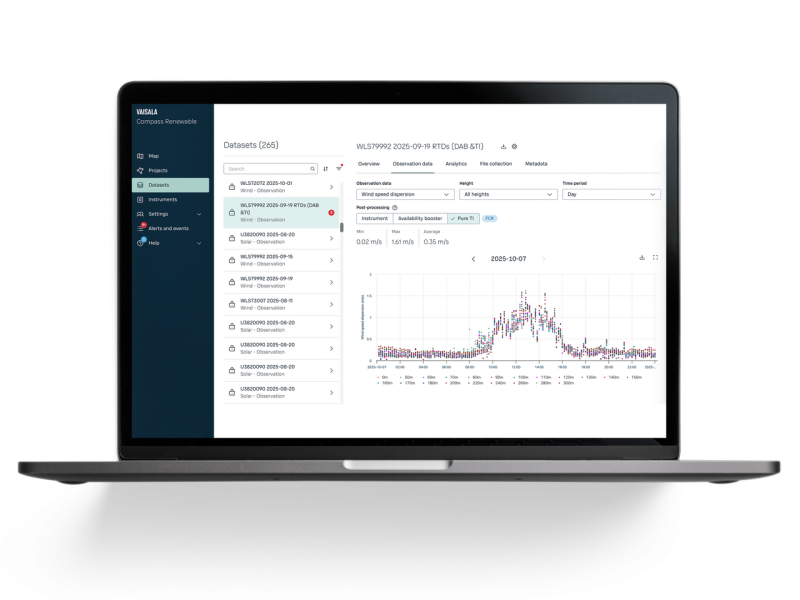
Yes. If 1 Hz RTD files were stored, they can be uploaded into Vaisala’s Compass Renewable platform and tagged as a historical campaign. Pure TI is then applied in the cloud, and outputs are clearly marked as reprocessed historical data for auditability.
The target architecture is to have Pure TI running natively on WindCube hardware. However, embedded deployment requires very extensive qualification over a wide operational envelope.
Compass Renewable is therefore the first deployment layer:
WindCube Pure TI has been validated and shown to significantly improve lidar TI measurements. However, the algorithm is currently computationally intensive, making its deployment directly on the WindCube firmware not yet feasible. Optimizing the computational performance of the algorithm is therefore a key next step toward its integration into the lidar firmware.
Multiple validations indicate that terrain complexity has only a weak impact on Pure TI performance when used correctly:
In practice:
The residual bias in complex terrain is smaller than initially expected and conservative for loads, which many OEMs and IEs view as an acceptable trade‑off versus building and permitting multiple met masts.
Today, Pure TI is offered as a processing workflow in Compass Renewable. You connect your WindCube to Compass, upload or stream RTD files, and Pure TI is applied in the cloud. This can be run daily as new data arrive or as a one‑time bulk reprocessing of past data. Direct activation purely via a remote firmware update on all devices is not yet how the algorithm is deployed.
Pure TI and the Data Availability Booster are delivered as one‑click solutions. The user does not need to define or tune parameters: you simply select the dataset and run the algorithm. All model choices, thresholds and underlying physical formulations are handled by Vaisala as part of the validated implementation.
The 80% threshold was chosen deliberately conservative to ensure each 10‑minute statistic is based on a representative sample of the turbulence distribution. Recent work suggests that, for WindCube, 50% availability can still be sufficient in many conditions, indicating potential to relax thresholds case‑by‑case where justified.
The algorithm combines:
Validation results demonstrate a negligible impact on data quality, which enables users to recover more data without compromising confidence in the measurements. In addition, some IEs are already using DAB in the campaigns they manage.
The gain is most significant at low‑aerosol (“clean air”) sites where baseline availability is poor; in inherently high‑availability environments, the incremental benefit is smaller.
Yes. As long as the necessary underlying data are available, DAB can be run on historical periods through Compass Renewable. This enables:
No hardware replacement is required if you already operate supported WindCube versions and store 1 Hz RTD data.
The intended workflow for consultants/OEMs is:
OEMs remain free to treat mast‑based TI as the reference, but the residual gap between Pure‑TI‑corrected lidar TI and cup TI is now small enough that, for many projects, lidar‑based TI can be accepted as a practical alternative where mast deployment is constrained.
The divergence has been driven by standards:
The IEC 61400‑15‑2 Committee Draft explicitly:
As 61400‑15‑2 proceeds through the IEC process, it provides a common global reference for:
For consultants and OEMs, the key implication is that WindCube Pure TI and the Availability Booster are now sufficiently mature to be integrated into standard energy yield assessment and site‑suitability pipelines, especially where met‑mast deployment is costly, logistically challenging, or constrained by permitting.
In complex terrain, a workflow that combines FCR or CFD for the mean flow with Pure TI for turbulence reconstruction provides a practical and conservative lidar‑based TI solution that aligns well with existing OEM load assessment philosophy. With IEC 61400‑15‑2 now explicitly recognizing standalone lidar under defined conditions, the technical and standards framework for broader acceptance is largely in place; the remaining work lies in embedding these methods into internal consultant and OEM procedures, as well as into lender and insurer guidance, so that lidar‑centric approaches can be adopted consistently and with confidence.
Webinar
How much more value could you get from your WindCube data?
Wind resource assessment campaigns are increasingly pushed into harsher, more complex environments—exactly where lidar data availability and turbulence intensity (TI) can become limiting factors for bankable assessments.
In this webinar, Vaisala, Kjeller Vindteknikk and Nordex will present how the Availability Booster for WindCube and WindCube Pure TI™ in Compass Renewable can enhance your existing and future WindCube campaigns.
Ultra-reliable, ultrasonic
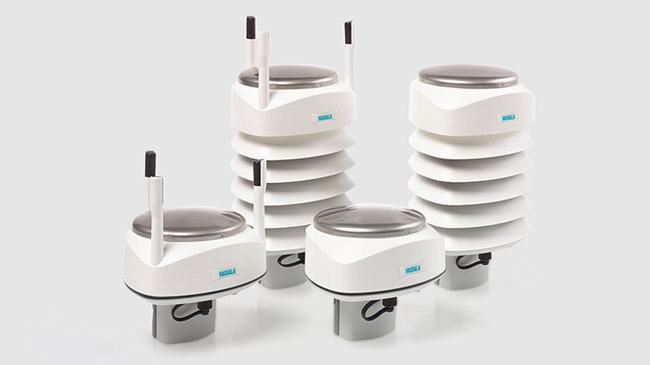
Vaisala Weather Transmitter WXT530 series is a unique collection of cost-effective sensors that accurately and reliably measure weather conditions…

Qué son la humedad relativa, el punto de rocío, la humedad absoluta y la razón de mezcla, cómo la temperatura y la presión distorsionan la lectura, y…

Cómo se comporta la humedad en condiciones reales, los tres problemas de medición más frecuentes, y dos escenarios prácticos —aire calentado y aire…

Cuándo medir humedad relativa y cuándo punto de rocío, qué exige la alta y la baja humedad, cómo influyen temperatura y presión, y cuándo conviene…

La climatización representa hasta el 40 % de la demanda energética de un centro de datos. Esta guía de Vaisala explica cómo la exactitud de medición…
Un especialista responde con la solución, el instrumento y el servicio que corresponden.
Instrumentos para cotizar
Todavía no hay instrumentos. Se puede escribir igual: un especialista responde.