


CAB100 Industrial Cabinet for continuous monitoring systems
for cleanrooms and industrial settings
Nota técnica
Recently, I received a question from an attendee of our webinar "Mastering Temperature Mapping."
Dear Paul,
For small chambers (upright freezers or incubators), we qualify the unit with empty and max load studies. To meet the minimum requirement, we place 10 temperature sensors within the chamber—one in each corner, one in the center, and one near the control probe.
But, do we need to redo the max load study if the shelf configuration inside the chamber changes, for example, changing from five shelves to four?”
My short answer is... maybe.
The original sensor placement, as described, doesn’t account for the shelves themselves. If the shelves are wire racks, airflow may not be significantly impacted. But it’s not just about the shelves—it’s about the product sitting on those shelves.
Here are a few key questions I would answer in deciding whether to requalify:
Let’s break it down by application.
Freezers generally have wider temperature tolerances and often rely on conduction more than airflow. Most have wire shelves and tend to perform better when more thermal mass is present (i.e., more product). A slight change in shelf configuration is less likely to impact performance significantly.
Incubators, on the other hand, usually have much narrower temperature ranges and rely heavily on airflow for thermal uniformity. They often have solid shelves, which can restrict that airflow, making shelf placement and loading patterns more critical. Any change in configuration or loading could affect performance and may warrant requalification.
This question is a good one—and it merits investigation, particularly for incubators. Before launching into re-mapping, I would evaluate whether the changes affect load distribution, airflow, or thermal uniformity. Start by reviewing your risk assessment and qualification rationale, and look closely at how the equipment operates under the new configuration.
for cleanrooms and industrial settings

para secadores refrigerantes

para aplicações OEM

para inspeções rápidas e verificação do local

Transmissores de ±1,5% de U.R. para HVAC exigente, com um certificado
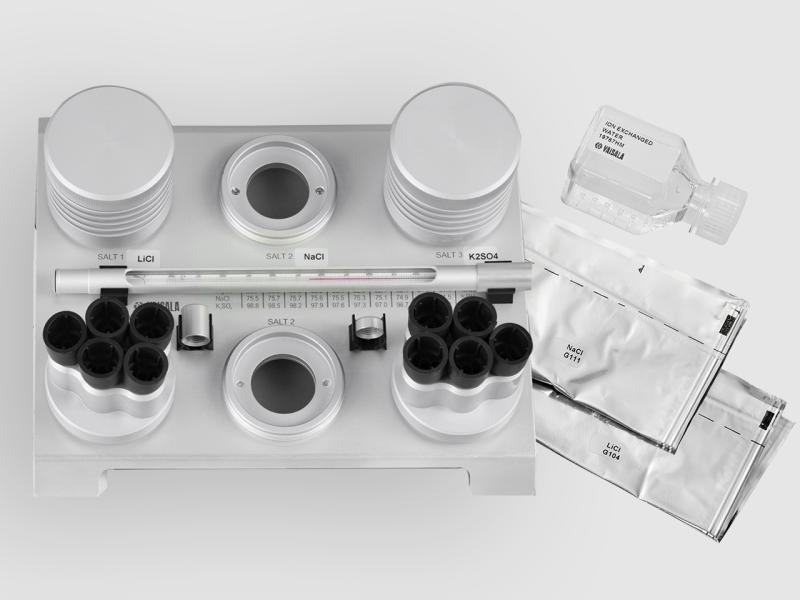
O calibrador de umidade HMK15 da Vaisala faz a calibração e a verificação rápida de sondas e transmissores de umidade de forma fácil e confiável.

O que são umidade relativa, ponto de orvalho, umidade absoluta e razão de mistura, como a temperatura e a pressão distorcem a leitura, e por que o…

Como a umidade se comporta em condições reais, os três problemas de medição mais frequentes, e dois cenários práticos —ar aquecido e ar comprimido—…

Quando medir umidade relativa e quando ponto de orvalho, o que exigem a alta e a baixa umidade, como influem temperatura e pressão, e quando convém…

A climatização representa até 40 % da demanda energética de um data center. Este guia da Vaisala explica como a exatidão de medição reduz custos e…
Um especialista responde com a solução, o instrumento e o serviço adequados.
Instrumentos para cotar
Ainda não há instrumentos. É possível escrever mesmo assim: um especialista responde.