

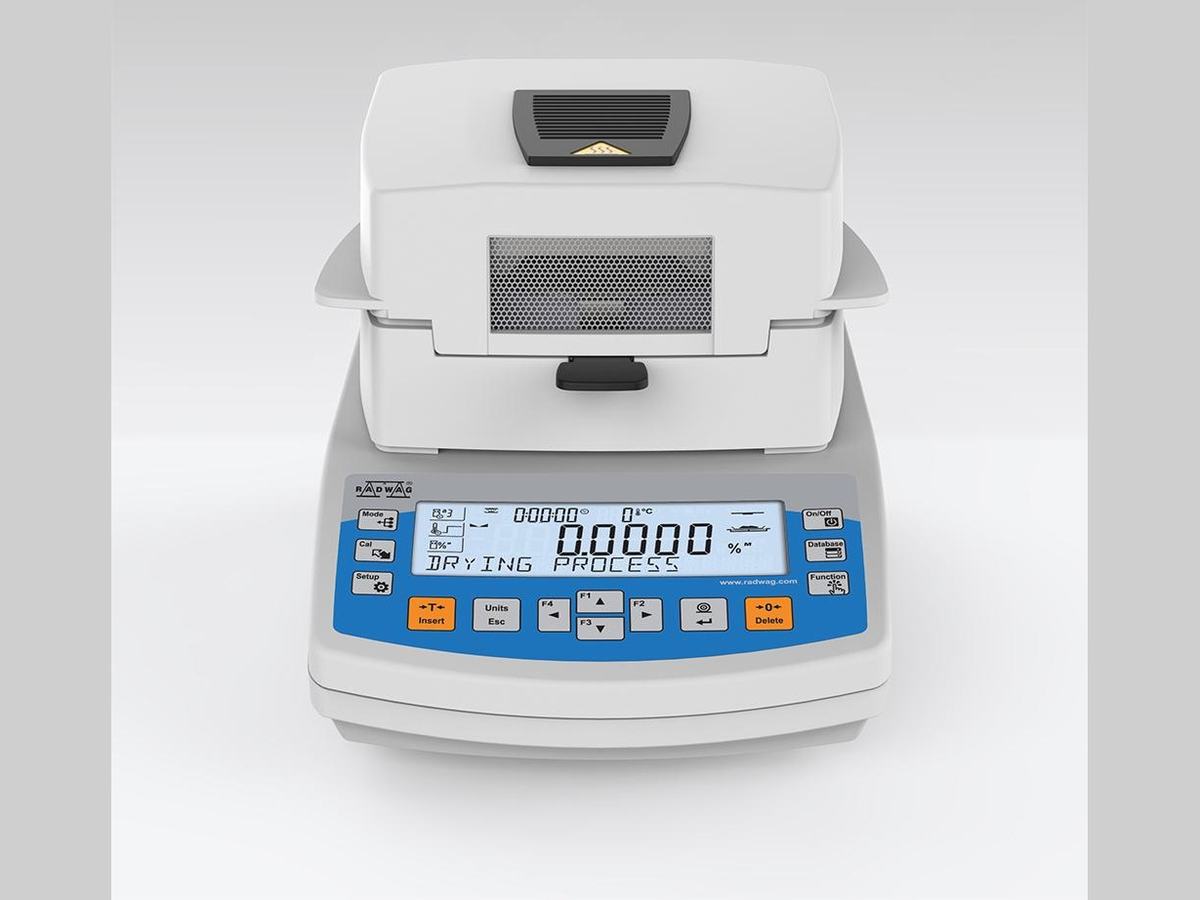
MA 50/1.R Moisture Analyzer
The MA.R series is enriched with various interfaces: RS232, USB type A, USB type B and Wi-Fi®. The moisture analyzer is housed in a plastic casing…
Application note
Water content is an essential quality-related parameter in the plastic processing industry. The surplus of water in plastic granules while they are processed usually results in a low-quality product, frequently with conspicuous defects of the surface. The structure defects may emerge even when the granule is pre-dried, which may suggest a need to modify process parameters. The most common method of testing water content in plastics is specification of the loss of drying (LOD), the so-called moisture analyzer method. This seemingly simple method of testing cannot always assure real results as it requires a very precise measuring of the smallest loss of mass. Precision and accuracy of water content determination can be achieved with MA R, MA X2, MA X7 and MA 5Y moisture analyzers by Radwag.
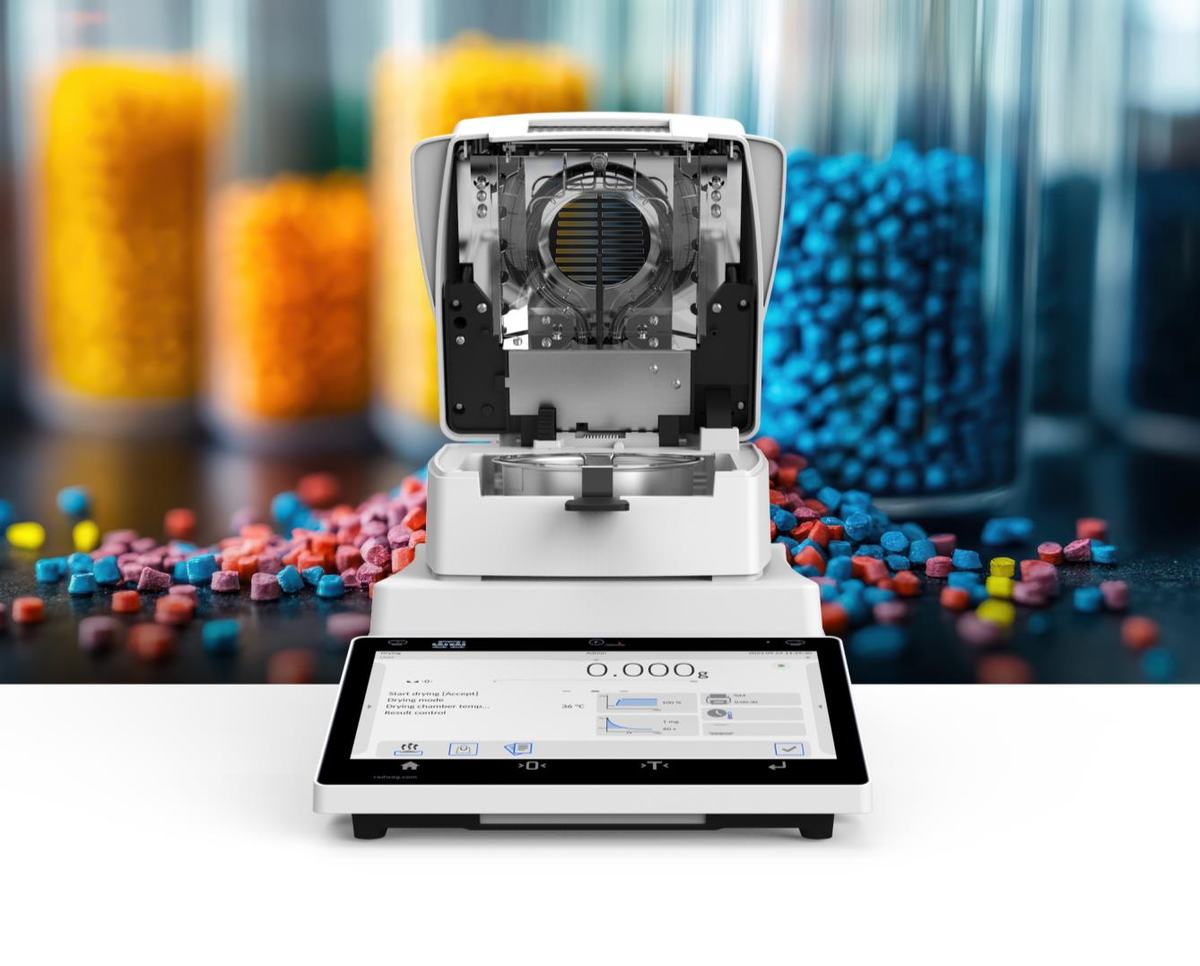
The application note includes basic information for validation of the plastic granules drying method with the use of MA R, MA X2, MA X7 and MA 5Y moisture analyzers series by Radwag Wagi Elektroniczne. The application note may be the basis for elaborating own drying method with special regard to distinctive features of the product in question.
The method with the use of IR radiation
ACCURACY of determining water / dry matter content is the difference between the result of the water / dry matter content received in the moisture analyzer method and the result of the water / dry matter content received while drying the same sample through a reference method. PRECISION is a degree of compliance between independent results of the test, received in specific conditions. The measure of precision is a standard deviation from a series of several measurements.
Testing water content in plastic granules has been based on the Karl Fischer’s coulometric method as per requirements of the ISO 15512 B2 Plastics – Determination of water content standard.
Before testing, samples must be stored in tightly sealed containers.
Karl Fischer’s apparatus, reagents, samples in question.
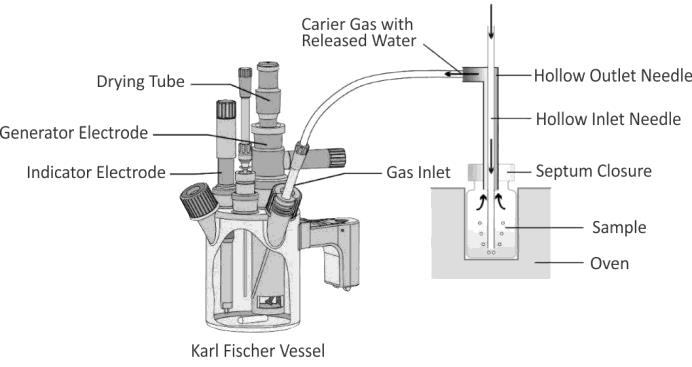
In the ISO 15512 B2 method, a small amount of each sample (ca. 0.5 g) was placed in tightly sealed vials that were then put into the rotating store. During measurements, a single vial was automatically moved to the heating stove chamber.
As a result of the temperature rise, water in the sample was evaporated and transferred into the titration cell through the dry air (nitrogeny) by means of the probe. The water collected was titrated in the cell on the basis of the Karl Fischer’s method.
Karl Fischer’s coulometric method diagram, source: Determination of Moisture in Petroleum Samples According to ASTM D6304 (Karl Fischer Oven Method). Metrohm USA Inc
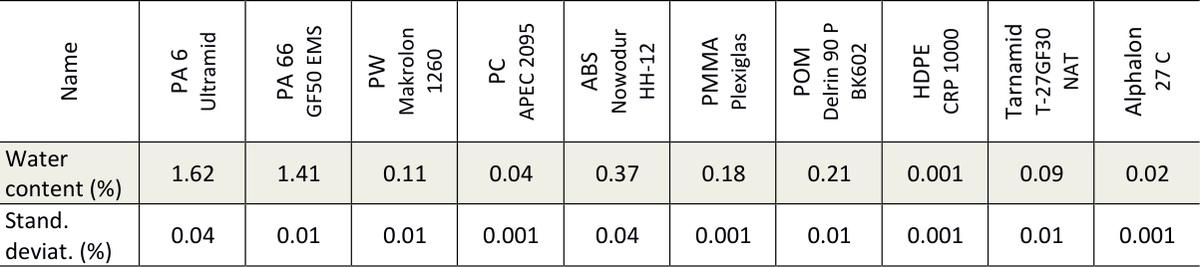
An important factor in testing plastic water content is a hygroscopic nature, that is ability to absorb moisture from the surrounding. Hygroscopic plastics, such as PA, PS, PC, PET, ABS, PBT, prove to absorb a way more moisture that migrates into the interior of the granule, which in effect leads to the volume increase. For this reason every sample must be stored in a tightly sealed container.
No requirements.
MA 50/1.R or MA 50/1.X2.A moisture analyzer, glass weighing vessels with a lid, laboratory spoon.
Choose the drying profile as Standard. Set drying parameters presented below. Place the sample with a mass of ca. 12- 15 g on the balance weighing pan. Lock the drying chamber manually or automatically.
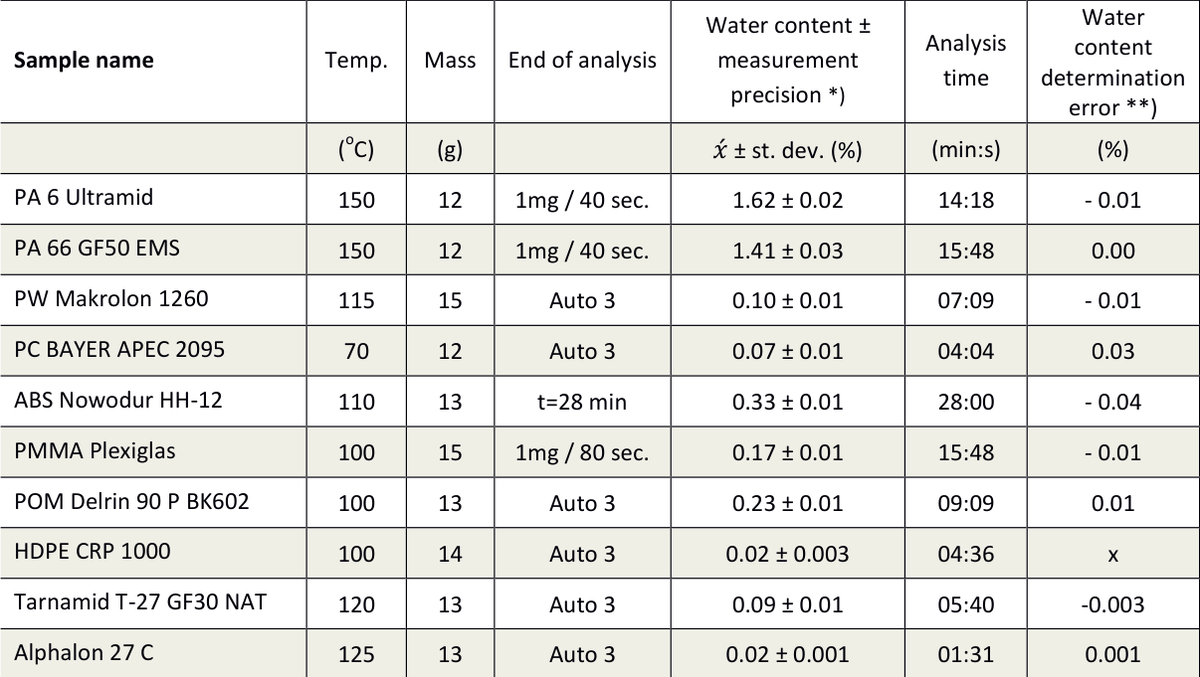
*) – the measurement precision has been determined as a standard deviation from a series of 5 measurements. **) – the water content determination error has been determined as a difference between the average water content value obtained with the use of the moisture analyzer and the result of the water content obtained on the basis of the Karl Fischer’s method.
The method in question has been verified by the Research Laboratory, yet the results do not include factors arising from diversity of tested samples, operators’ personal skills as well as measuring capability used by moisture analyzer users. For this reason Radwag shall not be held responsible for drying parameters but they can be used to elaborate own drying method.

The MA.R series is enriched with various interfaces: RS232, USB type A, USB type B and Wi-Fi®. The moisture analyzer is housed in a plastic casing…
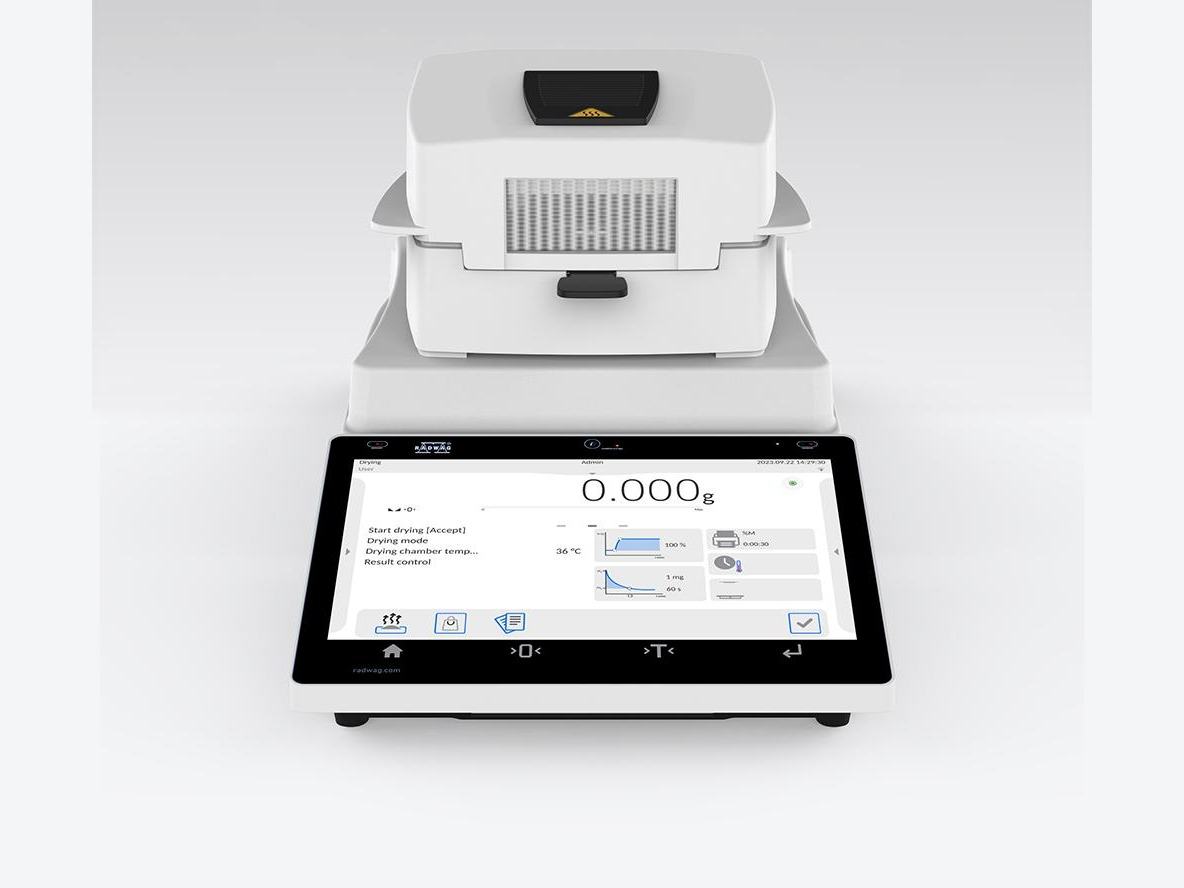
The MA 5Y Moisture Analyzer offers you four drying profiles: standard, mild, fast and step.
The MA 5Y Moisture Analyzer offers you four drying profiles: standard, mild, fast and step.
The MA 5Y Moisture Analyzer offers you four drying profiles: standard, mild, fast and step.
The MA 5Y Moisture Analyzer offers you four drying profiles: standard, mild, fast and step.
The MA 5Y Moisture Analyzer offers you four drying profiles: standard, mild, fast and step.
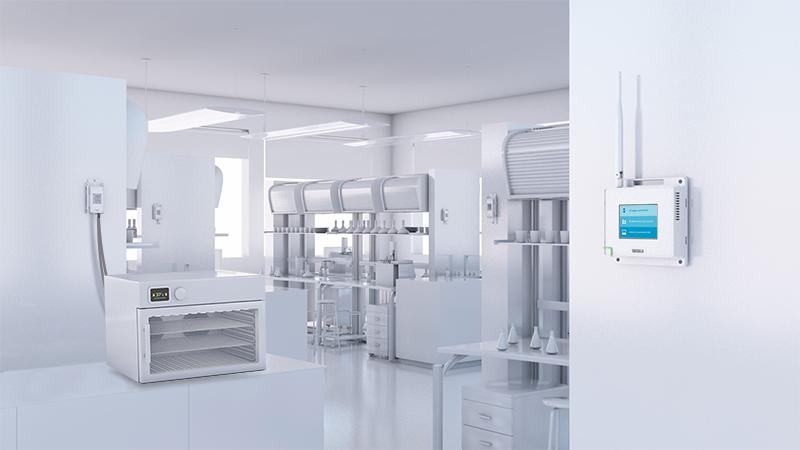
The Vaisala viewLinc Monitoring System tracks environmental conditions wirelessly using Vaisala’s VaiNet wireless devices based on LoRa®* technology…

One of the most important requirements to reduce cooling costs is to measure conditions properly in the first place. The first things to consider are:
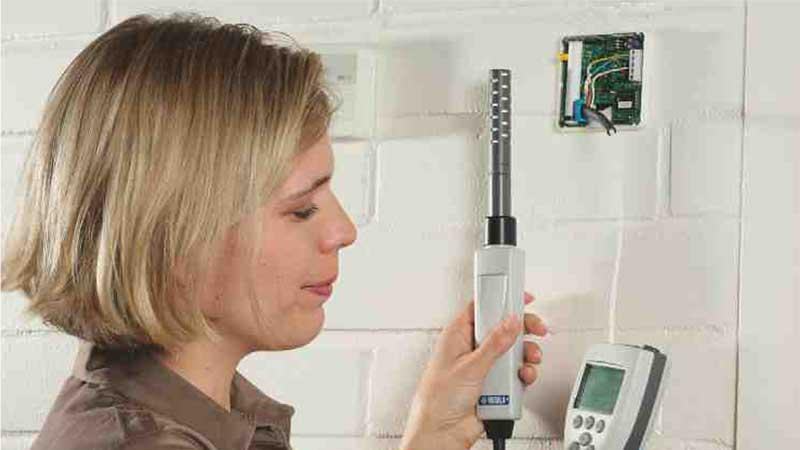
Carbon dioxide and other gases consisting of two or more dissimilar atoms absorb infrared (IR) radiation in a characteristic, unique manner. Such…
Another approach to preventing explosions is to install electrical equipment inside of “explosion proof” housings. These housings can withstand…
A specialist replies with the solution, the instrument and the service that fit.
Products to quote
No products yet. An enquiry can be sent anyway: a specialist answers.