

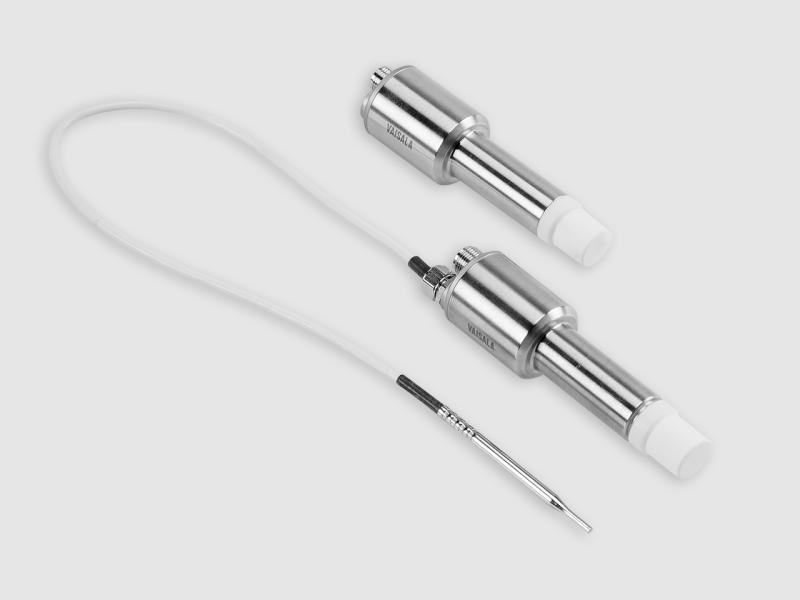
Vaporized Hydrogen Peroxide, Humidity and Temperature Measurement HPP270 Series
for bio-decontamination processes
Technical note
The PEROXCAP® sensor for vaporized hydrogen peroxide bases its measurement on two HUMICAP® sensors. To understand how HUMICAP sensors work, it is useful to know a little about thin-film polymer sensors. In this type of sensor, there is a thin layer of polymer between two electrodes. The film absorbs or releases vapor according to humidity changes in the environment.
As the humidity changes, the dielectric properties and capacitance of the sensor changes. A dielectric is an insulator that impedes an electric charge; capacitance is the ability of conductive materials to respond to voltage changes. Essentially a thin film polymer sensor is measuring voltage changes that occur with the amount of water vapor in the environment. Electronics within the instrument use the capacitance of the sensor to give a humidity measurement.
The PEROXCAP sensor uses two HUMICAP sensors: one with and one without a catalytic layer. The catalytic layer breaks down the hydrogen peroxide so that the HUMICAP sensor with the layer senses only the humidity, while the sensor without the catalytic layer senses both hydrogen peroxide vapor and water vapor in the air. The instrument calculates the difference between the two sensors to give a measurement of H2O2 concentration.
However, humidity sensors are different from other sensors, such as temperature sensors, because they are in direct contact with the environment they measure. Although the HPP270 series probes provide the highest accuracy and precision, even the best sensors will drift over time. Dirt, chemicals and temperature changes can also cause a drift in accuracy. Regular calibration mitigates incremental sensor drift and ensures instruments are operating within their specifications.
Factory Calibration:We recommend H2O2 calibration at a Vaisala laboratory for traceable calibration service. Calibration for the hydrogen peroxide measurement uses two different H2O2 vapor concentrations. Calibrations on the HPP272 probes are performed for H2O2, Relative Saturation, Relative Humidity, Temperature and analog output. Note that the HPP271 probes measure H2O2 only (no temperature or relative humidity calibration needed.) Calibration service comes with a certificate and full instrument maintenance is optional. For factory service, find your nearest calibration center.
On-site Calibration:For on-site calibrations, we offer a do-it-yourself option with the HMK15 RH calibrator as a reference and our Insight software. The software shows you the drift in both Relative Saturation (RS) and Relative Humidity (RH) and gives you the possibility to make two-point adjustment to these parameters in order to show the same value as a reference value. Based on the humidity calibration, the software also calculates H2O2 ppm error at a certain ppm level. High quality H2O2 measurement performance is also ensured by calibration and adjustment.
for bio-decontamination processes
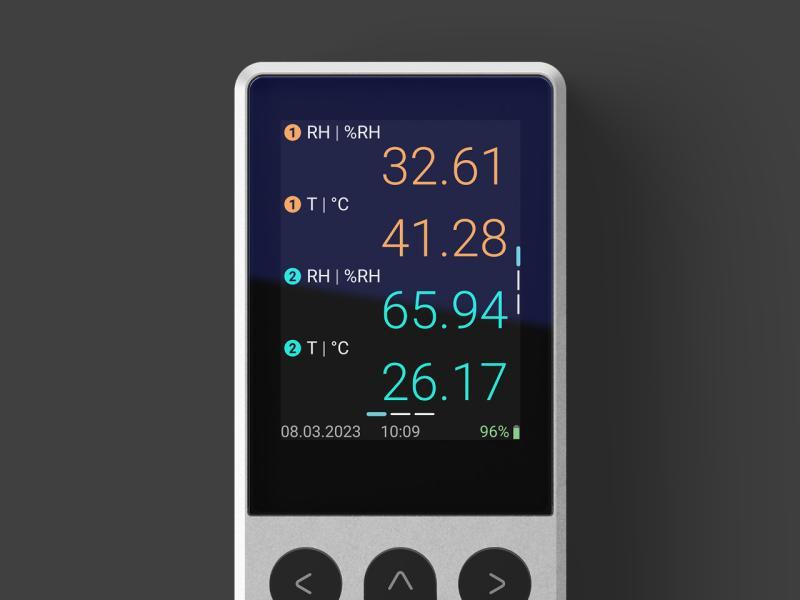
The latest addition to the Indigo family of transmitters and probes, the Indigo80 is a compact, handheld indicator and data logger. Ideal for field…
The latest addition to the Indigo family of transmitters and probes, the Indigo80 is a compact, handheld indicator and data logger. Ideal for field…

Upper air soundings provide the crucial data necessary for a complete atmospheric weather profile that leads to accurate forecasting. However…
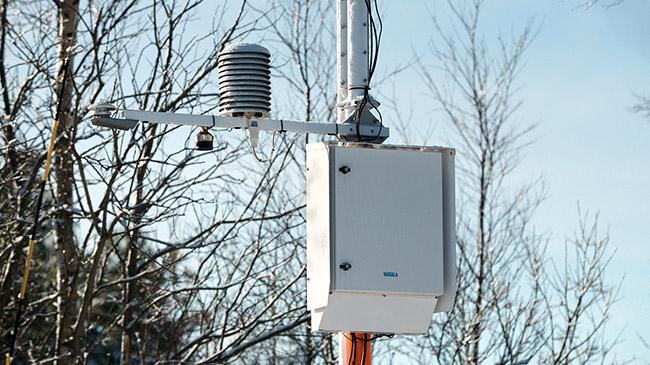
Vaisala Automatic Weather Station AWS310 is a complete communication and weather observation solution that can be used as a standalone unit, or as…
Our next-generation, cyber secure and modular Maritime Automatic Weather Station AWS830 is engineered for harsh marine environments and compliant…

Vaisala DRYCAP® Dew Point and Temperature Probe DMP5 is designed for in-line humidity measurement in industrial drying applications with high…

Dr. Lauri Reuter is an expert in the future of food, and the person to ask if you’ve ever wondered what we are going to eat in the future, and how…

Industrial companies are continuing to take action to minimize their carbon emissions. Many are reducing their use of fossil fuels and switching to…

In the causticizing process, passive chemicals are converted into active cooking chemicals to make white liquor. This is used in the digester as a…
A specialist replies with the solution, the instrument and the service that fit.
Products to quote
No products yet. An enquiry can be sent anyway: a specialist answers.