

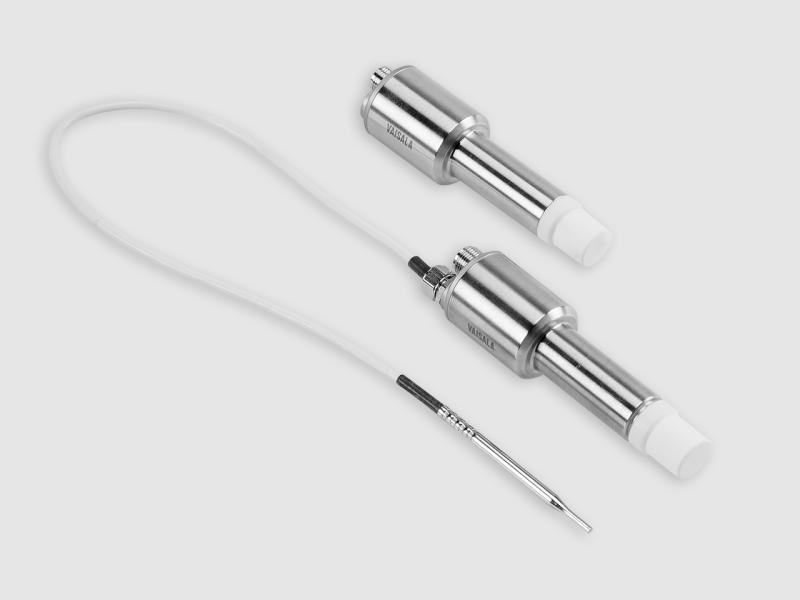
Vaporized Hydrogen Peroxide, Humidity and Temperature Measurement HPP270 Series
for bio-decontamination processes
Technical note
This blog is the fourth in a 4-part series where we describe how process parameters influence vaporized hydrogen peroxide bio-decontamination applications.
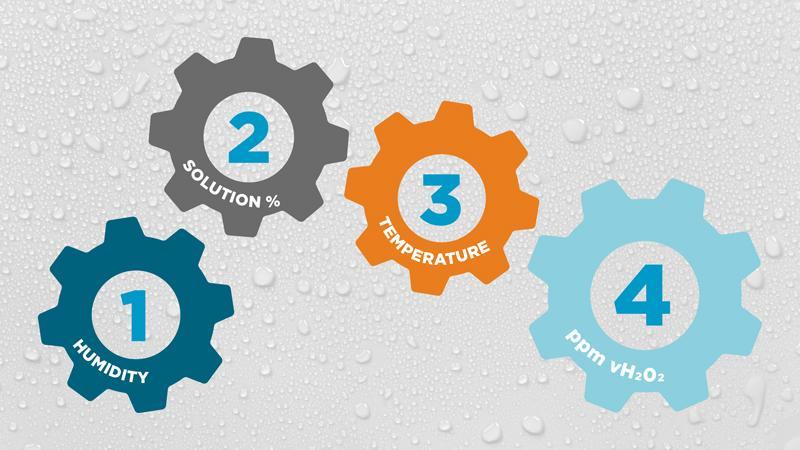
First blog: Humidity, condensation point, and maximum achievable vH2O2
Second blog: H2O2 Solution Concentration Ratio, Condensation Point & Maximum Achievable vH2O2
Third blog: Temperature, Condensation Point & Maximum Achievable vH2O2 ppm in Bio-decontamination
In this series, we propose four basic process parameter rules. This blog focuses on the 4th rule:
Increasing the H2O2 vapor concentration decreases the amount of water vapor the air can hold, and therefore, condensation occurs sooner.
In Figure 7 (from our white paper), we can see that increasing the H2O2 vapor concentration decreases the amount of water vapor the air can hold and condensation occurs sooner.
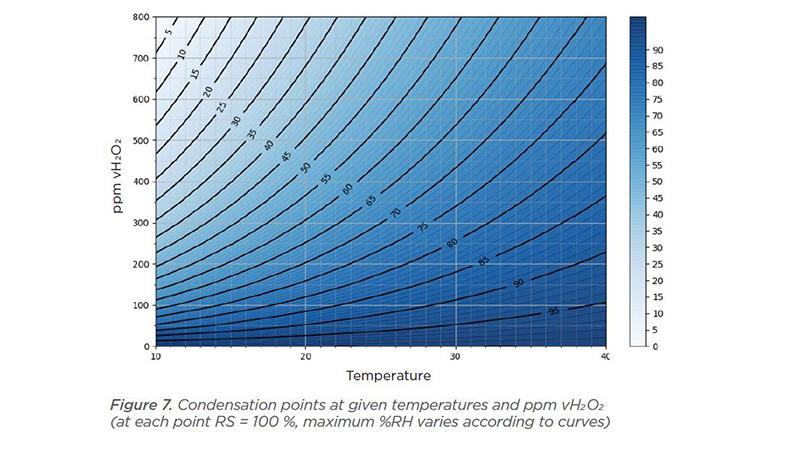
Each point in Figure 7 is a condensation point, meaning that Relative Saturation is 100 %. Temperature is on the x axis and ppm vH2O2 is on the y axis. The curve in the graphs shows the maximum relative humidity at a given temperature and concentration of ppm vH2O2.
As shown, at 20 °C and 300 ppm hydrogen peroxide, relative humidity will be 60% and relative saturation will be 100%. If we increase vH2O2 to 600 ppm at 20 °C, relative humidity is then 39 % and relative saturation is 100 %.
By increasing the air temperature to 40 °C with vH2O2 concentration at 300 ppm, relative humidity will be 87% and relative saturation will be 100%. The higher the temperature, the more water vapor the air can hold; relative humidity is increased.
To summarize our proposed rules for controlling condensation in vaporized hydrogen peroxide bio-decontamination applications:
Over this series of blogs (based on our white paper), we have demonstrated how an in-depth understanding of the relation between critical process parameters allows for the development of effective, repeatable vH2O2 bio-decontamination cycles.
Single-parameter measurement is often insufficient for monitoring and ineffective for process control. We have also shown why relative saturation is an important value in accurately predicting condensation. This is why Vaisala’s unique PEROXCAP® technology measures multiple parameters in a single sensing unit, including: hydrogen peroxide vapor ppm, temperature, dew point, vapor pressure, and humidity as both relative humidity and relative saturation.
for bio-decontamination processes
The latest addition to the Indigo family of transmitters and probes, the Indigo80 is a compact, handheld indicator and data logger. Ideal for field…
The latest addition to the Indigo family of transmitters and probes, the Indigo80 is a compact, handheld indicator and data logger. Ideal for field…
Upper air soundings provide the crucial data necessary for a complete atmospheric weather profile that leads to accurate forecasting. However…
Vaisala Automatic Weather Station AWS310 is a complete communication and weather observation solution that can be used as a standalone unit, or as…
Our next-generation, cyber secure and modular Maritime Automatic Weather Station AWS830 is engineered for harsh marine environments and compliant…

Vaisala DRYCAP® Dew Point and Temperature Probe DMP5 is designed for in-line humidity measurement in industrial drying applications with high…

Dr. Lauri Reuter is an expert in the future of food, and the person to ask if you’ve ever wondered what we are going to eat in the future, and how…

Industrial companies are continuing to take action to minimize their carbon emissions. Many are reducing their use of fossil fuels and switching to…

In the causticizing process, passive chemicals are converted into active cooking chemicals to make white liquor. This is used in the digester as a…
A specialist replies with the solution, the instrument and the service that fit.
Products to quote
No products yet. An enquiry can be sent anyway: a specialist answers.