


Bringing out the beauty of wood: Veneer drying with humidity control
Vaisala DRYCAP® Dew Point and Temperature Probe DMP5 is designed for in-line humidity measurement in industrial drying applications with high…
Technical note
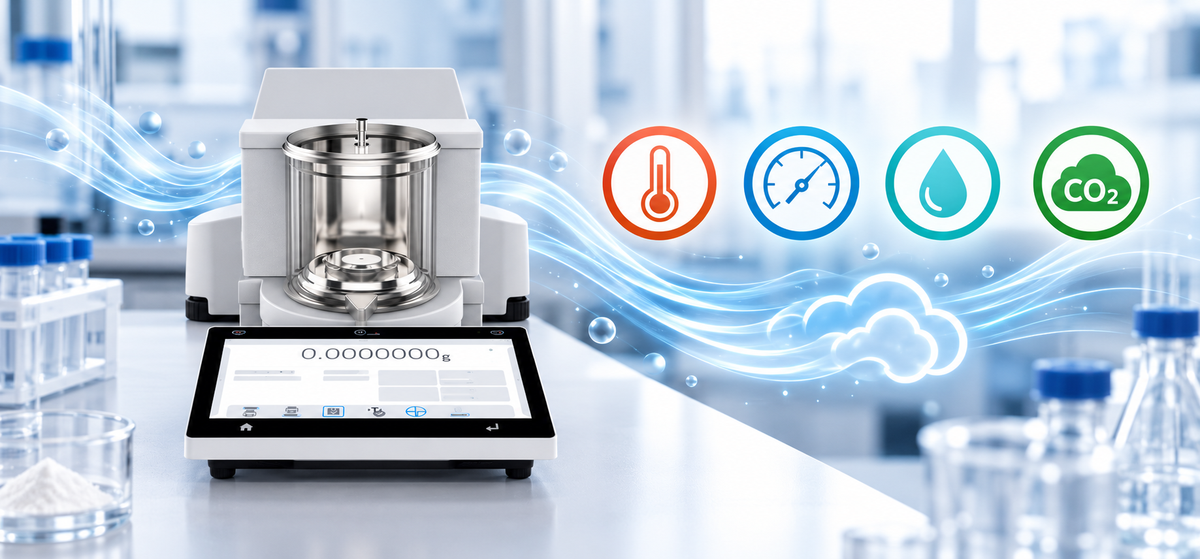
In a laboratory, the weighing result depends not only on the sample and the balance’s specifications. Environmental conditions also play a role: temperature, pressure, humidity and even CO₂ concentration. When performing very precise measurements, the influence of these factors can no longer be ignored.
A sample placed on the weighing pan is surrounded by air, which exerts a buoyant force on it. The magnitude of this force depends, amongst other things, on the density of the air, which varies with temperature, pressure and humidity. Therefore, two measurements of the same sample taken under different conditions may yield slightly different results. The greater the measurement accuracy, the more significant these differences become.
Changes in temperature affect both the density of the air and the sample itself, as well as the balance components. A warm or cold sample may also cause convective air movements, which make it difficult to stabilise the reading.
Higher pressure means greater air density and, consequently, greater buoyancy. In high-precision measurements, the effect of atmospheric pressure may therefore need to be taken into account.
Water vapour and carbon dioxide alter the composition and density of the air. In typical measurements, their effect is negligible, but in high-precision metrology, these parameters may also be significant.
A stable temperature, no draughts, proper sample preparation and regular monitoring of environmental conditions are essential for accurate weighing. It is also important to use a suitably selected balance and its functions that support control of the measurement process.
The smaller the sample mass and the greater the required accuracy, the more important the conditions under which the measurement is performed. That is why RADWAG’s range includes instruments designed for various levels of accuracy – from the 5Y series ultra-microbalances and microbalances, through the 5Y series analytical balances, to the AS X7 analytical balances.
The 5Y series ultra-microbalances and 5Y series microbalances are designed for the most demanding measurements, where even the slightest changes in mass are significant. With such high sensitivity, environmental influences – including air movement, temperature and pressure changes – become particularly significant. The design and features of these balances are intended to facilitate stable, repeatable results even when measurement requirements are exceptionally high.
The 5Y series analytical balances meet the needs of laboratories where high accuracy and thorough control of the weighing process are required. These are solutions for day-to-day research and analytical work, where it is not only the resolution of the balance itself that matters, but also the ability to monitor the conditions under which the measurement is performed.
The AS X7 analytical balances, on the other hand, combine high accuracy, excellent repeatability and design features that minimise the influence of the environment. The series includes models with a readability of 0.01 mg, as well as models with larger weighing ranges. The spacious weighing chamber minimises the impact of air movement on the result, whilst the stable aluminium base ensures the stability of the measuring system.
The AS X7 balances can also be integrated with the THBR 2.0 System – Ambient Conditions Monitoring, which allows for the monitoring of environmental parameters relevant to the weighing process. The balance can therefore not only display the result, but also provide information about the conditions under which that result was obtained.
This is particularly important for the most demanding measurements. The greater the accuracy of the balance, the more difficult it is to consider the measurement result in isolation from the environment. Temperature, humidity, pressure and air properties become part of the entire measurement process, and a suitably selected balance helps to control this process.
Temperature changes affect the density of the air and the sample itself, as well as balance components. Warm or cold samples can also cause convective air movements, making it difficult to stabilize the reading. Higher air pressure means greater air density, which consequently increases the buoyant force exerted on the sample. In high-precision measurements, this effect of atmospheric pressure may need to be taken into account. Humidity and carbon dioxide concentration can alter the composition and density of the air. While their effect is usually negligible in typical measurements, they can be significant in high-precision metrology. Minimizing environmental influences requires a stable temperature, no draughts, proper sample preparation, and regular monitoring of conditions. Using a suitably selected balance with functions that support process control is also important. The AS X7 balances have a spacious weighing chamber that minimizes the impact of air movement on the result, and a stable aluminum base ensures the stability of the measuring system. They can also be integrated with the THBR 2.0 System for ambient conditions monitoring.How do temperature changes affect weighing results?
Why is air pressure important in precise measurements?
What environmental factors besides temperature and pressure can influence weighing?
How can environmental influences on weighing be minimized?
Check out professional precision balances at our distributor in your country.What features of RADWAG AS X7 balances help minimize environmental impact?
Vaisala DRYCAP® Dew Point and Temperature Probe DMP5 is designed for in-line humidity measurement in industrial drying applications with high…

Dr. Lauri Reuter is an expert in the future of food, and the person to ask if you’ve ever wondered what we are going to eat in the future, and how…

Industrial companies are continuing to take action to minimize their carbon emissions. Many are reducing their use of fossil fuels and switching to…

In the causticizing process, passive chemicals are converted into active cooking chemicals to make white liquor. This is used in the digester as a…
A specialist replies with the solution, the instrument and the service that fit.
Products to quote
No products yet. An enquiry can be sent anyway: a specialist answers.