


Bringing out the beauty of wood: Veneer drying with humidity control
Vaisala DRYCAP® Dew Point and Temperature Probe DMP5 is designed for in-line humidity measurement in industrial drying applications with high…
Technical note
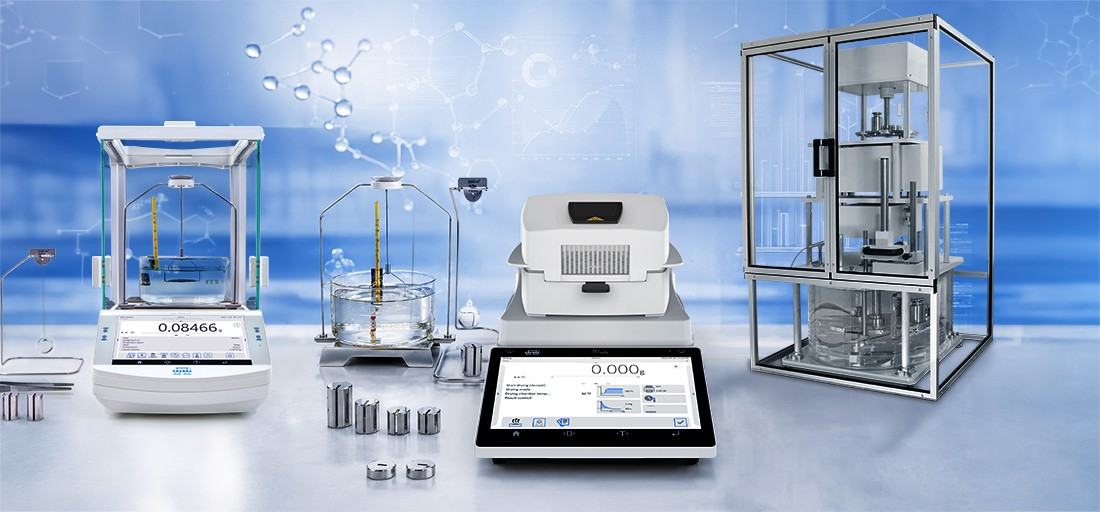
When we think of weighing, we usually picture a simple process: we place an object on a weighing pan and read its mass. In reality, modern metrology goes far beyond this scenario. Laboratory balances can provide information about the properties of materials, measure physical phenomena, and even indirectly determine the parameters of substances which… cannot simply be placed on the weighing pan.
Does that sound paradoxical? That is precisely why weighing is one of the most versatile measurement methods used in modern science and industry.
A modern balance does not measure what lies on the weighing pan – it measures the force acting on the measuring system. Using appropriate research methods, this information can be used to determine many other parameters. This is precisely why a single balance can be used not only to determine mass, but also to calculate density, monitor sorption processes, analyse material changes or conduct research into the interaction of liquids and gases.
A good example is the measurement of buoyant force. If a sample is immersed in a liquid, its apparent mass will decrease by a value corresponding to the buoyant force described by Archimedes’ principle. For the balance, this means a change in load which can be measured with very high accuracy. On this basis, it is possible, amongst other things, to:
The balance does not measure density directly – it records a slight change in the force acting on the measuring system, and appropriate calculations allow the desired parameter to be determined.
Although we don’t usually notice it, air also exerts a buoyant force. This is of little significance for everyday measurements, but when weighing to the nearest microgram, the effect of air can be comparable to the value of the measured signal.
For this reason, laboratories carrying out high-precision measurements take into account, amongst other things:
Based on this data, appropriate corrections can be made so that the result better reflects the actual mass of the object being tested.
Gases are not weighed in the same way as solids, but their mass can be determined using gravimetric methods. The simplest example is weighing a sealed container – first when empty, and then after it has been filled. The difference in the readings corresponds to the mass of the gas inside. A similar principle is used in:
In such applications, the balance does not measure the gas directly. It records the change in mass of the entire system, from which the quantity of the accumulated substance can be determined.
Some materials constantly exchange moisture or other substances with their surroundings. Paper, wood, building materials, pharmaceuticals and food can absorb or release water. The changes may be slight, but modern laboratory balances allow them to be monitored almost in real time. This makes it possible to investigate:
In many laboratories, it is precisely this change in mass that serves as the most sensitive indicator of the physical and chemical processes taking place.
Increasingly, a balance is becoming part of a larger measurement system. It works in conjunction with climatic chambers, laboratory furnaces, dispensers and automation systems. This allows one to observe how the mass of a sample changes under the influence of temperature, humidity, time or the action of specific substances. Such measurements are used, amongst other things, in:
When taking measurements at the microgram or nanogram level, phenomena that we do not normally notice in everyday life become significant. The result may be affected by, amongst other things:
Therefore, the design of modern laboratory balances requires not only advanced electronics, but also a very good understanding of mechanics, physics and metrology.
Although at first glance a balance appears to be a simple device, in reality it is an extremely sensitive force detector. It is precisely this sensitivity which enables the balance to be used in research that goes far beyond the conventional weighing of objects. Measuring density, analysing gas absorption, studying changes in moisture content or observing processes occurring within materials – all these activities share a common denominator. The starting point is the precise measurement of minute changes in the force acting on the measuring system.
Therefore, the answer to the question posed in the title is: yes – it is possible to weigh much more than just the objects placed on the weighing pan. In modern metrology, mass often becomes a tool for understanding phenomena that cannot be seen with the naked eye, and sometimes cannot even be touched directly.
A modern balance measures the force acting on its measuring system. This force measurement can be used with specific research methods to determine parameters like density, monitor sorption processes, analyze material changes, or study the interaction of liquids and gases. Density is determined by measuring the buoyant force when a sample is immersed in a liquid. The balance records the resulting change in force acting on the measuring system, and appropriate calculations are then performed to determine the material's density. Air exerts a buoyant force that can be significant at high precision levels, comparable to the measured signal. Laboratories account for temperature, atmospheric pressure, air humidity, and air density to make corrections and obtain a more accurate mass reading. The mass of a gas can be determined using gravimetric methods by weighing a sealed container first empty and then filled with the gas. The difference in readings represents the mass of the gas contained within. At very high precision levels, measurements can be affected by vibrations, air movement, electrostatic charges, temperature differences between the sample and surroundings, magnetic fields, and heat transferred from the operator.How can a balance measure properties other than mass?
How is density determined using a balance if it doesn't measure density directly?
Why is air considered in high-precision measurements?
How can the mass of a gas be determined using a balance?
Check out professional precision balances at our distributor in your country.What factors can affect measurements at the microgram or nanogram level?
Vaisala DRYCAP® Dew Point and Temperature Probe DMP5 is designed for in-line humidity measurement in industrial drying applications with high…

Dr. Lauri Reuter is an expert in the future of food, and the person to ask if you’ve ever wondered what we are going to eat in the future, and how…

Industrial companies are continuing to take action to minimize their carbon emissions. Many are reducing their use of fossil fuels and switching to…

In the causticizing process, passive chemicals are converted into active cooking chemicals to make white liquor. This is used in the digester as a…
A specialist replies with the solution, the instrument and the service that fit.
Products to quote
No products yet. An enquiry can be sent anyway: a specialist answers.