


Bringing out the beauty of wood: Veneer drying with humidity control
Vaisala DRYCAP® Dew Point and Temperature Probe DMP5 is designed for in-line humidity measurement in industrial drying applications with high…
Technical note
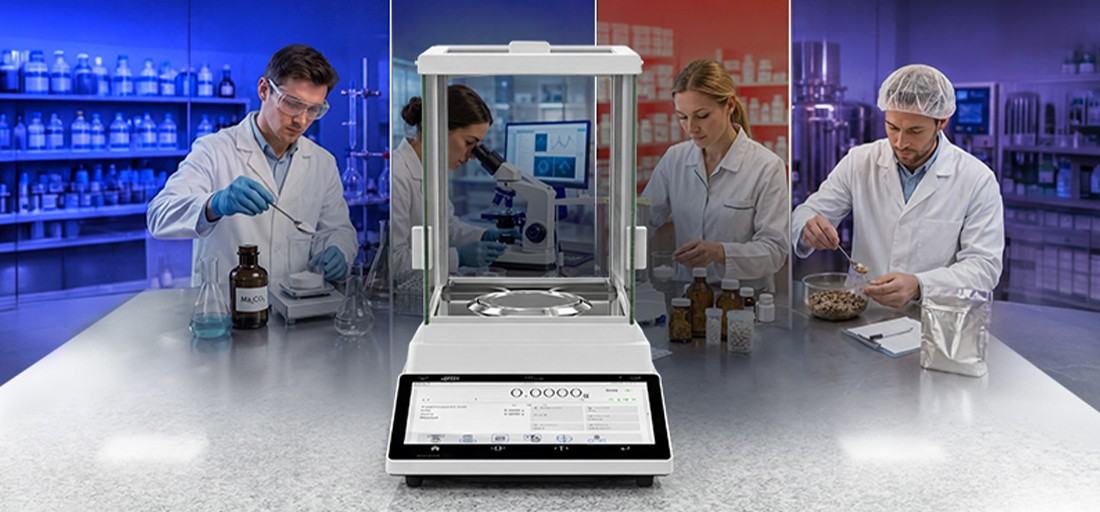
In laboratories, every hundredth, thousandth or even ten-thousandth of a gram can affect the final test result. This is precisely why analytical balances are among the most important measuring instruments used in research, industrial, pharmaceutical and university laboratories. Their accuracy enables measurements to be performed with the utmost precision as well as ensures the reliability of analyses and the reproducibility of results.
Choosing the right analytical balance is not just a matter of working comfort, but also an investment in the quality of laboratory processes and the safety of the research being conducted.
Analytical balances are designed to perform extremely precise mass measurements. Depending on the model, they offer a readout of up to 0.0001 g (0.1 mg), thereby enabling the weighing of very small quantities of substances.
Modern instruments are equipped with a range of functions which optimise day-to-day laboratory work, such as automatic calibration, compensation for ambient conditions, communication with laboratory systems, and the ability to archive results. This not only increases the accuracy of measurements but also streamlines the documentation of processes in accordance with applicable quality requirements.
One of the primary uses of analytical balances is the precise measurement of chemical reagents in laboratory analyses and the preparation of solutions. Even the slightest deviations in mass can affect the course of chemical reactions and the reliability of the results obtained. This is precisely why chemical laboratories use analytical balances wherever the highest accuracy in dosing reagents is required.
When conducting laboratory tests, it is extremely important to determine the mass of the samples being analysed accurately. This applies to scientific, industrial and environmental laboratories alike. Precise weighing forms the basis of many analytical methods and ensures full reproducibility of results between successive measurements.
The pharmaceutical industry is one of the sectors in which accuracy requirements are particularly stringent. The manufacture of medicines necessitates the precise measurement of active and excipient substances, as even slight differences in mass can affect the quality, efficacy and safety of the finished product. Analytical balances are used in research and development, as well as in quality control and production processes.
Precise mass measurements also play a vital role in industrial and food laboratories. Analytical balances are used, amongst other things, for quality control of raw materials, product composition analysis, materials testing and the development of new production technologies. The accuracy of these measurements helps to maintain high product quality and ensure compliance with applicable standards and procedures.
The selection of the right analytical balance model should take into account the nature of the measurements being conducted, the required weighing range, readability and laboratory operating conditions. The modern solutions offered by RADWAG enable the equipment to be tailored to the needs of laboratories with different profiles – from research units, through industrial laboratories, to pharmaceutical plants and testing institutions.
Analytical balances are instruments without which it is difficult to imagine a modern laboratory functioning. They ensure the highest precision of measurements, help maintain process quality and increase the reliability of test results. Regardless of the industry, accurate mass measurement remains one of the cornerstones of effective laboratory analysis.
If you are looking for a solution tailored to the specific nature of your work, explore RADWAG’s range of analytical balances and choose a model that meets your laboratory’s requirements.
Analytical balances offer a readout of up to 0.0001 g (0.1 mg), allowing for the weighing of very small quantities of substances with high precision. Analytical balances are crucial in research, industrial, pharmaceutical, and university laboratories. They are essential in the pharmaceutical industry for precise measurement of active and excipient substances, and in industrial and food laboratories for quality control. Analytical balances ensure measurements are performed with utmost precision, which guarantees the reliability of analyses and the reproducibility of results. This accuracy is vital for weighing chemical substances, laboratory samples, and ingredients in the pharmaceutical industry. Modern analytical balances are equipped with functions such as automatic calibration, compensation for ambient conditions, communication with laboratory systems, and the ability to archive results. These features increase measurement accuracy and streamline process documentation. When selecting an analytical balance, consider the nature of the measurements, the required weighing range, readability, and the laboratory operating conditions. Choosing the right model ensures it is tailored to the specific needs of the laboratory.What is the typical readout precision of an analytical balance?
In which industries are analytical balances crucial for accuracy?
How do analytical balances contribute to the reliability of laboratory results?
What features do modern analytical balances offer to optimize laboratory work?
Check out professional precision balances at our distributor in your country.What factors should be considered when selecting an analytical balance?
Vaisala DRYCAP® Dew Point and Temperature Probe DMP5 is designed for in-line humidity measurement in industrial drying applications with high…

Dr. Lauri Reuter is an expert in the future of food, and the person to ask if you’ve ever wondered what we are going to eat in the future, and how…

Industrial companies are continuing to take action to minimize their carbon emissions. Many are reducing their use of fossil fuels and switching to…

In the causticizing process, passive chemicals are converted into active cooking chemicals to make white liquor. This is used in the digester as a…
A specialist replies with the solution, the instrument and the service that fit.
Products to quote
No products yet. An enquiry can be sent anyway: a specialist answers.