


Bringing out the beauty of wood: Veneer drying with humidity control
Vaisala DRYCAP® Dew Point and Temperature Probe DMP5 is designed for in-line humidity measurement in industrial drying applications with high…
Technical note
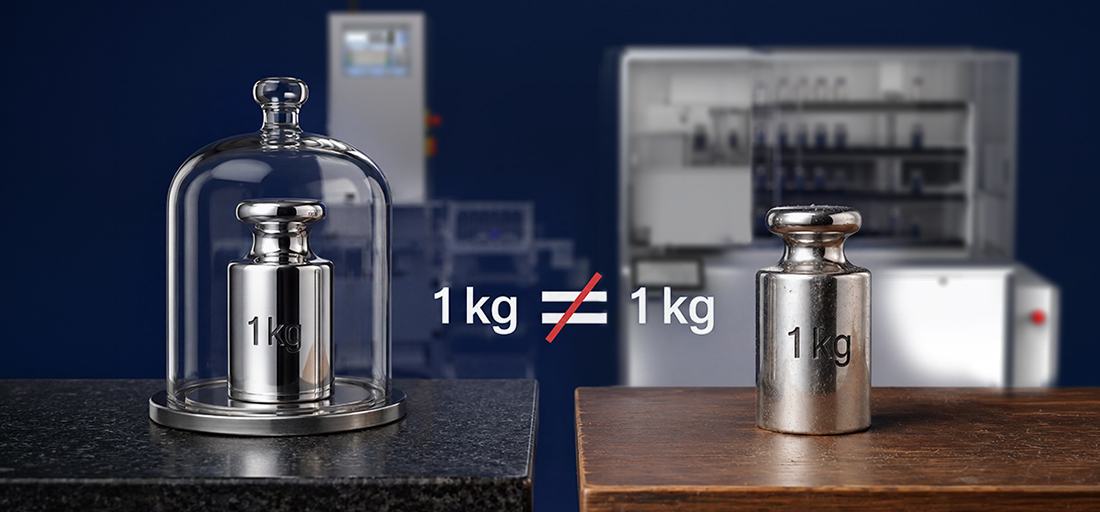
At first glance, the answer seems obvious. If an object has a mass of 100 grams, it should always weigh 100 grams. However, in metrological practice, the situation is much more complex. It turns out that the result of weighing the same object can vary depending on the measurement conditions, the equipment used and the location where the measurement is taken. Does this mean that the mass of the object changes? Not necessarily. What does change, however, are the conditions under which we attempt to determine it.
In everyday language, we often say that we ‘weigh’ 80 kilograms. From a physics perspective, however, the kilogram is a unit of mass, not of weight. These two concepts are often confused, even though they mean something completely different. Mass is a measure of the amount of matter and remains constant regardless of where it is measured. Weight, on the other hand, is the force with which a body is attracted by the Earth. It is this weight that acts on the measuring sensor of an electronic balances/scales, and the device converts this value into a result given in units of mass.
Gravitational acceleration is not the same across the entire surface of our planet. The value of gravitational force depends, amongst other things, on latitude and altitude above sea level. This means that an identical mass standard placed on a balance in different parts of the world may yield slightly different values for gravitational force. In everyday applications, these differences are imperceptible; however, in calibration laboratories and research centres, they are of significant importance for the accuracy of measurements.
Most people assume that weighing takes place in a vacuum. In reality, every measurement is carried out in the atmosphere, which exerts a force on the object being weighed. Air generates a buoyant force that acts in opposition to the force of gravity. This effect is small, but becomes noticeable during very high-precision measurements. That is why metrology laboratories monitor temperature, atmospheric pressure and air humidity. These parameters enable the density of the air to be determined and appropriate corrections to be made.
Some materials can absorb moisture from the environment, whilst others release it; as a result, their mass can change even within a matter of minutes. This phenomenon is particularly significant in the pharmaceutical, chemical and food industries. Hygroscopic materials require special preparation and storage procedures prior to measurement.
If both balances/scales are correctly calibrated and operating under appropriate conditions, the readings should fall within specified limits of agreement. However, this does not mean that they will always be identical down to the last digit. Every measuring instrument is characterised by a specific measurement uncertainty. This is precisely why metrology does not refer to a perfectly accurate result, but to a result together with its uncertainty.
In the modern economy, weighing results form the basis for many business and technological decisions. They are used to manufacture medicines, account for raw materials, monitor product quality and conduct scientific research. That is why modern mass metrology does not focus solely on the measurement itself – its aim is to ensure the reliability, comparability and repeatability of results, regardless of where and when the measurement is taken.
Although the mass of an object remains constant, the result of its measurement depends on many factors. Gravity, atmospheric conditions, material properties and the characteristics of the measuring instrument all influence the result. This is precisely why modern weighing is more than just a number on a display. Behind every result lies advanced metrology, whose task is to answer the seemingly simple question: ‘How much does it really weigh?’
The result of weighing can vary due to measurement conditions, the equipment used, and the location of the measurement. These factors influence the gravitational force and atmospheric conditions affecting the object. Mass is the amount of matter in an object and is constant, while weight is the force of attraction exerted by the Earth on that mass. Balances measure weight and convert it into a mass reading. Gravitational acceleration varies across the Earth's surface due to factors like latitude and altitude. This variation means an identical mass standard can yield slightly different weight values in different locations. The atmosphere exerts a buoyant force on objects being weighed, opposing gravity. This effect, along with temperature, pressure, and humidity, influences the air density and requires corrections for high-precision measurements. Yes, some materials can absorb or release moisture from the environment, causing their mass to change. This is particularly significant for hygroscopic materials in industries like pharmaceuticals and food. Even with correct calibration and conditions, readings from two balances may not be identical down to the last digit due to each instrument's specific measurement uncertainty.Why can weighing the same object yield different results?
What is the difference between mass and weight?
How does location affect weighing results?
Why are atmospheric conditions important in weighing?
Can the mass of a sample change before weighing?
Check out professional precision balances at our distributor in your country.Should readings from two calibrated balances always be identical?
Vaisala DRYCAP® Dew Point and Temperature Probe DMP5 is designed for in-line humidity measurement in industrial drying applications with high…

Dr. Lauri Reuter is an expert in the future of food, and the person to ask if you’ve ever wondered what we are going to eat in the future, and how…

Industrial companies are continuing to take action to minimize their carbon emissions. Many are reducing their use of fossil fuels and switching to…

In the causticizing process, passive chemicals are converted into active cooking chemicals to make white liquor. This is used in the digester as a…
A specialist replies with the solution, the instrument and the service that fit.
Products to quote
No products yet. An enquiry can be sent anyway: a specialist answers.