


Bringing out the beauty of wood: Veneer drying with humidity control
Vaisala DRYCAP® Dew Point and Temperature Probe DMP5 is designed for in-line humidity measurement in industrial drying applications with high…
Technical note
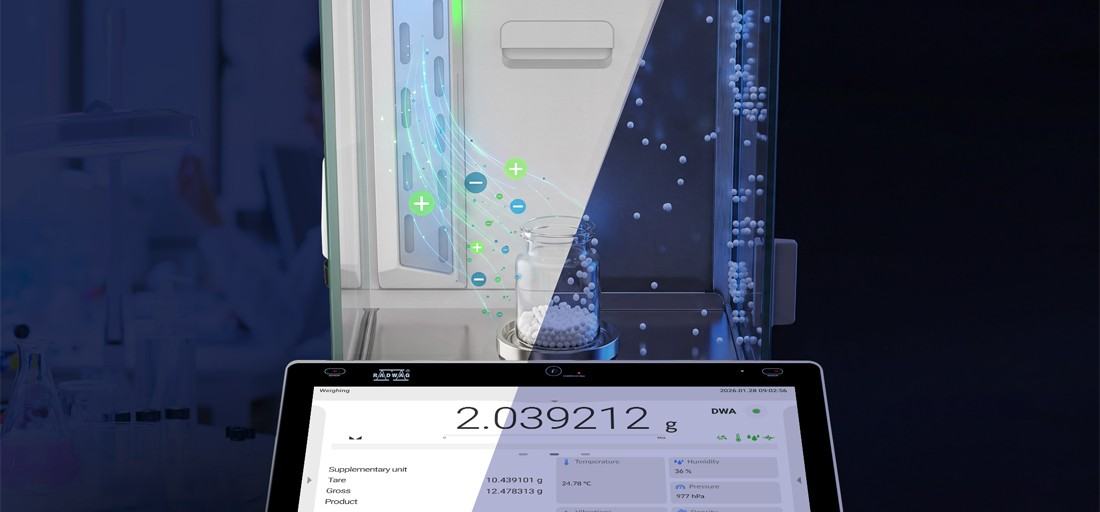
On the one hand, accurate balance, controlled conditions and an experienced operator; on the other, inconsistent results. One of the most commonly overlooked culprits is electrostatic charge – a phenomenon which is exceptionally effective at interfering with mass measurements.
Electrostatic charges build up easily: during friction, when pouring powders, when working with plastics, or even when taking off gloves. In laboratory conditions, this is an everyday occurrence. The problem arises when a charged weighing vessel or sample begins to interact with its surroundings. Instead of resting on the weighing pan, the material may:
· Stick to the walls of the weighing vessel
· Be attracted to or repelled by components of the weighing chamber
· Migrate from the dosing point
· Cause unstable readings.
As a result, the weighing result no longer reflects the actual mass of the sample.
The effect of electrostatic charge is particularly noticeable in the case of:
· Bulk materials and light powders
· Materials with low conductivity
· Plastic weighing vessels and pans
· Very small masses requiring high resolution.
The higher the sensitivity of the balance, the more pronounced the problem becomes – microgram-level disturbances can significantly affect the result.
In response to this invisible but significant problem, modern laboratory balances are increasingly equipped with systems to neutralise electrostatic charges. In RADWAG balances, antistatic ionisers play a key role, effectively eliminating accumulated charges in the vicinity of the sample. The XA 5Y.M.A Microbalances and XA 5Y.A Analytical Balances come as standard with an antistatic ioniser built into the weighing chamber. Meanwhile, the 5Y ultra-microbalances, other 5Y microbalances and other 5Y analytical balances, as well as the AS X7 and AS R2 PLUS Analytical Balances, can be fitted with an additional external ioniser, which operates on the same principle as the one built into the balance.
The ioniser generates a stream of positive and negative ions, which neutralise surface electrostatic charges. In practice, this means:
· The elimination of particle attraction and repulsion
· More stable sample behaviour in the weighing chamber
· Faster stable reading
· Improved result repeatability.
Importantly, this process is contactless and does not affect the structure or properties of the sample.
Ionisation is particularly important wherever the highest accuracy is required, namely in:
· Pharmaceutical laboratories
· Quality control
· Chemical analysis
· Materials testing
· Weighing microscopic substances.
In such applications, electrostatic effects are not a minor disturbance – they can determine the reliability of the results.
Electrostatic charge cannot be eliminated from the laboratory environment, but it can be effectively controlled. That is why, in RADWAG’s modern solutions, ionisers are not merely an add-on – they are an integral part of a system that ensures genuine measurement reliability.
Electrostatic charges can build up easily through friction, pouring powders, working with plastics, or even when removing gloves. These actions are common occurrences in laboratory conditions and can lead to inaccuracies in mass measurements. Electrostatic charge can cause a charged weighing vessel or sample to interact with its surroundings. This can lead to the material sticking to the vessel walls, being attracted to or repelled by weighing chamber components, migrating from the dosing point, or causing unstable readings, thus affecting the accuracy of the measured mass. Electrostatic effects are particularly noticeable with bulk materials, light powders, materials with low conductivity, plastic weighing vessels, and when weighing very small masses that require high resolution. The higher the balance sensitivity, the more pronounced the problem becomes. Antistatic ionisers generate a stream of positive and negative ions that neutralize surface electrostatic charges. This contactless process eliminates particle attraction and repulsion, leading to more stable sample behavior, faster stable readings, and improved result repeatability. The XA 5Y.M.A Microbalances and XA 5Y.A Analytical Balances come standard with an antistatic ioniser built into the weighing chamber. Controlling electrostatic charges is particularly important in pharmaceutical laboratories, quality control, chemical analysis, materials testing, and when weighing microscopic substances, where the highest accuracy is required and electrostatic effects can significantly impact result reliability.What causes electrostatic charge to build up in a laboratory setting?
How does electrostatic charge affect weighing results?
What types of materials and weighing scenarios are most susceptible to electrostatic errors?
How do antistatic ionisers in RADWAG balances work to improve measurements?
Which RADWAG balance models come standard with a built-in antistatic ioniser?
Check out professional precision balances at our distributor in your country.In which applications is controlling electrostatic charges particularly important?
Vaisala DRYCAP® Dew Point and Temperature Probe DMP5 is designed for in-line humidity measurement in industrial drying applications with high…

Dr. Lauri Reuter is an expert in the future of food, and the person to ask if you’ve ever wondered what we are going to eat in the future, and how…

Industrial companies are continuing to take action to minimize their carbon emissions. Many are reducing their use of fossil fuels and switching to…

In the causticizing process, passive chemicals are converted into active cooking chemicals to make white liquor. This is used in the digester as a…
A specialist replies with the solution, the instrument and the service that fit.
Products to quote
No products yet. An enquiry can be sent anyway: a specialist answers.