


Bringing out the beauty of wood: Veneer drying with humidity control
Vaisala DRYCAP® Dew Point and Temperature Probe DMP5 is designed for in-line humidity measurement in industrial drying applications with high…
Technical note
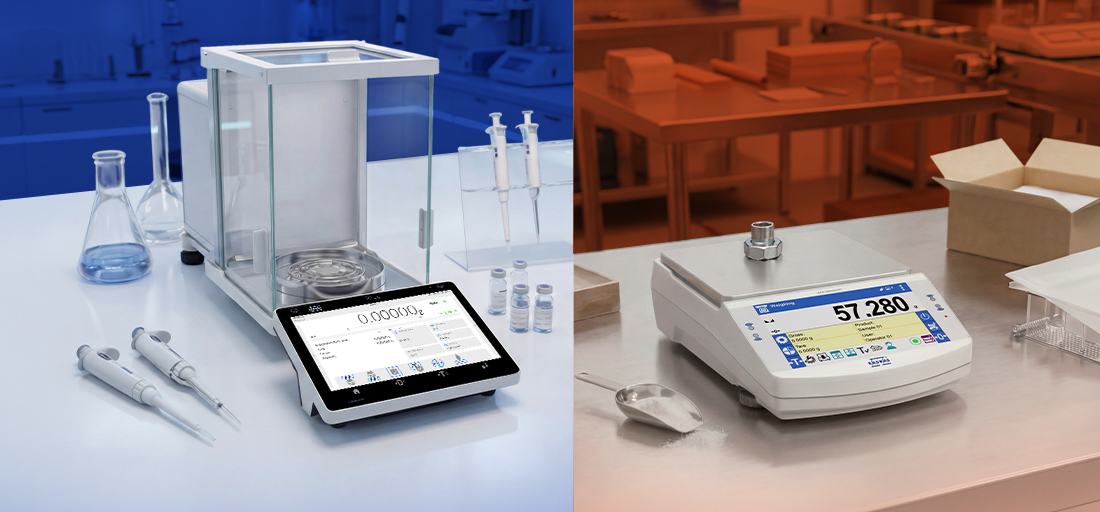
Choosing the right laboratory balance often seems straightforward – until the moment you have to make a purchase decision. In practice, many laboratories, quality control departments and manufacturing companies face the same question: do they need an analytical balance, or is a precision balance sufficient? The problem is that a device which is too advanced entails unnecessary costs, whilst a balance which is too ‘simple’ can lead to errors, claims or even issues with process compliance. So where does the line lie between a sensible investment and an unnecessary risk?
The main difference concerns the readability and the operating conditions.
1. Analytical balance
Analytical balances offer very high measurement accuracy – typically:
They are equipped with a draft shield and designed for use in controlled laboratory conditions. Even slight air movement, table vibrations or temperature changes can affect the weighing result. These devices are used, amongst other things, in:
2. Precision balance
Precision balances offer lower readability but greater versatility and ease of use. Typical readout resolutions are:
These balances are well suited to applications where fast and stable measurement matter, but the analysis of trace quantities of substances is not required. Most common applications:
In practice, companies very often buy an analytical balance ‘just in case’. The problem is that greater readability does not always translate into real value for the process.
Example 1: weighing production components
If an operator measures ingredients with a tolerance of ±0.1 g, purchasing a balance with a readability of 0.0001 g will not improve the quality of the process. What is more, it will:
In such a case, a robust precision balance is a better solution.
Example 2: checking the weight of the finished product
When checking packaging, parts or mechanical components, analytical accuracy is usually of no practical significance. What matters is:
Purchasing an analytical balance for such applications simply means overpaying for features which will not be used.
However, there are situations in which choosing a too ‘simple’ balance can have serious consequences.
1. Pharmaceuticals and chemical laboratories
When weighing active substances, even the slightest deviation can affect:
In such cases, a precision balance may prove insufficient.
2. Analysis of small samples
If a sample weighs a few milligrams, a balance with a 1 mg resolution can generate a very large relative error. For example:
This represents up to 20% measurement uncertainty. In such applications, an analytical balance is essential.
In many industries, the following are of key importance:
If a process requires a specific level of measurement accuracy, using the wrong balance may result in problems during an audit.
The best approach is to analyse the weighing process, rather than simply choosing the ‘most accurate’ instrument. It is worth asking yourself a few questions:
1. What mass do you weigh most often?
A different balance will be suitable for samples weighing 2 mg, and another for components with a mass of 2 kg.
2. What is the acceptable tolerance?
This is a key parameter. The balance’s readability should be significantly better than the required process tolerance.
3. In what environment will the device operate?
An analytical balance requires:
If the device is to be used on the production floor, a precision balance may be more practical.
4. Is the weighing subject to standards or audits?
If so, it is worth considering:
This is one of the biggest myths in the field of laboratory weighing. Greater accuracy:
A well-chosen balance is not the ‘best on the market’, but the one that meets the actual requirements of the application.
Analytical and precision balances are devices for different applications – and it is the right choice which determines work efficiency and process safety.
The greatest costs arise when the instrument is poorly chosen:
Therefore, before purchasing, it is worth analysing not only the technical specifications, but also – and above all – the actual needs of the process.
The main difference lies in their readability and the operating conditions required. Analytical balances offer very high accuracy, typically in milligrams, and need controlled laboratory environments, while precision balances have lower readability but offer greater versatility and ease of use for less trace-level analyses. You might be overpaying for an analytical balance if your process involves weighing components with a tolerance of ±0.1 g or checking the weight of finished products like packaging or mechanical parts. In these cases, the enhanced readability of an analytical balance does not improve process quality and can increase costs and environmental requirements. Choosing a precision balance can be a risk in pharmaceutical and chemical laboratories when weighing active substances, where even slight deviations can impact product safety and compliance. It is also insufficient for analyzing very small samples, where a balance with only 1 mg resolution can lead to significant measurement uncertainty. When choosing a balance, consider the mass you typically weigh, the acceptable tolerance for your process (the balance's readability should be significantly better), and the environment where the device will operate. Also, determine if the weighing is subject to standards, audits, verification, or qualification requirements. No, a higher accuracy balance does not always improve process quality. It can often increase costs, hinder day-to-day work, and require more stringent environmental conditions. The best balance is one that meets the actual requirements of the specific application, not necessarily the most accurate one available.What is the primary difference between an analytical balance and a precision balance?
When might purchasing an analytical balance be considered overpaying?
In what situations can choosing a precision balance be a risk?
What factors should be considered when choosing a balance for a specific weighing process?
Check out professional precision balances at our distributor in your country.Does a higher accuracy balance always lead to better process quality?
Vaisala DRYCAP® Dew Point and Temperature Probe DMP5 is designed for in-line humidity measurement in industrial drying applications with high…

Dr. Lauri Reuter is an expert in the future of food, and the person to ask if you’ve ever wondered what we are going to eat in the future, and how…

Industrial companies are continuing to take action to minimize their carbon emissions. Many are reducing their use of fossil fuels and switching to…

In the causticizing process, passive chemicals are converted into active cooking chemicals to make white liquor. This is used in the digester as a…
A specialist replies with the solution, the instrument and the service that fit.
Products to quote
No products yet. An enquiry can be sent anyway: a specialist answers.