


Bringing out the beauty of wood: Veneer drying with humidity control
Vaisala DRYCAP® Dew Point and Temperature Probe DMP5 is designed for in-line humidity measurement in industrial drying applications with high…
Technical note
Modern laboratories are operating under increasing pressure to improve efficiency, comply with standards and optimise costs. The growing number of tests, the need to maintain the highest quality of results, and the limited availability of qualified staff mean that laboratory management today requires not only organisational skills but also the informed use of modern technologies.
One area where there is significant potential for optimisation is pipette calibration. This process is essential for ensuring the reliability of results, but it is also time-consuming and ties up laboratory resources to a far greater extent than is often realised.
When analysing laboratory operating costs, the focus is usually on expenditure related to equipment, consumables and maintenance. However, one of the most expensive resources remains the working time of laboratory specialists.
Manual pipette calibration involves several stages:
Each of these activities involves qualified personnel and increases the risk of human error. Even minor mistakes can result in the need to repeat measurements, incurring additional costs and prolonging order completion times. In practice, this means that the actual cost of a single calibration is significantly higher than just the cost of an employee’s man-hour.
This issue is particularly evident in:
In such environments, even a slight reduction in the time taken for a single process translates into significant savings on a monthly and annual basis. More and more laboratories are therefore realising that effective management is not solely about increasing staff numbers, but above all about optimising processes.
Automation is becoming the natural direction of development. Modern measurement systems make it possible to reduce the operator’s involvement in routine tasks, increase the reproducibility of results and improve workplace ergonomics.
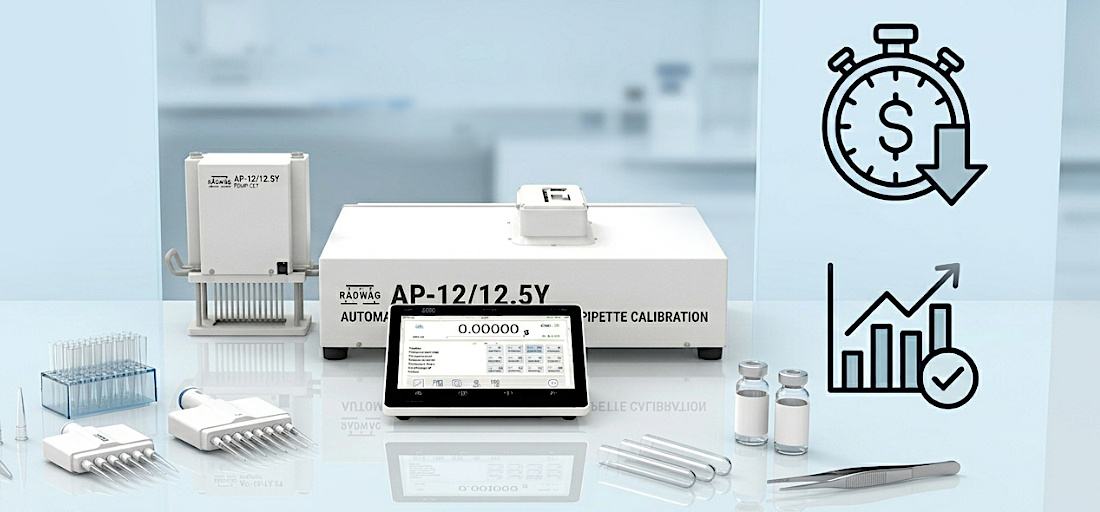
An example of such a solution is the AP-12/12.5Y
Automatic Device for Multichannel Pipette Calibration manufactured by RADWAG. The device has been designed for laboratories which require high throughput in the calibration process whilst maintaining compliance with applicable standards.
1. A significant reduction in measurement time
The system, equipped with 12 weighing modules, enables up to 12 measurements to be carried out in approximately 5 seconds. Compared to the traditional manual method, this represents a significant acceleration of the process. In practice, the laboratory can handle a greater number of calibrations without the need to increase staffing levels.
2. Parallel processing
The simultaneous execution of multiple measurements eliminates downtime and allows for more efficient use of staff time. The operator can carry out other tasks related to quality control or data analysis at the same time.
3. Reduction of human error
Automatic recording of results and generation of documentation significantly reduces the risk of errors arising from manual data transcription. This is particularly important in laboratories operating in regulated and audited environments.
4. Work ergonomics
Modern automated workstations improve the working comfort of laboratory staff through:
In the context of growing staffing challenges and the need to retain highly qualified staff, ergonomics is becoming one of the most important aspects of laboratory management.
In laboratories operating in accordance with quality management systems, it is not only speed of operation which is crucial, but also compliance with regulatory requirements and data security.
The AP-12/12.5Y automated pipette supports compliance with the following requirements:
This enables the laboratory to simultaneously increase process efficiency and maintain compliance with audit and regulatory requirements.
The automation of laboratory processes is increasingly seen not as a cost, but as an investment which impacts the efficiency of the entire organisation.
The benefits include:
In many cases, the savings resulting from reduced working time and fewer errors allow a return on investment to be achieved sooner than originally anticipated.
Effective laboratory management today requires a strategic approach to processes. Optimising working time, eliminating repetitive tasks and automating key stages of analysis are becoming the cornerstone of modern laboratories.
Solutions such as the AP-12/12.5Y demonstrate that automation can simultaneously boost productivity, improve the quality of work and support compliance with industry requirements.
At a time when speed of operation and the reliability of results have a direct impact on the competitiveness of laboratories, investing in smart technologies is becoming a natural direction for development.
Manual pipette calibration involves preparing the measurement station, taking measurements, documenting results, analysing data, and creating reports in accordance with quality requirements. The AP-12/12.5Y device, equipped with 12 weighing modules, can perform up to 12 measurements in approximately 5 seconds, significantly reducing overall measurement time compared to manual methods. Automation reduces human error through automatic data recording, improves workplace ergonomics by reducing manual tasks and strain, and allows for parallel processing, leading to more efficient use of staff time. The AP-12/12.5Y automated pipette supports compliance with ISO 8655 regarding pipette calibration and 21 CFR Part 11 concerning the integrity and security of electronic data. Automation reduces the actual cost of calibration by minimising staff working time and the risk of errors, leading to shorter process turnaround times, increased throughput, and better utilisation of staff expertise.What are the main stages involved in manual pipette calibration?
How does the AP-12/12.5Y device accelerate pipette calibration?
What are the benefits of automating pipette calibration beyond speed?
Which quality standards does the AP-12/12.5Y automated pipette support?
Check out professional precision balances at our distributor in your country.How does automating pipette calibration impact laboratory costs and efficiency?
Vaisala DRYCAP® Dew Point and Temperature Probe DMP5 is designed for in-line humidity measurement in industrial drying applications with high…

Dr. Lauri Reuter is an expert in the future of food, and the person to ask if you’ve ever wondered what we are going to eat in the future, and how…

Industrial companies are continuing to take action to minimize their carbon emissions. Many are reducing their use of fossil fuels and switching to…

In the causticizing process, passive chemicals are converted into active cooking chemicals to make white liquor. This is used in the digester as a…
A specialist replies with the solution, the instrument and the service that fit.
Products to quote
No products yet. An enquiry can be sent anyway: a specialist answers.