


Bringing out the beauty of wood: Veneer drying with humidity control
Vaisala DRYCAP® Dew Point and Temperature Probe DMP5 is designed for in-line humidity measurement in industrial drying applications with high…
Technical note
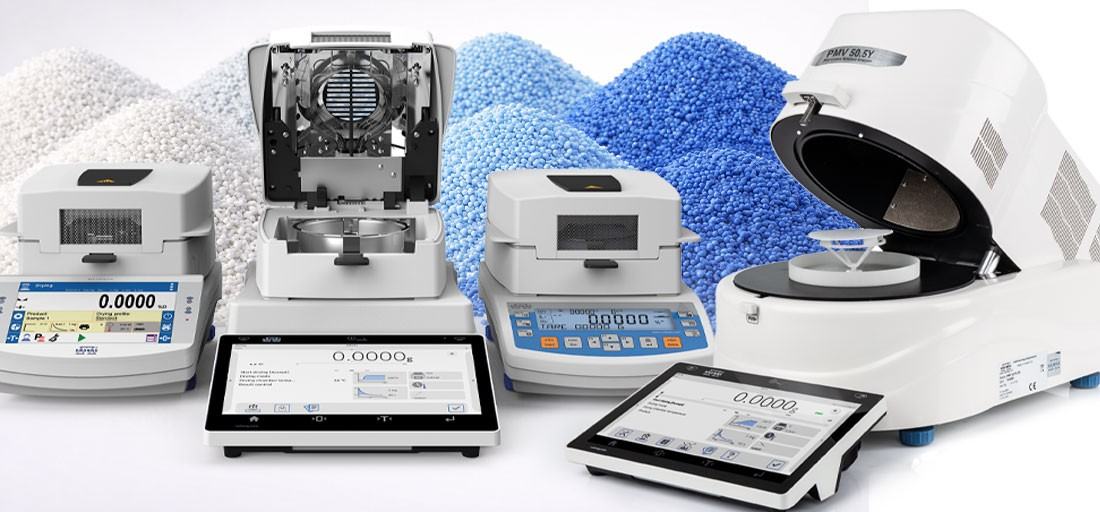
In modern plastics production, precise control of granule moisture content determines the stability of the technological process, the strength of parts and the minimisation of material losses. One of the most important parameters to control is the moisture content of the granules. This is where a professional moisture analyzer – a device combining the functions of a precision balance and an analytical dryer – proves indispensable.
Moisture in plastic granules, such as PA, PET or ABS, affects the entire processing process:
Plastic granules are hygroscopic, so they absorb moisture from the air during storage. For this reason, it is necessary to check the moisture level before the injection process.
Traditional methods of moisture determination, such as oven drying and sample weighing, are time-consuming and prone to human error. A moisture analyzer automates this process by:
This means that moisture control can take minutes instead of hours, which directly speeds up production decisions and minimises material preparation time.
In practice, several methods are used to determine the moisture content of plastics:
a) Classic (oven) drying
b) Rapid measurement methods (e.g. notched analyzers, capacitive sensors)
c) Thermogravimetry in moisture analyzers
A moisture analyzer combines weighing precision with controlled sample drying thanks to thermogravimetric moisture analysis (balance and dryer in one). The process involves weighing the sample before and after drying and automatically calculating the mass loss, which is interpreted as moisture content. This solution is most reliable for plastics – it allows repeatable results to be obtained even with small sample quantities and under different drying conditions.
A moisture analyzer is a tool that not only measures but also controls and makes decisions in plastics production. It allows you to:
As a result, RADWAG moisture analyzers provide reliable support in production and control/laboratory processes where measurement accuracy and speed have a real impact on product quality.
Too high water content in plastic granules can lead to surface defects in moulded parts, such as blisters or dullness. It can also weaken the material and cause uneven curing, potentially increasing cycle time or mould wear. Plastic granules are hygroscopic and absorb moisture from the air during storage. Checking the moisture level before injection is necessary to ensure the quality and stability of the technological process and the strength of the final parts. A moisture analyzer automates the process by rapidly heating and drying the sample in a controlled chamber and measuring the mass before and after drying in a single operation. This allows moisture control to take minutes instead of hours, speeding up production decisions. Classic oven drying is very time-consuming, potentially taking up to 2 hours. It also requires manual weighing and is prone to operator error, making it less efficient and reliable than other methods. Thermogravimetry in moisture analyzers combines weighing precision with controlled sample drying. This method allows for repeatable results, even with small sample quantities and under different drying conditions, making it highly reliable for plastics.What happens if plastic granules have too high a water content?
Why is it necessary to check the moisture level of plastic granules before the injection process?
How does a moisture analyzer speed up pre-injection testing compared to traditional methods?
What are the disadvantages of classic oven drying for determining moisture content in plastics?
Check out professional precision balances at our distributor in your country.Why is thermogravimetry in moisture analyzers considered the most reliable method for plastics?
Vaisala DRYCAP® Dew Point and Temperature Probe DMP5 is designed for in-line humidity measurement in industrial drying applications with high…

Dr. Lauri Reuter is an expert in the future of food, and the person to ask if you’ve ever wondered what we are going to eat in the future, and how…

Industrial companies are continuing to take action to minimize their carbon emissions. Many are reducing their use of fossil fuels and switching to…

In the causticizing process, passive chemicals are converted into active cooking chemicals to make white liquor. This is used in the digester as a…
A specialist replies with the solution, the instrument and the service that fit.
Products to quote
No products yet. An enquiry can be sent anyway: a specialist answers.