


Bringing out the beauty of wood: Veneer drying with humidity control
Vaisala DRYCAP® Dew Point and Temperature Probe DMP5 is designed for in-line humidity measurement in industrial drying applications with high…
Technical note
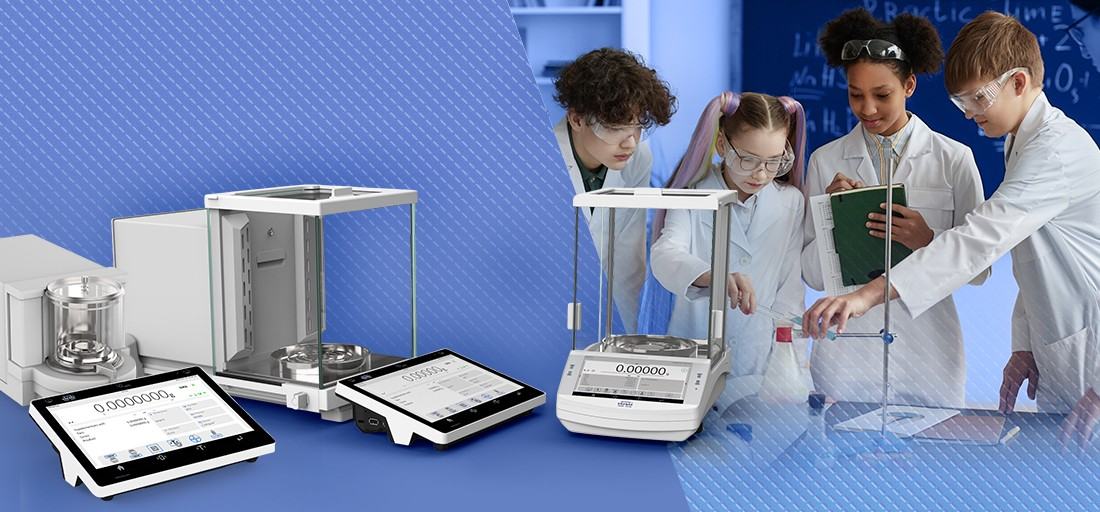
Precision is not only the domain of industry – it is also the foundation of science. Every day, substances, materials, samples and reagents are weighed in teaching and research laboratories with a readability of milligrams or even micrograms. That is why it is so important for pupils and students to have access to professional electronic balances as early as the education stage. RADWAG, as one of the world’s leading manufacturers of balances, provides solutions which support the teaching process and develop the skills of future specialists.
The basic principles of laboratory work are formed as early as secondary school or the first years of university. It is then when pupils and students learn how to take measurements correctly, prepare solutions, analyse samples and keep records of experiments.
Without the right equipment, this education remains purely theoretical or, worse, imprecise. The use of outdated spring scales or simple mechanical models not only limits teaching opportunities, but can also lead to the reinforcement of bad habits. Only modern electronic balances with the appropriate readability, stability and repeatability allow students to understand what precise measurement really is.
RADWAG offers a wide range of balances which are ideal for educational environments, both in secondary schools and universities. The most popular models are:
These devices provide a readability of 0.1 mg, which allows most laboratory exercises to be carried out in accordance with academic standards. These balances are characterised by their robust construction, intuitive operation and simple interface, which does not discourage novice users.
RADWAG offers models with a simplified menu, allowing students to quickly master the basic weighing functions. This enables them to focus on the analysis of results and the scientific process itself, rather than on operating the device.
More and more laboratory classes require digital documentation. RADWAG balances can automatically save measurement results, which significantly facilitates the creation of reports and analyses after classes. Data can be exported to CSV or PDF files or sent directly to a computer.
For academic laboratories with many users, RADWAG offers systems with personalised access – each student can log in to the balance and save their results individually. This increases control over experiments and allows for easy assessment of work.
Teaching laboratories are increasingly using modern technologies. RADWAG balances can be integrated with computer systems, allowing students to analyse data on an ongoing basis, create graphs, compare results and send them to the cloud or university systems.
In the era of remote learning, remote monitoring of balances is proving to be a particularly valuable feature – lecturers can conduct experiments online and present measurement data in real time. This makes it possible to provide valuable laboratory classes even in hybrid working conditions.
There is no room for randomness in education – every experiment should teach reliability, accuracy and critical thinking. RADWAG balances, present in hundreds of educational and research laboratories, help educate new generations of specialists who understand the importance of precise measurement.
For RADWAG, it is not just a matter of supplying equipment – it is a mission to support science, development and innovation from the ground up.
View our most accurate laboratory balances:
Standard class analytical balances from RADWAG offer a readability of 0.1 mg. This level of precision allows for the majority of laboratory exercises to be conducted in line with academic standards. Balances with an educational interface feature a simplified menu, enabling students to quickly learn basic weighing functions. This allows them to concentrate on analyzing results and the scientific process rather than device operation. RADWAG balances can automatically save measurement results, which can be exported to CSV or PDF files or sent directly to a computer. This capability significantly simplifies the creation of reports and analyses after laboratory classes. RADWAG balances can be integrated with computer systems for ongoing data analysis and can be monitored remotely. This allows lecturers to conduct experiments online and present real-time measurement data, facilitating valuable laboratory classes even in hybrid conditions. Modern electronic balances with appropriate readability, stability, and repeatability allow students to truly understand precise measurement. Using outdated spring scales or simple mechanical models limits teaching opportunities and can reinforce bad habits.What readability do standard class analytical balances from RADWAG offer for educational purposes?
How do RADWAG balances with an educational interface benefit students?
What are the options for documenting measurements with RADWAG balances in educational settings?
How can RADWAG balances support remote learning and hybrid educational models?
Check out professional precision balances at our distributor in your country.What are the advantages of using modern electronic balances over older weighing equipment in education?
Vaisala DRYCAP® Dew Point and Temperature Probe DMP5 is designed for in-line humidity measurement in industrial drying applications with high…

Dr. Lauri Reuter is an expert in the future of food, and the person to ask if you’ve ever wondered what we are going to eat in the future, and how…

Industrial companies are continuing to take action to minimize their carbon emissions. Many are reducing their use of fossil fuels and switching to…

In the causticizing process, passive chemicals are converted into active cooking chemicals to make white liquor. This is used in the digester as a…
A specialist replies with the solution, the instrument and the service that fit.
Products to quote
No products yet. An enquiry can be sent anyway: a specialist answers.