


Bringing out the beauty of wood: Veneer drying with humidity control
Vaisala DRYCAP® Dew Point and Temperature Probe DMP5 is designed for in-line humidity measurement in industrial drying applications with high…
Technical note
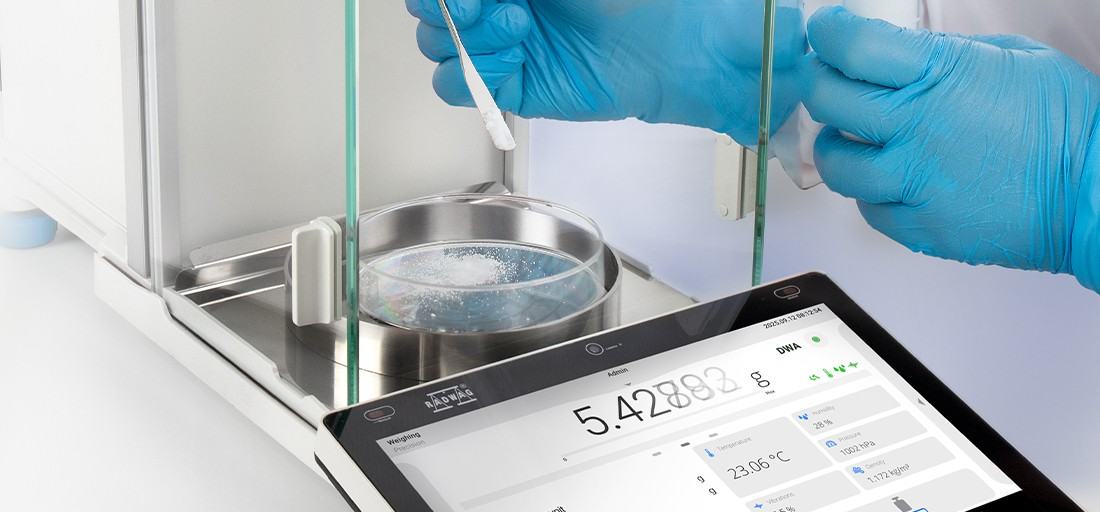
We often hear the question: ‘Which balance is the fastest?’ And rightly so – no one likes to wait. Especially in a laboratory, where every second counts and accuracy is paramount. But does ‘speed’ always go hand in hand with readability? And is it worth trusting the results which appear on the display after a fraction of a second? The answer, as is usually the case, is: it depends.
At first glance, it all seems child’s play: we place the sample on the balance, the numbers jump around, stabilize after a moment, and we have the result. But what is really happening? The balance must:
In practice – especially with balances as accurate as ultra-microbalances, microbalances and analytical balances – this process must take time. Physics cannot be cheated. At least if we want a result which means something.
Some companies, in pursuit of ‘speed’, use various tricks. They:
What happens then? The result is fast, but not always accurate, and the user is unaware that their data may be flawed.
For years, we have been committed to measurement integrity. RADWAG balances have advanced signal filtering algorithms which reduce measurement time without compromising accuracy. Our advantages are:
Our measurement time is the time it takes to obtain a reliable result, not just a nice-looking number.
which allow you to speed up measurement in difficult conditions.
enabling faster readings while maintaining the highest readability.
If we say that the stabilization time is 2 seconds, it means that after 2 seconds you have an accurate and stable result, not just the first numbers which come along.
Speed is important, but the reliability of results is even more important. This is especially true where every microgram counts – in pharmaceutical and chemical laboratories or in quality control. That is why at RADWAG we focus on transparency. You will not find ‘magical’ measurements achieved in 0.5 seconds with a readability of 0.01 mg, because we know that this is simply impossible without the risk of error.
When choosing a balance, ask yourself whether you care more about speed or measurement quality. At RADWAG, we believe that one does not have to exclude the other – but only if we rely on real technology, not marketing gimmicks. Because precision is not just a matter of equipment – it is a matter of trust.
A balance must register the load, suppress vibrations and oscillations, correct for ambient conditions like temperature and air movement, identify a stable signal, and then display the result with the appropriate readability. This entire process requires time, especially for highly accurate balances. Some companies use tricks such as displaying a temporary result before it is fully stabilized, lowering the threshold for detecting changes to make numbers freeze faster, or using software to mask instability. These methods can lead to fast but less reliable results. RADWAG balances use advanced signal filtering algorithms to reduce measurement time without compromising accuracy. They focus on real stabilization time, integrated anti-vibration and compensation systems, and DUAL-READABILITY innovations for faster, reliable readings. For RADWAG, real stabilization time is the duration required to obtain a reliable and accurate result, not just the first numbers that appear on the display. If the specification states 2 seconds, it means an accurate and stable result is achieved within that time. In applications like pharmaceutical, chemical, or quality control laboratories where every microgram counts, the reliability of results is paramount. RADWAG prioritizes transparency and avoids 'magical' fast measurements with high readability that carry a risk of error.What factors influence the stabilization time of a balance?
How do some companies achieve faster balance readings?
What is RADWAG's approach to balance measurement speed?
What does RADWAG mean by 'real stabilization time'?
Check out professional precision balances at our distributor in your country.Why is measurement reliability more important than speed in certain applications?
Vaisala DRYCAP® Dew Point and Temperature Probe DMP5 is designed for in-line humidity measurement in industrial drying applications with high…

Dr. Lauri Reuter is an expert in the future of food, and the person to ask if you’ve ever wondered what we are going to eat in the future, and how…

Industrial companies are continuing to take action to minimize their carbon emissions. Many are reducing their use of fossil fuels and switching to…

In the causticizing process, passive chemicals are converted into active cooking chemicals to make white liquor. This is used in the digester as a…
A specialist replies with the solution, the instrument and the service that fit.
Products to quote
No products yet. An enquiry can be sent anyway: a specialist answers.