


Bringing out the beauty of wood: Veneer drying with humidity control
Vaisala DRYCAP® Dew Point and Temperature Probe DMP5 is designed for in-line humidity measurement in industrial drying applications with high…
Technical note
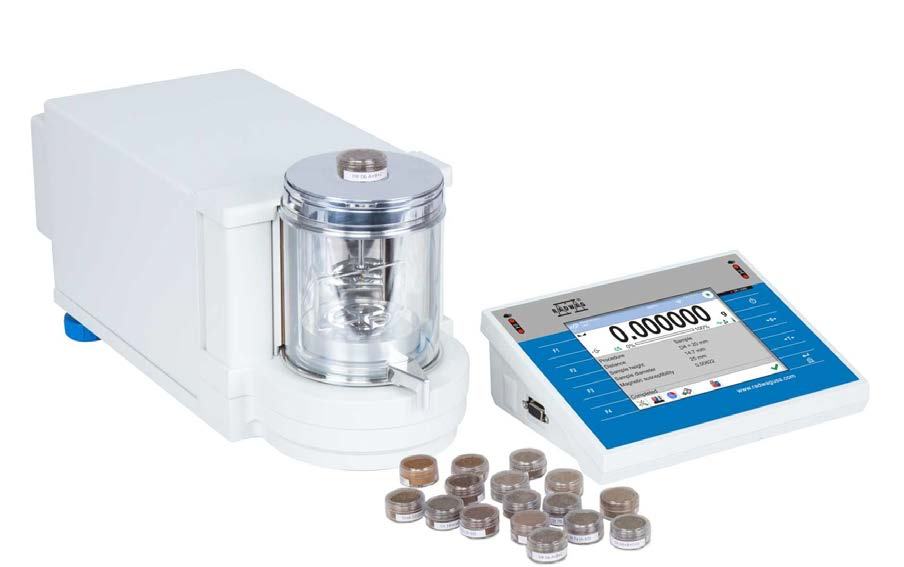
DETECTION OF MAGNETIC PARTICLES IN SOLID, LIQUID AND SEMI-LIQUID BODIES
1
2
One of the quality parameters of the environment that surrounds us is the heavy metal content. Heavy metal particles emitted by zinc smelters, ironworks, cement factories, power plants or coking plants are accumulated in soils and then absorbed by plants. Such a cycle represents a very real ecological threat, which is important for the health and life of the human population. The use of field magnetometry (in situ) allows for precise identification of places where there is an excessive concentration of metallic particles and thus for preventive measures to be taken. On the other hand, such tests may be carried out under laboratory conditions taking into account elements such as sampling, transport and preparation of the sample for testing.
Magnetic susceptibility is one of the basic physical quantities describing the magnetic properties of matter. It is the ability of the medium to magnetise itself under the influence of an external magnetic field. Magnetic susceptibility ( κ ) is determined as the ratio of the volumetric magnetization (M) induced in a material with susceptibility ( κ ) to the strength of magnetic field H that causes this magnetization:
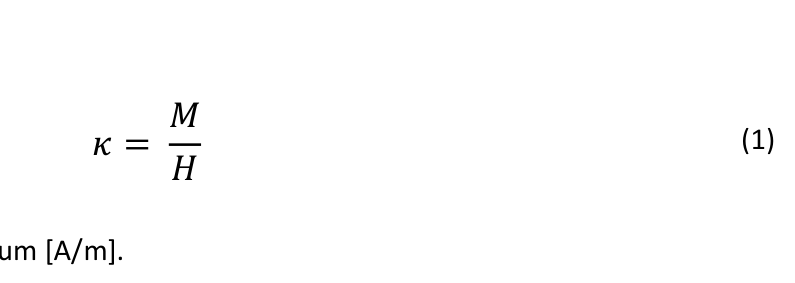
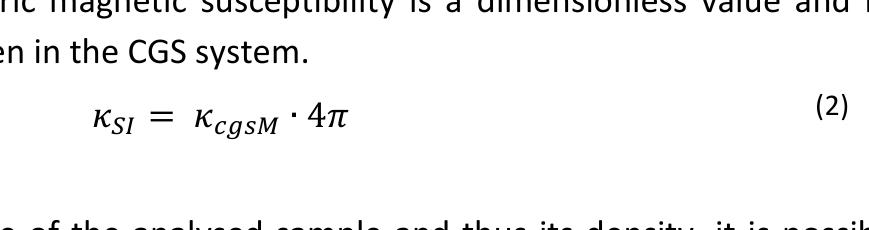
where: M – volumetric magnetization of the medium [A/m]. H – magnetic field strength [A/m] In the SI system the volumetric magnetic susceptibility is a dimensionless value and is 4.5 times higher than the same value given in the CGS system.
Knowing the mass and volume of the analysed sample and thus its density, it is possible to obtain information on the specific magnetic susceptibility (the so-called mass-specific magnetic susceptibility), which allows the analysis also to take into account the variable density of the soil samples tested.
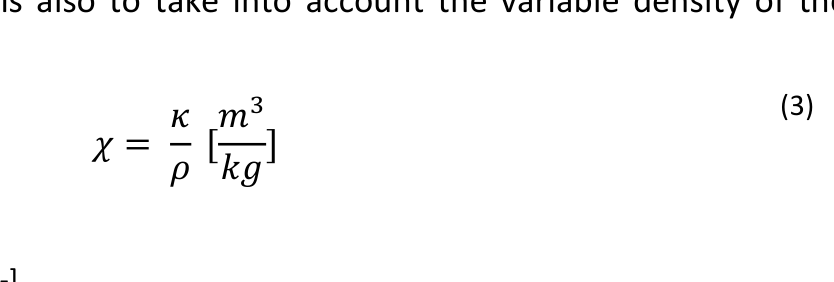
where: κ – volumetric magnetic susceptibility [-] ρ – sample density [kg/m 3 ]
3
1.
Usually, the magnetic susceptibility of samples is measured with measuring instruments in which the induction coil is supplied with alternating current at a frequency of several hundred to several thousand hertz. The principle of measuring magnetic susceptibility comes down to determining the change of inductance of a coil located in the instrument as a result of interaction of magnetic particles in the structure of the product being tested. Such a measuring device is the Bartington MS2B - the analyzed sample in a cylindrical container is placed in a measuring cell (2). Measurements are taken at two frequencies, 0.465 kHz and 4.65 kHz. The MS2B device is presented in Figure 1.
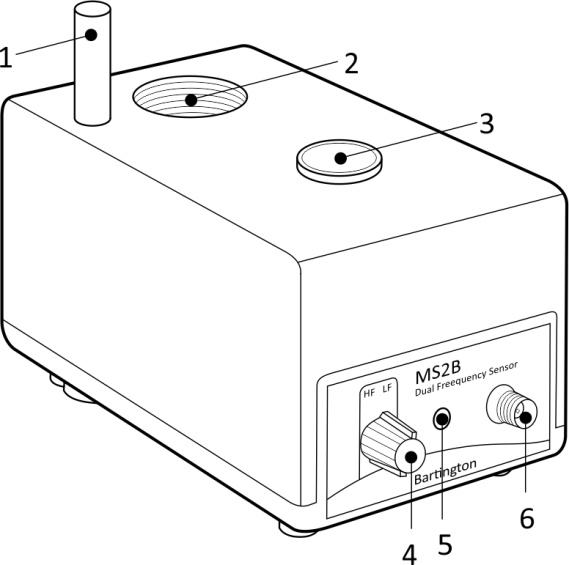
Figure 1. MS2B measuring device by Bartington
Key:
1. Sample insertion mechanism and height adjustment screw 2. Sample measuring chamber 3. Control sample - device adjustment 4. Operating frequency switch 5. HF calibration switch 6. TNC connector for connecting the MS2 device Another commonly used measuring instrument for testing the magnetic susceptibility of rocks and soils is the Kappa meter. Inside the device there is an oscillator and an induction coil, which influences the frequency of the oscillator. When there are no bodies with magnetic particles near the coil, the frequency of the oscillator determines only the magnetic permeability of the air. In the measuring cycle the frequency of the oscillator depends on the magnetic permeability of the sample. The signal received is converted to magnetic susceptibility. An important parameter in this method is the thermal stability of the oscillator.
4
2.
The observed magnetic susceptibility may result from the presence of ferromagnets such as magnetite, maghemite (particles of anthropogenic origin) or superparamagnets (grains of natural origin) in the structure of the tested sample. The origin of magnetic particles can be estimated by testing the same sample at two different frequencies. The value of the magnetic susceptibility frequency factor ( fd χ ) is expressed by relation (4).
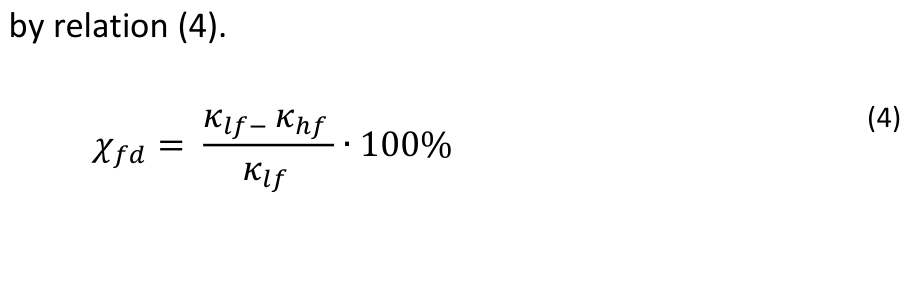
where: κ lf – volumetric magnetic susceptibility measured at low frequency, κ lf – volumetric magnetic susceptibility measured at high frequency.
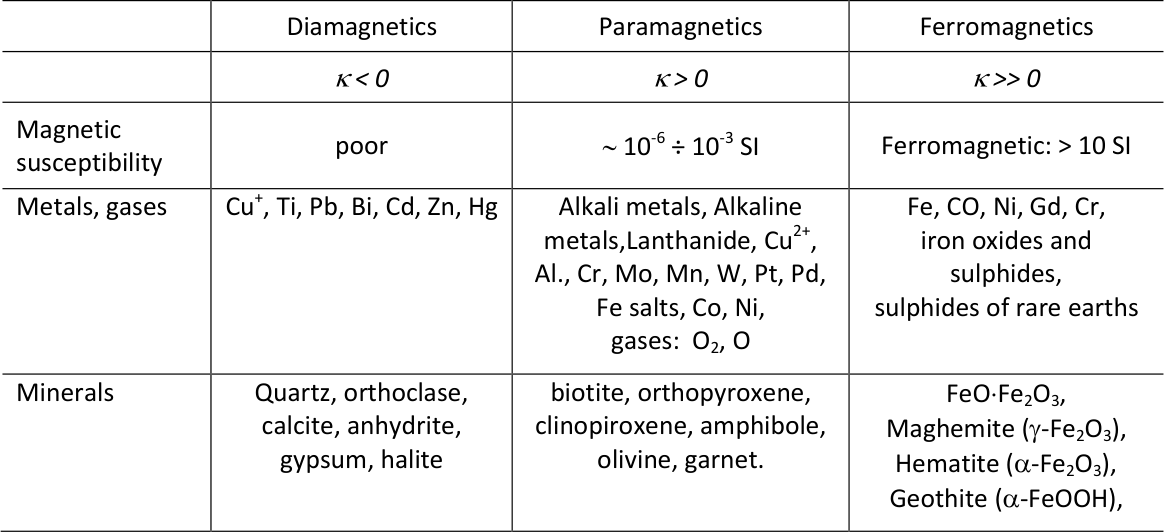
The value of the frequency factor of magnetic susceptibility determines the percentage decrease of magnetic susceptibility when measuring susceptibility at different frequencies. If the χ fd value is greater than 4%, it means that superparamagnets (grains of natural origin) are present in the soil. A value below 4% indicates anthropogenic magnetic particles. The estimated magnetic susceptibility for metals and minerals is presented in Table 1.
Table 1. Magnetic susceptibility of metals, gases and minerals Diamagnetics Paramagnetics Ferromagnetics
5
3.
3.1.
The idea of the gravimetric method is to combine the process of measuring the mass of a sample with the possibility of determining the volumetric and specific (mass) magnetic susceptibility. A diagram of such a measuring system is presented in Figure 2.
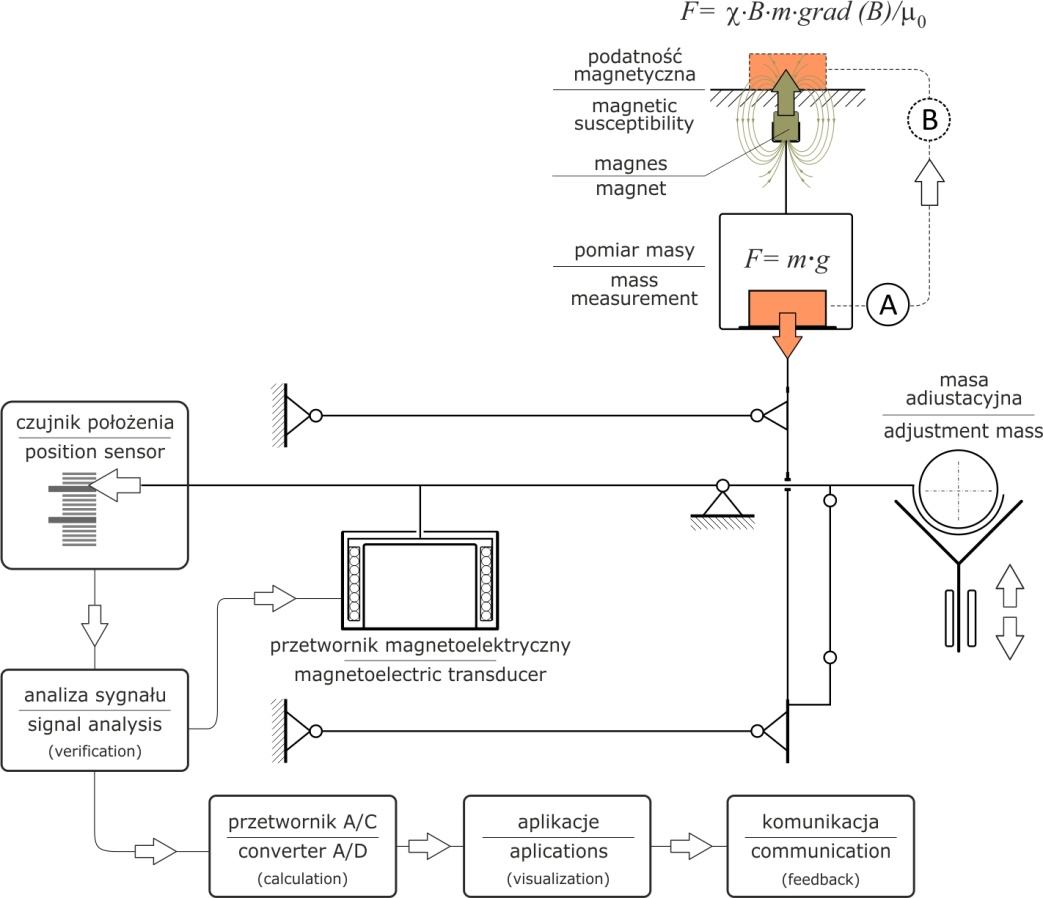
Figure 2. Diagram of MYA 4.Y microbalance with magnetic susceptibility testing equipment Before the load is placed on the weighing pan, the measuring system is in equilibrium. When the load is placed on the weighing pan (A), the position sensor is moved from its original stable state as a result of gravitational force on the load according to the relation F=mg . The measuring system analyses the measuring signal and generates a compensation signal to restore the measuring system to its original equilibrium position. The factory adjustment of the measuring converter indications in relation to certified mass standards allows the generated compensating signal to be presented in the form of the weighing result expressed in mass units, in grams. This method makes it possible to determine the exact weight of the test sample, both net and gross.
Transferring the sample from the weighing platform (A) to the fixed support of the weighing chamber (B) enables determination of the magnetic susceptibility of the sample. Before the load is placed, the measuring system is in equilibrium. Placing the sample in position (B) changes the indication of the measuring system as a result of interaction between the magnetic particles contained in the structure of the sample and the permanent magnet field, which magnet is placed in the upper holder of the weighing pan. Taking into account the geometric dimensions of the sample, its distance from the magnet and the indication of the measuring system, the volumetric and mass magnetic susceptibility are calculated.
6
3.2.
The design of the magnetic susceptibility test kit allows for testing changes in mass and magnetic susceptibility of filters with a maximum diameter of 47 mm, and soil samples placed in containers with an external diameter of 25 mm, at a volume of 5.43 cm 3 . The kit itself is over 11 g, so it can be:
− installed in the construction of already used microbalances of the MYA 4Y series with a maximum capacity higher than 11 g. − installed in any MYA 4.Y series microbalance, modification of the microbalance design during manufacturing. Graphic visualisation of the magnetic susceptibility test kit is presented in Figure 3.
Key: 1 – microbalance weighing pan; mass measurement of the analysed samples 2 – magnet holder 3 – magnet 4 – bottom base ring 5 – spacer ring 1 6 – spacer ring 2 7 – spacer ring 3 8 – bottom weighing chamber lid 9 – upper weighing chamber lid; platform for magnetic susceptibility testing
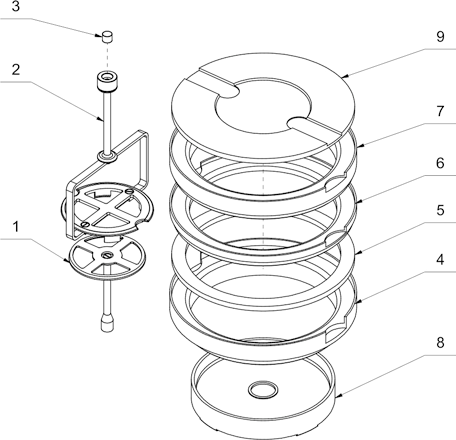
Figure 3. Magnetic susceptibility test kit
If the kit is used in the MYA 21.4Y microbalance mechanical design, the microbalance adjustment has to be carried out before the kit is installed. After installation of the kit, tare the microbalance display. The microbalance is ready for operation.
For the pre-installed kit, all possibilities for mass measurement and adjustment are available, just like for a standard microbalance. The kit must be installed before the microbalance is started.
7
4.
4.1.
The soil sample to be tested shall be homogeneous. The mixed sample shall be placed in a plastic container in some excess and then the container shall be closed with a nut slightly pressing the excess sample. In case of filters, conditioning must be carried out under stable laboratory conditions. Measurement of filter mass before and after exposure without prior conditioning may be subject to error due to changes in filter mass as a result of moisture absorption. For filters collecting unbalanced electrostatic charges, deionization shall be carried out before weighing (DJ-02 deionizer).
4.2.
Obtaining the correct results of the specific magnetic susceptibility requires an accurate determination of the mass of the tested samples. For this purpose, the first step is to carry out microbalance adjustment. The process is automatic. Procedure:
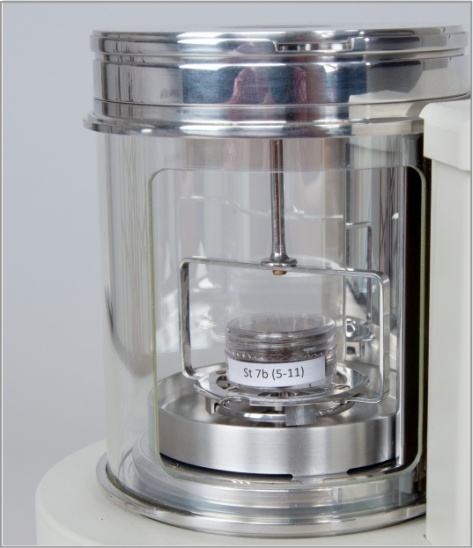
− unload the microbalance weighing pan − zero the indication − carry out internal adjustment
Sample mass measurement
− zero the microbalance indication − open the weighing chamber automatically − load the weighing pan with the sample and close the weighing chamber − wait for stabilization, read and save the measurement result − open the weighing chamber, remove the sample,
close the weighing chamber
CAUTION: the net mass of the sample may be determined by taring the empty container beforehand or by using the digital tare function. In this case, the tare value of the container shall be given during gross weighing - the indication shall be automatically corrected and the result of the weighing shall be presented as the net weight of the sample tested.
On the basis of the measurement of the sample net mass and its known volume of 5.43127E- 06 m 3 calculate the density of the sample tested using relation (5)
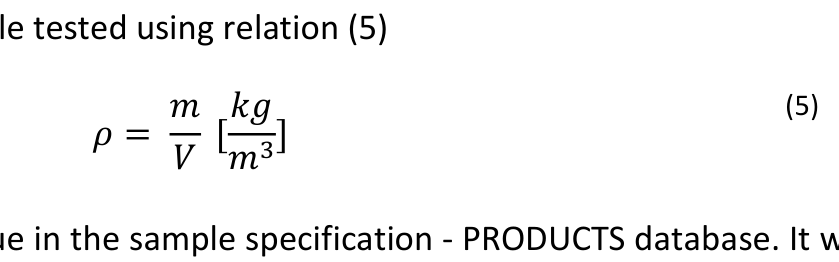
Enter the calculated density value in the sample specification - PRODUCTS database. It will be necessary for the calculation of the specific susceptibility in accordance with the relation (3).
8
4.3.
Prior to the magnetic susceptibility test, the test parameters such as the distance between the sample and the magnet (5 mm, 10 mm, 15 mm, 20 mm) and the geometric dimensions of the sample shall be determined. The test procedure requires the sample to be placed in a cylindrical container. These values shall be set in the microbalance menu, table 3 - magnetic susceptibility testing function. The value of the magnetic field, depending on the distance between the test sample and the magnet, is presented in Table 2.
Table 2. Magnetic field value over the test cycle
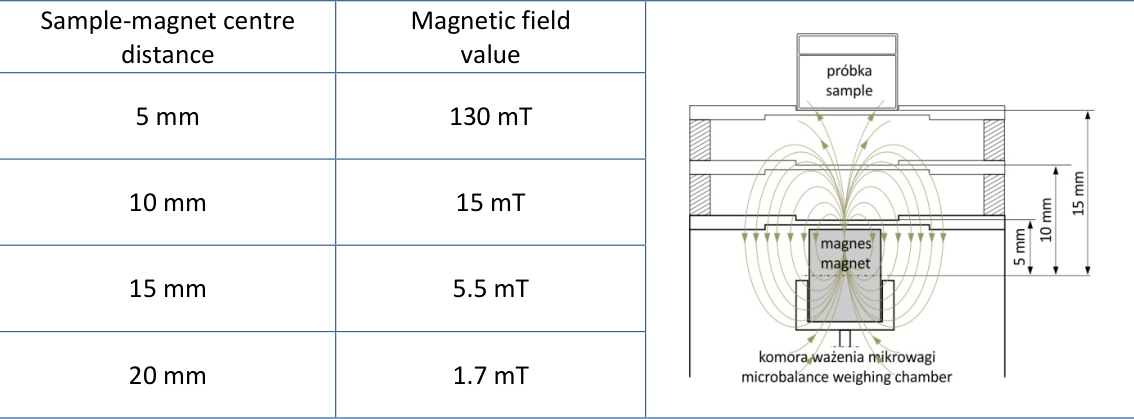
CAUTION: Selecting a specific distance between the sample and the magnet means that a suitable spacer ring is installed. This results in an alternating value of the magnetic field that interacts with the magnetic particles in the sample structure.
Table 3. Microbalance menu - magnetic susceptibility
1 Spacer D4 = 15 mm
2 Sample height 14.7 mm
3 Sample diameter 25 mm
4 Start
9
Upon setting the magnetic susceptibility test parameters, press the Start button. Next, place the sample on the upper lid of the weighing chamber (item 9, figure 3). Upon indication stabilization, press the Start/Confirm button (see the microbalance user manual). The magnetic susceptibility is calculated automatically and its value is given in the Info field, as presented in Table 4.
Table 4. Sample view and balance display - magnetic susceptibility testing.
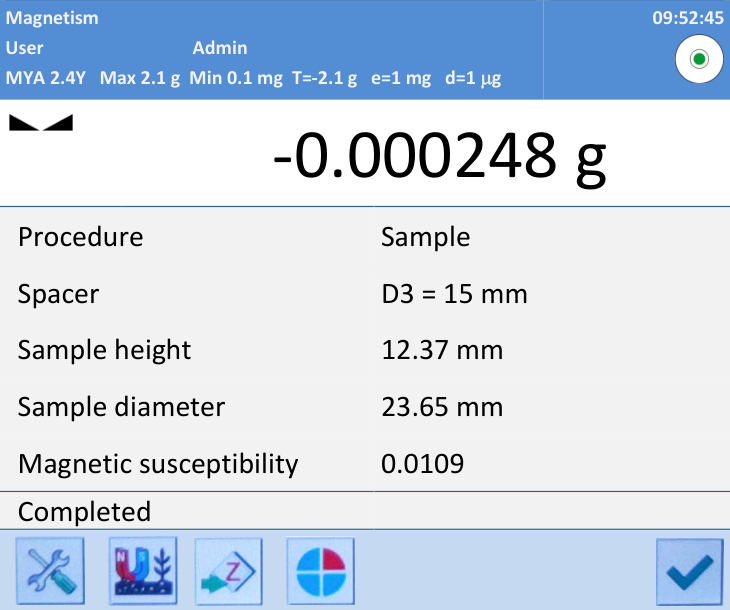
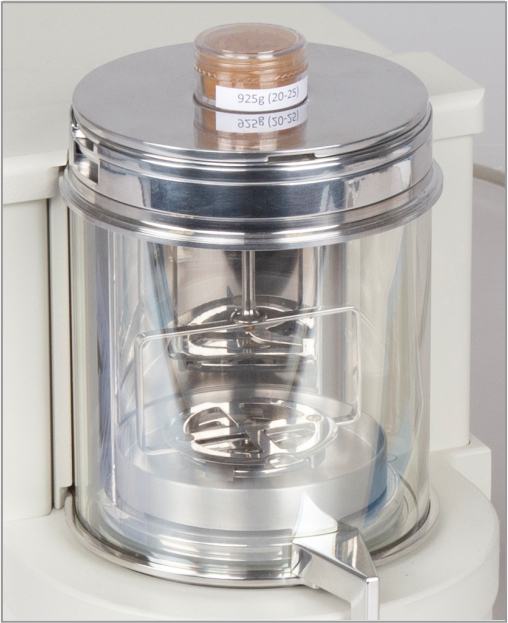
Sample view during testing Microbalance display – susceptibility function
10
Vaisala DRYCAP® Dew Point and Temperature Probe DMP5 is designed for in-line humidity measurement in industrial drying applications with high…

Dr. Lauri Reuter is an expert in the future of food, and the person to ask if you’ve ever wondered what we are going to eat in the future, and how…

Industrial companies are continuing to take action to minimize their carbon emissions. Many are reducing their use of fossil fuels and switching to…

In the causticizing process, passive chemicals are converted into active cooking chemicals to make white liquor. This is used in the digester as a…
A specialist replies with the solution, the instrument and the service that fit.
Products to quote
No products yet. An enquiry can be sent anyway: a specialist answers.