


Bringing out the beauty of wood: Veneer drying with humidity control
Vaisala DRYCAP® Dew Point and Temperature Probe DMP5 is designed for in-line humidity measurement in industrial drying applications with high…
Technical note
Izabela Dasiewicz-Szparaga (1) , Sławomir Janas (2) , Małgorzata Kowalska (3) (1) Municipal Water and Waste Water Administrative Body in Radom, (2) Testing Laboratory Radwag, (3) Kazimierz Pułaski University of Technology and Humanities in Radom, Materials Science, Technology and Design Section, Chemistry Department
Currently, for the purpose of determination of dry mass of waste water sludge, reference methods, specified by respective standards, are the most frequently used methods. In general these methods consist in determining weight value of the sludge before and after the process of dehydration. Due to the fact that the said methods are time consuming, their use is very limited. Moisture analyzers, where the source of heat is the infrared radiation, are a substitute often adapted for the above mentioned determination. The moisture analyzers allow to reduce the required time to few or several dozens of minutes. The process of dry mass content determination is a fully automatic process and as such it does not require constant monitoring to be done by the technical staff. This article aims to present an alternate method for determination of dry mass content of waste water sludge, i.e. a method using microwave radiation. The PMV 50 microwave moisture analyzer, used during the tests, is an innovative device that allows to carry out determination of dry mass content of the sludge automatically. During the test, measurement accuracy of 0.05 % was obtained, and the analysis took 5 minutes 42 seconds on average at 0.26 % standard deviation.
Omnipresent urbanisation and consumptive style of life of a contemporary society is one of many causes of growing liquid waste. The easiest solution for management of increasing amount of wastes is either their storage or burning. Bearing in mind the fact that waste water contains organic substances and food leftovers it is obvious that neither of the above is an optimal utilisation method. As the authors claim (Jakubas 2006) much better solution when it comes to economy and sustainable development is use of the waste water in farming sector. Dehydrated waste water sludge contain a lot of macroelements, nitrogen, phosphorus, magnesium, sulfur which in a visible way contributes to the harvesting processes in agriculture. Sludge intended to be used for agricultural purposes shall comply with the requirements regarding the content of fungi, bacteria, viruses, parasitic eggs and heavy metals (Napora, Grobelak 2014). Excess of heavy metals in waste water sludge practically excludes use of the dehydrated sludge in farming sector, nevertheless it does not prevent it from being processed in order to be used as an alternative fuel (Środa et al. 2006). With regard to the above it must be said that not each sludge is an optimal raw material that can be processed in agriculture. However food industry is the industry that generates sludge containing the least significant amount of heavy metals and other objectionable substances. Determination of dry mass of waste water sludge was carried out in the Research Laboratory of waste water sludge department in Municipal Water and Waste Water Administrative Body in Radom. The first stage covered tests carried out in accordance with the reference method, EN 12880:2004, the obtained result of dry mass content was 22.2 %. Next, a small amount of the product was taken from the same sample and subjected to tests based on microwave radiation. The device used for this purpose was the PMV 50 microwave moisture analyzer, manufactured by Radwag Wagi Elektroniczne, Poland. Both construction and means of operation of PMV 50 are presented in figure 1 and 2.
PMV moisture analyzer manufactured by Radwag is the latest solution using the microwave radiation for determination of water content and dry mass. Sludge temperature increase is provided as a result of absorption of the microwave radiation by polar compounds of the sludge (mainly water). In consequence of radiation absorption, reorientation of dipoles of polar compounds occurs which leads to molecular friction (Al-Harahsheh M, Al-Muhtaseb and Magee 2009). This brings about fast increase of temperature within the whole product volume, which is a cause of short analysis duration. Drying process efficiency depends on the power and frequency of the emitted microwaves, and also on both the product structure and its chemical content (Soysal 2004; Kamińska and Ciesielczyk 2011). PMV microwave moisture analyzer is a modern and productive weighing equipment, it offers:
short drying time (2 – 5 minutes maximum), products, drying programs, completed drying procedures databases, statistical analysis for water content determination of selected product, interactive menu with definable buttons, info fields, permission levels, etc., programmable proximity sensors drying process visualisation, presented as a drying curve,
2
export / import of products and drying programs databases, remaining data, communication via RS 232, USB, Ethernet, Wi-Fi.
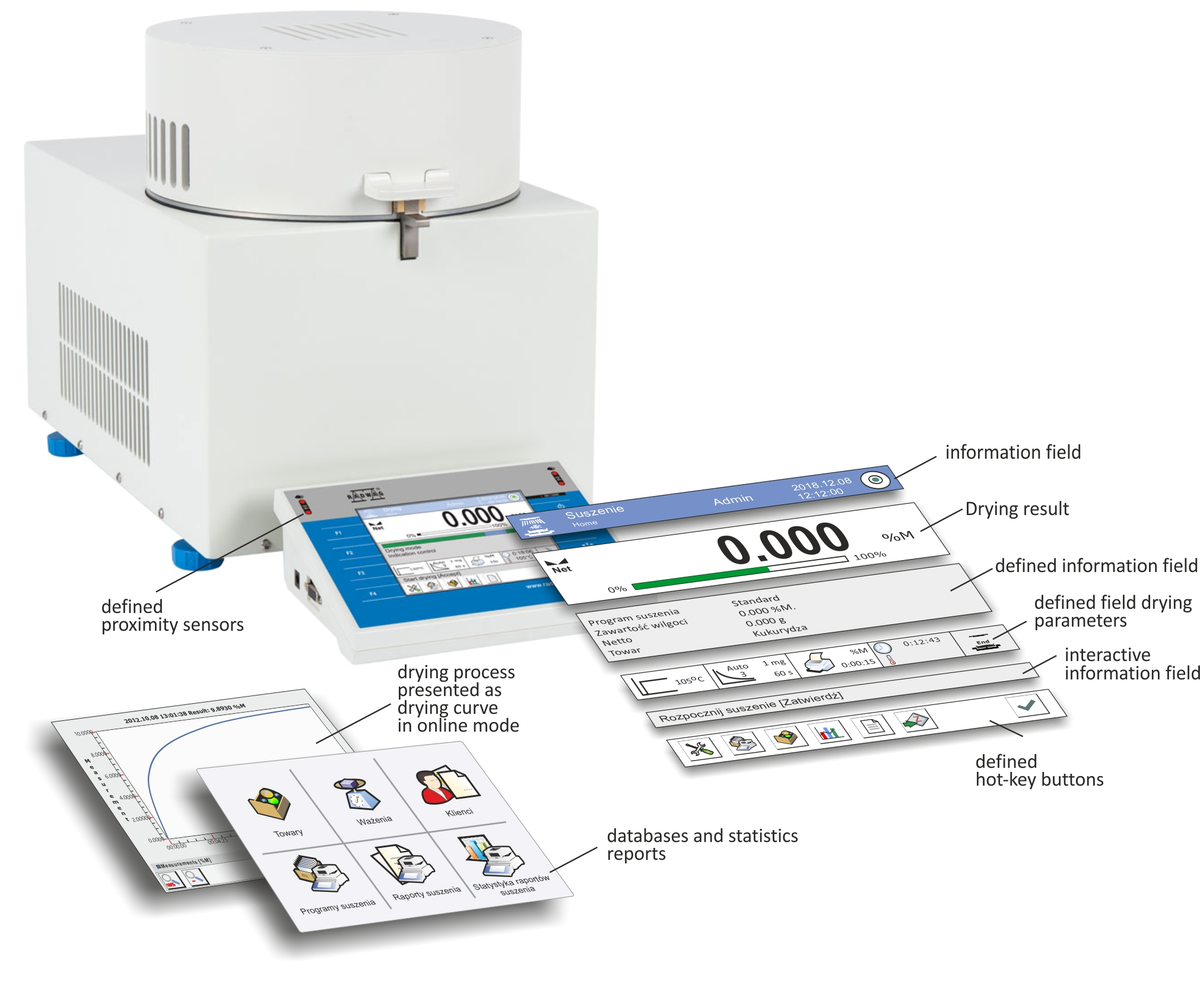
Figure 1. PMV 50 microwave moisture analyzer
Diagram of PMV 50 microwave moisture analyzer, manufactured by Radwag Wagi Elektroniczne , Poland, showing the main subassemblies has been presented in figure 2.
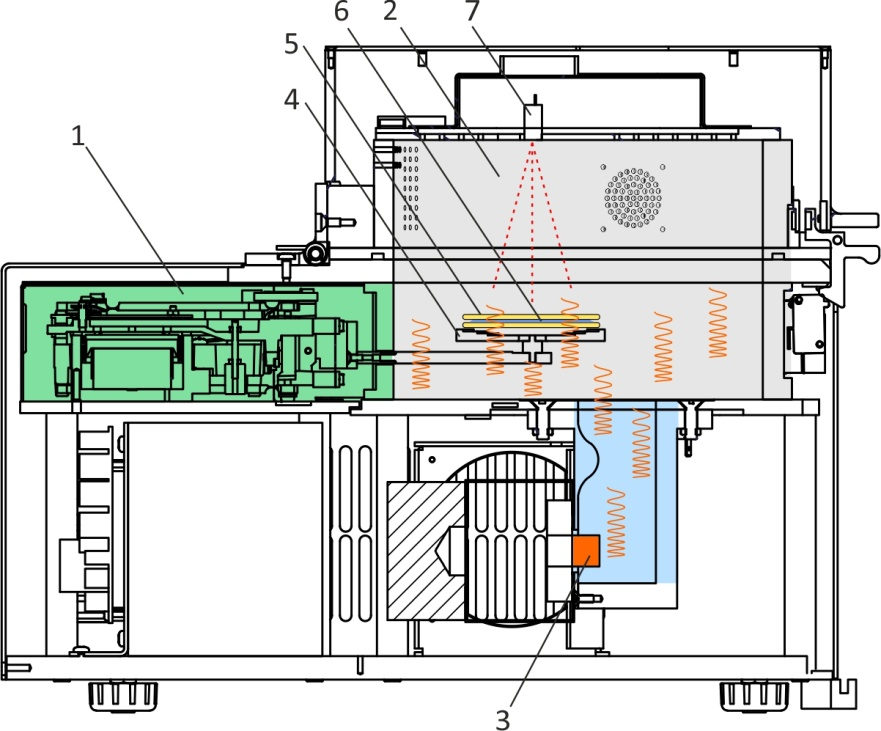
Figure 2. Diagram of PMV 50 microwave moisture analyzer
3
Measurement of the sludge mass is carried out using electromagnetic system (1), which comprises carefully selected monoblock components. Thanks to such solution the weighing system remains stable even when operating in unstable ambient conditions. Inside of the drying chamber (2) there is a weighing pan (4), it is loaded with a sludge sample (6) placed between two glass fibre filters (5). A magnetron (3) emits microwaves that are a cause of dipole effect of water molecules in a sludge (6). As a result, sludge temperature increases. The temperature is monitored via an infrared sensor (7) installed in the top part of the drying chamber (2). The obtained information is used via system controlling power of the magnetron (3). Along with the analysed sludge temperature drop, the emitted microwaves' power changes, its intensity matches dynamics of the process.
Dry mass content is analysed until the condition of sludge mass stability over time is met, which in this case means complete desorption of water from the tested sludge structure. Means of operation of this mechanism is presented in figure 3.
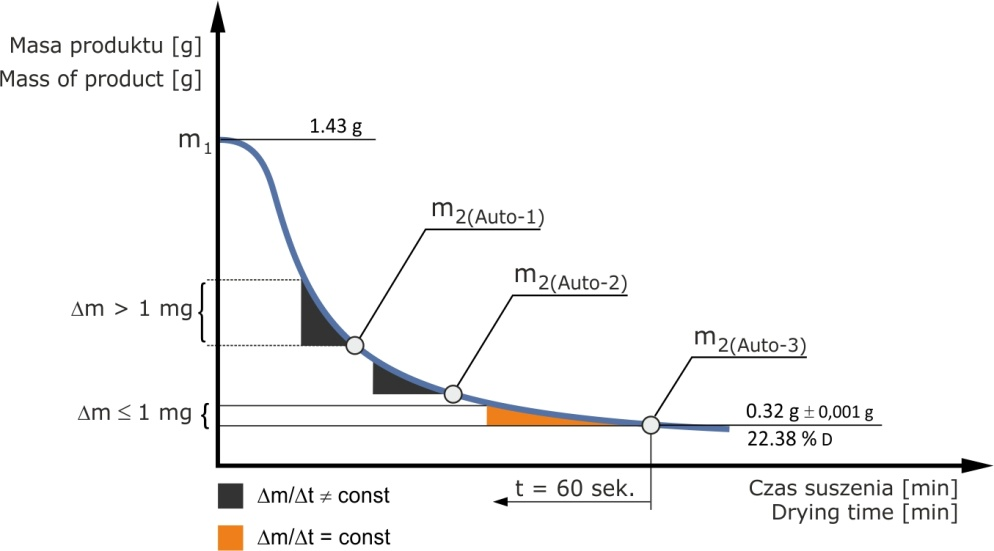
Figure 3. Diagram of PMV 50 microwave moisture analyzer
Dry mass content of waste water sludge (%D) is automatically calculated using the following equation:
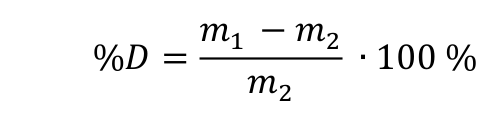
where: %D – dry mass content
m 1 – wet sludge mass, prior to analysis start m 2 – dry sludge mass, upon analysis completion
4
The first stage of the test was determination of dry mass in waste water sludge using the reference method EN 12880:2004. 22.20 % of dry mass was obtained, the value was taken as a reference point for determination of accuracy of the method based on microwave radiation (PMV 50 moisture analyser). Small amount of sludge in a form of a thin layer was placed between two glass fibre filters. Thus prepared sample was dried until constant weight value was obtained.
It was experimentally determined that the optimum temperature for analysis performance, for Auto 2 selected as the process finish mode, is 80 o C. This provided constant sludge mass after drying in the range of 1 mg in 25 seconds. The obtained results are presented in Table 1. Table 1 Dry mass in waste water sludge (PMV 50 moisture analyzer)
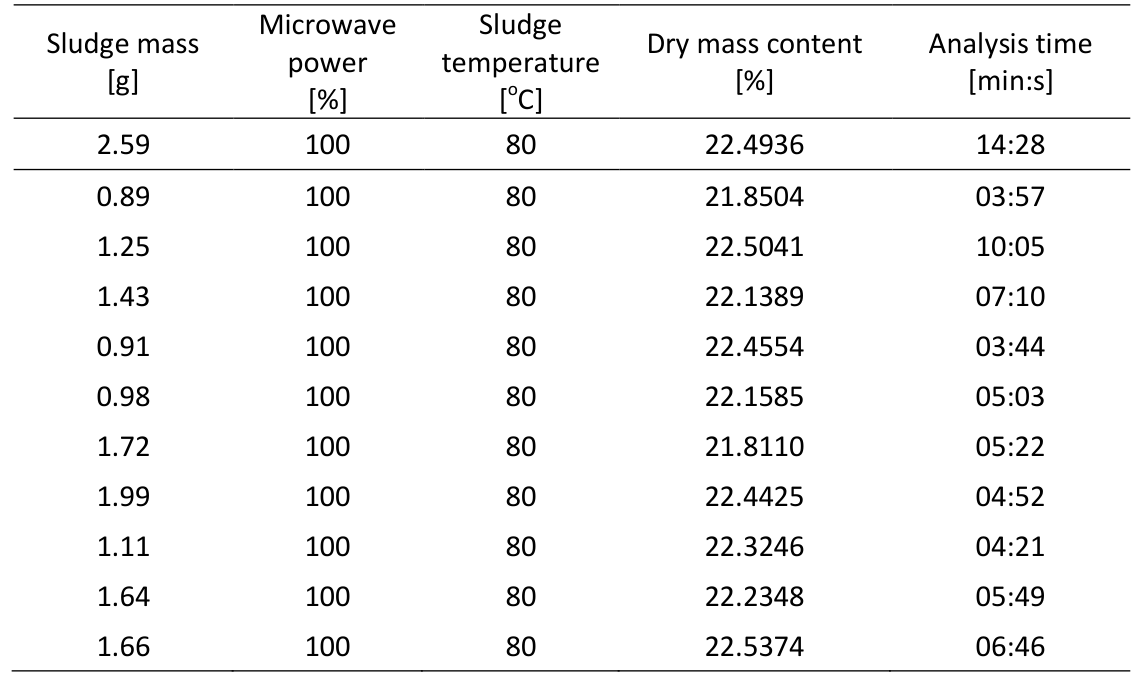
Dry mass content determination accuracy was 0.05 %. It was calculated using the following equation:

where: A – test accuracy
x̅ EN 1288 0 - average value of dry mass of waste water sludge obtained using reference method EN 12880 x̅ PMV 50 - average value of dry mass of waste water sludge obtained using the microwave method (PMV 50) Percent deviation of accuracy of successive dry mass content measurements in reference to value obtained using the reference method EN 12880 is presented in figure 4. The greatest deviation of accuracy was 1.75 %, the smallest 0.19 %, this proved that analysed product's structure was not
5
homogeneous. It must be then concluded that sample inhomogeneity did influence test accuracy and precision significantly.
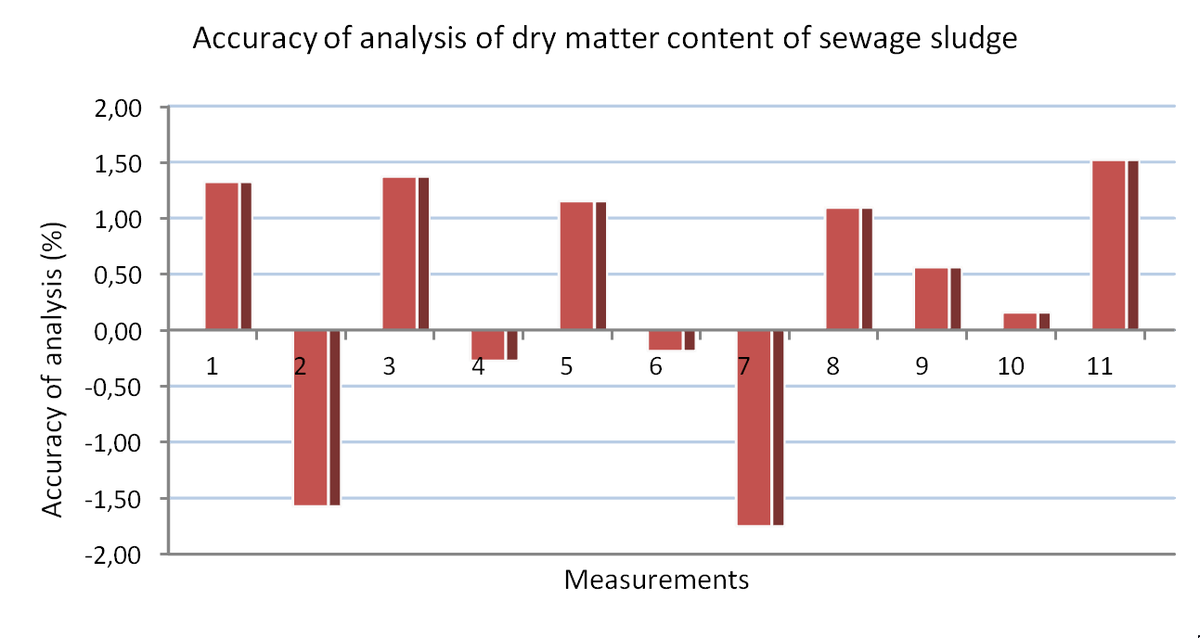
Figure 4. Accuracy of determination of dry mass of waste water sludge using microwave radiation (PMV 50
moisture analyzer)
For method based on microwave radiation, the measurement precision has been presented by means of standard deviation calculated for series of measurements, 0.26 % of dry mass was obtained. Using this value for estimation of uncertainty of the dry mass content, it was concluded that with 95% probability the dry mass content of waste water sludge is comprised within 21.73 % - 22.77 % range. Graphic visualisation of the above is presented in figure 5.
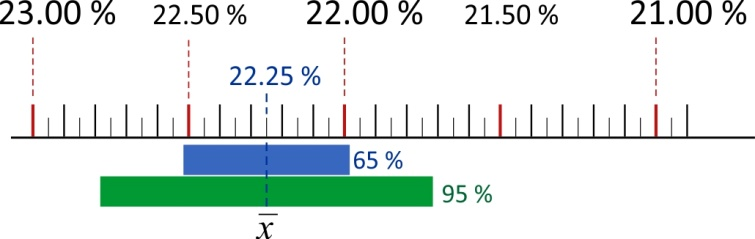
Figure 5. Uncertainty of determination of dry mass of waste water sludge During evaluation of the quality of waste water sludge upon dehydration usually one determination is carried out. It must be however said that in case of waste water sludge that are a mixture of various substances, the obtained result may not be a representative one. Therefore it is recommended to carry out three determinations at least, with this it will be possible to provide more reliable result. In the context of the above, analysis duration becomes an issue. For tests carried out using the microwave radiation, average analysis time of 5 minutes and 42 seconds was obtained. It was a relatively short time when compared to analysis of the same samples tested using the infrared radiation which took ca. 30 – 40 minutes.
6
Use of microwave method for determination of dry mass content of sludge provided 6 times shorter analysis when compared to method based on the infrared radiation. Accuracy of the carried out analysis was comparable to the accuracy of the reference method. It was concluded that measurement precision was conditioned mainly by analysed sludge homogeneity. Due to short test duration, the PMV 50 moisture analyzer may be used wherever information about the dry mass content must be obtained in a fast and reliable way.
1. Al-Harahsheh M., A.H. Al-Muhtaseb, T.R.A. Magee. 2009. Microwave drying kinetics of tomato pomace: Effect of osmotic dehydration. Chemical Engineering and Processing 48: 524–531. 2. Jakubas M. 2006. Ocena przydatności osadów ściekowych w nawożeniu roślin. Woda-Ścieki- Obszary Wiejskie t6, z.2 (18), 87-97
3. Kamińska A., W. Ciesielczyk. 2011. Kinetyka suszenia mikrofalowego wybranych warzyw i owoców”. Inżynieria i Aparatura Chemiczna 50 (1): 19-20.
4. Napora A., A. Grobelak. 2014. Wpływ osadów ściekowych na aktywność mikrobiologiczną i biochemiczną gleby. Inżynieria i Ochrona Środowiska t 17(4), 619-630
5. PN-EN 12880:2004. Charakterystyka osadów ściekowych. Oznaczanie suchej pozostałości i zawartości wody.
6. Środa K., A. Kijo-Kleczkowska, H. Otwinowski. 2012. Termiczne unieszkodliwianie osadów ściekowych . Inżynieria Ekologiczna 28, 67-81.
7. Soysal Y. 2004. Microwave Drying Characteristics of Parsley. Biosystems Engineering 89 (2): 167- 173.
7
Vaisala DRYCAP® Dew Point and Temperature Probe DMP5 is designed for in-line humidity measurement in industrial drying applications with high…

Dr. Lauri Reuter is an expert in the future of food, and the person to ask if you’ve ever wondered what we are going to eat in the future, and how…

Industrial companies are continuing to take action to minimize their carbon emissions. Many are reducing their use of fossil fuels and switching to…

In the causticizing process, passive chemicals are converted into active cooking chemicals to make white liquor. This is used in the digester as a…
A specialist replies with the solution, the instrument and the service that fit.
Products to quote
No products yet. An enquiry can be sent anyway: a specialist answers.