


CAB100 Industrial Cabinet for continuous monitoring systems
for cleanrooms and industrial settings
Nota técnica
Back for more on Mean Kinetic Temperature with a customer question:
Hi Paul,
I have reviewed Vaisala’s application note on mean kinetic temperature. But, I am still wondering what particular guidance states that mean kinetic temperature should only be used for room temperature environments and not for refrigerators or freezers? That is Rule #5 on your 6 rules for MKT.
But I’m still unclear to me exactly why not to use it in colder temperatures. Your assistance is greatly appreciated.
Thank you!
K
Dear K,
Thank you for checking out our training materials! We are happy to provide these to our customers and contacts in the industry at large. Here are the links to the webinar and the application note.
First off, you are not alone in your question, so below I have listed several questions we received in our last webinar on mean kinetic temperature. You will see that your question about cold chambers was asked then as well. And it is a very common question.
Second, to review our application note and the rules you mention, I will list all of them again here.
6 Mean Kinetic Temperature Usage Recommendations:
Finally, the answer to your question: Why Not Use MKT in Cold Chambers?
Because the best guidance we can use, and probably the only one to use in regulated environments, is the source of the idea that we can use mean kinetic temperature to evaluate temperature excursions: John Taylor.
Here is the name of the paper: The Pharmaceutical Journal (Vol 267), July 2001, J. Taylor. “Recommendations on the Control and Monitoring of Storage and Transportation Temperatures of Medicinal Products.”
I draw your attention to the lower left-hand corner of page 131 in the paper:
Strict conditions should be applied to the use of mean kinetic temperature. It is applicable only to storage of products under controlled room temperature conditions (I.E., those labeled “do not store above 25°C”). Mean kinetic temperature can be applied to the shipping of these products and it may provide a degree of assurance during prolonged transit periods. Mean kinetic temperature is not appropriate for products requiring controlled low temperature storage and shipping.
This paper basically brought the mean kinetic temperature calculation into its current use and describes how and why to use it. Simply put, the guy who first thought that MKT might be good for evaluating excursions also explicitly stated where not to use it, saying: “[MKT] is not appropriate for products requiring controlled low temperature storage and shipping.” It was a great innovation in its time, but we recommend sticking to the original guidance that accompanied the use of mean kinetic temperature.
That’s why we made recommendation 5 in our application note. We can also find that rates of change in chemical reactions and degradation pathways further support this position. Our caution against using the value for cold chamber applications is directly from the seminal paper on the topic, but also from the likelihood that you might have an uphill battle convincing an auditor that mean kinetic temperature for refrigerated chambers is a better solution for evaluating excursions than the other tools we at our disposal. Please contact me further if you have any questions!
Paul Daniel
for cleanrooms and industrial settings

para secadores refrigerantes

para aplicaciones de fabricantes de equipos originales

para inspecciones rápidas y comprobación de errores

Transmisores de ±1,5 % HR para HVAC exigentes, con certificado
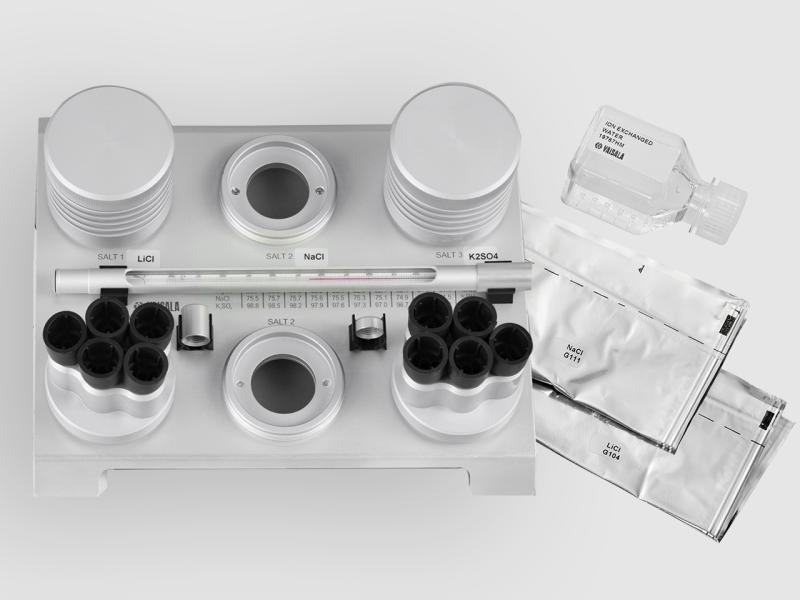
El calibrador de humedad HMK15 de Vaisala hace que la calibración y el control de punto de las sondas de humedad y transmisores sea fácil y confiable.

Qué son la humedad relativa, el punto de rocío, la humedad absoluta y la razón de mezcla, cómo la temperatura y la presión distorsionan la lectura, y…

Cómo se comporta la humedad en condiciones reales, los tres problemas de medición más frecuentes, y dos escenarios prácticos —aire calentado y aire…

Cuándo medir humedad relativa y cuándo punto de rocío, qué exige la alta y la baja humedad, cómo influyen temperatura y presión, y cuándo conviene…

La climatización representa hasta el 40 % de la demanda energética de un centro de datos. Esta guía de Vaisala explica cómo la exactitud de medición…
Un especialista responde con la solución, el instrumento y el servicio que corresponden.
Instrumentos para cotizar
Todavía no hay instrumentos. Se puede escribir igual: un especialista responde.