


Bringing out the beauty of wood: Veneer drying with humidity control
Vaisala DRYCAP® Dew Point and Temperature Probe DMP5 is designed for in-line humidity measurement in industrial drying applications with high…
Technical note
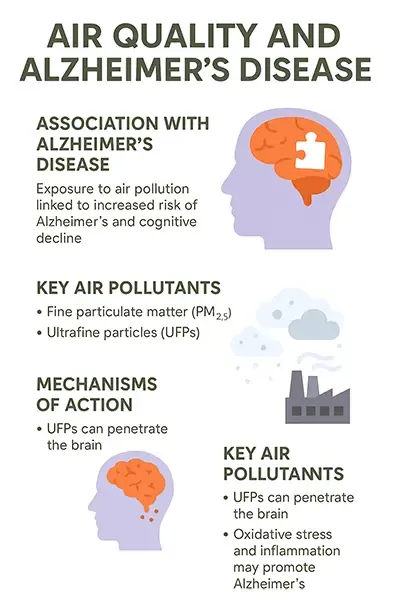
If you’ve ever wondered how the air you breathe might affect your brain, you’re not alone. Air pollution is now being recognized as a contributor to neurological diseases, including Alzheimer’s disease. Recent research shows a strong association between poor air quality and increased risk of Alzheimer’s, especially when it comes to ultrafine particles (UFPs) and fine particulate matter (PM2.5).
Ultrafine particles, or UFPs, are smaller than 0.1 microns—so tiny that they can bypass your body’s natural defenses and slip right past the blood-brain barrier. Once inside your brain tissue, these particles can trigger inflammation and oxidative stress, which are two key drivers behind the development of Alzheimer’s disease. Scientists have found that these particles are linked to the formation of amyloid plaques and neurofibrillary tangles, both of which are classic hallmarks of Alzheimer’s.
Traffic-related air pollution is a major source of UFPs. Living near busy roads isn’t just noisy and stressful—it’s also risky for your cognitive health. According to a study published in The Lancet Neurology, your risk of dementia goes up by 7% for every 50 meters closer you live to a major roadway. That’s a pretty big deal if you’re in an urban area or near highways.
You might think you’re safe inside, but indoor air quality can sometimes be just as bad as what’s outside. Everyday activities like cooking, cleaning, or burning candles can fill your home with fine particles.
If you’re looking for practical ways to improve indoor air quality and protect your cognitive health, here are some tips:
Poor air quality is a modifiable environmental factor linked to Alzheimer’s disease. The science is clear: exposure to UFPs, PM2.5, ozone, and nitrogen dioxide can all contribute to brain inflammation and accelerate cognitive decline. By taking steps to reduce both personal and community-level exposure, you can help protect your brain health and lower your risk of Alzheimer’s.
Air pollution and Alzheimer’s disease are more connected than most people realize. The good news? You have the power to make changes—both at home and in your community—to help protect your brain. Whether it’s supporting clean energy policies, using an air purifier, or simply checking the AQI before a walk, every step counts.
What changes have you made at home to improve your air quality? Have you noticed a difference in how you feel on days with better air?
Vaisala DRYCAP® Dew Point and Temperature Probe DMP5 is designed for in-line humidity measurement in industrial drying applications with high…

Dr. Lauri Reuter is an expert in the future of food, and the person to ask if you’ve ever wondered what we are going to eat in the future, and how…

Industrial companies are continuing to take action to minimize their carbon emissions. Many are reducing their use of fossil fuels and switching to…

In the causticizing process, passive chemicals are converted into active cooking chemicals to make white liquor. This is used in the digester as a…
A specialist replies with the solution, the instrument and the service that fit.
Products to quote
No products yet. An enquiry can be sent anyway: a specialist answers.