

Humidity Fundamentals, Part 1: Key Concepts
What relative humidity, dew point, absolute humidity and mixing ratio are, how temperature and pressure distort the reading, and why dew point is…
Technical note
A power transformer's service life is, in essence, the service life of its insulating paper — and the agents that degrade it are oxygen and moisture. That is why new transformers are built sealed, and many older units are being retrofitted to that configuration: keeping air out of the tank is one of the most direct ways to extend the asset's life.
But a seal only protects while it works. Detecting in time that a sealed transformer is taking in air is the problem the total gas pressure (TGP) method solves. For the general context of the DGA technique, see the dissolved gas in oil instrumentation landing.
The intuitive way to detect air ingress would be measuring the oxygen dissolved in the oil. In practice it has two serious limitations. The first is chemical: the oxygen entering the tank is consumed by the very oxidation reactions that degrade the paper and the oil — so a low concentration does not guarantee the absence of a leak: it can mean exactly the opposite, oxygen entering and reacting.
The second is interpretive: there is no international standard for interpreting oxygen concentration in transformer oil, and dissolved gas analysis in general requires specialist interpretation — as seen in the note on the role of online DGA monitoring. For a variable whose role is to trigger a simple maintenance action — repairing a seal —, depending on an expert to read it is an unnecessary cost.
The TGP method measures the total pressure of all gases dissolved in the oil. In a sealed transformer with degassed oil, that pressure stays low — far below atmospheric pressure. If the seal fails and air leaks in, nitrogen and oxygen become the dominating gases in the oil and the total pressure rises clearly and steadily.
The advantage lies in the reading: a total pressure increase indicates a sealing failure, with no calculation or specialist interpretation — the result is self-explaining and intuitive, and it integrates directly into automatic monitoring systems. The Optimus™ OPT100 monitor incorporates this measurement without oxygen sensors, alongside fault gas analysis.
Unlike fault gases — whose accelerated growth may demand immediate action —, air ingress does not force an urgent intervention. Detecting it early makes it possible to schedule the seal repair for the next planned maintenance, preventing months of oxygen and moisture exposure from further degrading the insulating paper.
That is the method's value in asset management terms: it turns a silent degradation — which sporadic sampling could miss for years — into a low-operating-cost early alarm that protects the one transformer component that cannot be replaced without a rebuild: its paper insulation.
This technical content is based on the Vaisala article "More robust air leak monitoring for power transformers – Total Gas Pressure" by Senja Leivo (Senior Industry Expert). AKRIBIS is an authorized Vaisala partner for distribution and technical support in the region — explore the full Vaisala instrumentation line. To evaluate air leak monitoring for your transformer fleet, consult a specialist.
What relative humidity, dew point, absolute humidity and mixing ratio are, how temperature and pressure distort the reading, and why dew point is…
How humidity behaves in real conditions, the three most common measurement problems, and two practical scenarios —heated air and compressed air—…
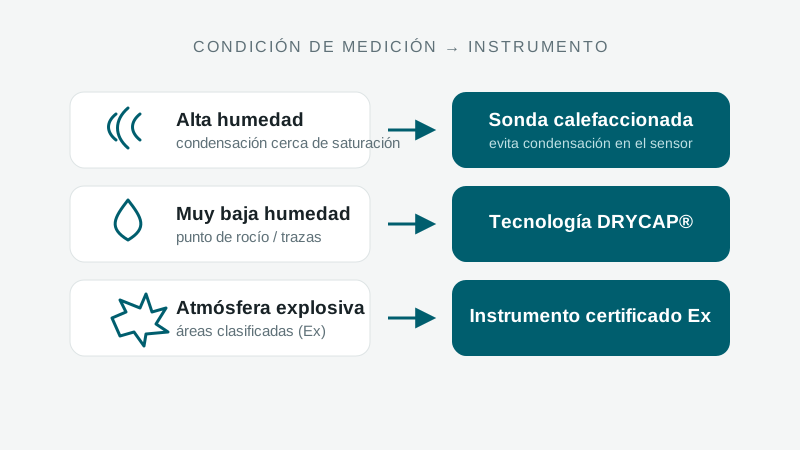
When to measure relative humidity vs. dew point, what high and low humidity demand, how temperature and pressure factor in, and when a warmed probe…

Cooling accounts for up to 40% of a data center's energy demand. This Vaisala guide explains how measurement accuracy cuts costs and risks, with a…
A specialist replies with the solution, the instrument and the service that fit.
Instruments to quote
No instruments yet. An enquiry can be sent anyway: a specialist answers.