

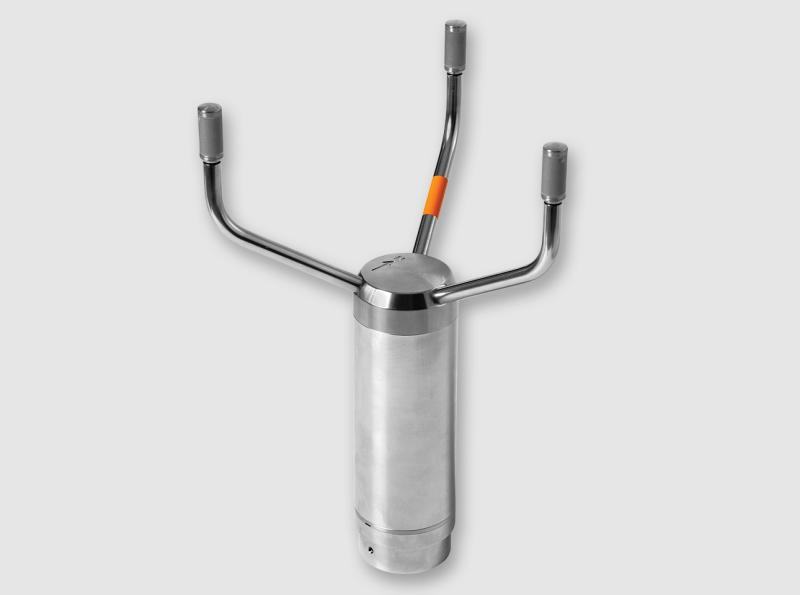
WINDCAP Ultrasonic Wind Sensor WMT700
Ultra-reliable, ultrasonic
Technical note
Multi-Project Validation Study of Vaisala’s Wake Loss Estimation Method
Vaisala has conducted a multi-project validation study of its unique wake loss estimation method, using one year of post-construction operational data from seven North American onshore wind energy projects in flat terrain. Observed wake losses were derived from the wind project SCADA data using a “reference set” approach to estimate the unwaked power. A mesoscale model simulation was used to determine the spatial variability of the unwaked wind field so that its signature could be removed from the observed estimate of wake losses. The pre-construction wake loss estimates were made with Vaisala’s time series-based method utilizing the Larsen single turbine wake model. Finally, error metrics were calculated describing the difference between the modeled and observed wake losses. The results showed that the observed wake losses were 21% larger than predicted, on average, indicating the need for a calibrative correction to the wake loss estimate. If the 21% bias is removed, the standard deviation of the remaining project-to-project random error is 16% of the observed wake loss. This is an encouraging result, considering that consultants typically assume uncertainties ranging from 20% to 30% of the total estimated wake loss. A caveat to both the mean bias and uncertainty results is that it is based on a relatively small sample size of seven projects, which yields large 90% confidence intervals on each statistic: +11% to +30% for the mean bias error, and also 11% to 30% for the uncertainty. Going forward, Vaisala intends to update the study with a larger sample size by adding new operational projects to the validation data set and thereby decrease uncertainty in the results.
...
Ultra-reliable, ultrasonic
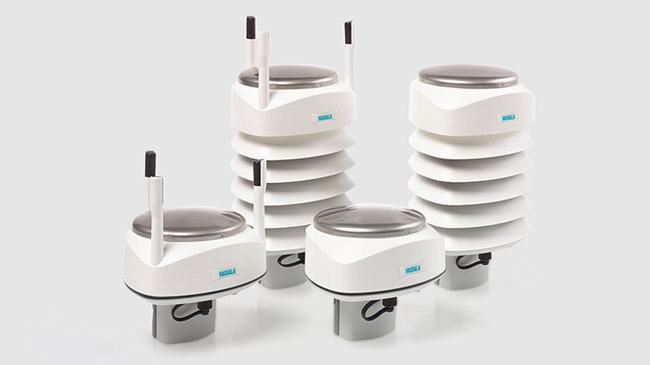
Vaisala Weather Transmitter WXT530 series is a unique collection of cost-effective sensors that accurately and reliably measure weather conditions…

What relative humidity, dew point, absolute humidity and mixing ratio are, how temperature and pressure distort the reading, and why dew point is…

How humidity behaves in real conditions, the three most common measurement problems, and two practical scenarios —heated air and compressed air—…

When to measure relative humidity vs. dew point, what high and low humidity demand, how temperature and pressure factor in, and when a warmed probe…

Cooling accounts for up to 40% of a data center's energy demand. This Vaisala guide explains how measurement accuracy cuts costs and risks, with a…
A specialist replies with the solution, the instrument and the service that fit.
Instruments to quote
No instruments yet. An enquiry can be sent anyway: a specialist answers.