

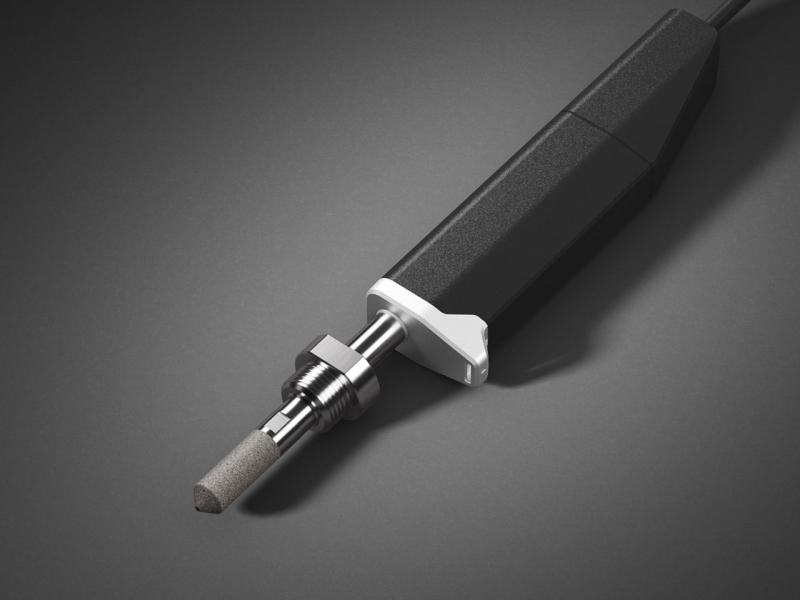
DMP80 DRYCAP® handheld probe for dew point and temperature
For spot-checking and calibrating dew point measurements
Technical note
Isolating the Sensor
The most common installation for a dew point sensor isolates the sensor from the compressed air line. This is accomplished by installing the sensor in a sample cell and connecting the cell to a T-piece in the compressed air line at the point of interest. A small amount of compressed air is then bled past the sensor. The cell should be made of stainless steel and connected to the T-piece with tubing (1/4" or 6 mm). It is useful to install an isolation valve between the cell and the air line. This enables easy installation and removal of the sensor.
Regulating the flow
A flow-regulating device is necessary to control to airflow past the sensor. The desired flow rate is only 1 L/min (2 scfh). The regulating device can be a leak screw or a valve. To measure pressure dew point, the regulating device is installed downstream of the sensor, so that when the isolation valve is opened, the sensor is at the process pressure. To measure dew point at atmospheric pressure, the regulating device should be installed upstream of the dew point sensor.
Avoiding a local pressure drop
Do not exceed the recommended flow rate. When measuring pressure dew point, an excessive flow rate will create a local pressure drop at the sensor. Because dew point temperature is pressure sensitive, this will create an error in the measurement.
Selecting the tubing material
The best tubing material is stainless steel. Nonmetallic tubing can absorb and desorb water vapor, creating a lag in measurement response. If stainless steel tubing is not available, consider using PTFE or other materials that do not absorb water. Avoid the use of clear plastic tubing or yellow rubber tubing.
Reducing installation costs
It is possible to reduce installation costs for permanent dew point instruments by installing the sensor directly in the compressed air line. In these cases, it is important to choose a location where the sensor has adequate airflow and where the temperature of the compressed air is at or near ambient. Not only does this save on installation costs, but it is also a good choice if the pressurized dew point reading is the desired measurement parameter.
Visit www.vaisala.com/compressedair for more information or scroll down to see the related dew point measurement products.
For spot-checking and calibrating dew point measurements

for refrigerant dryers

for OEM applications

The latest addition to the Indigo family of transmitters and probes, the Indigo80 is a compact, handheld indicator and data logger. Ideal for field…

for cleanrooms and industrial settings
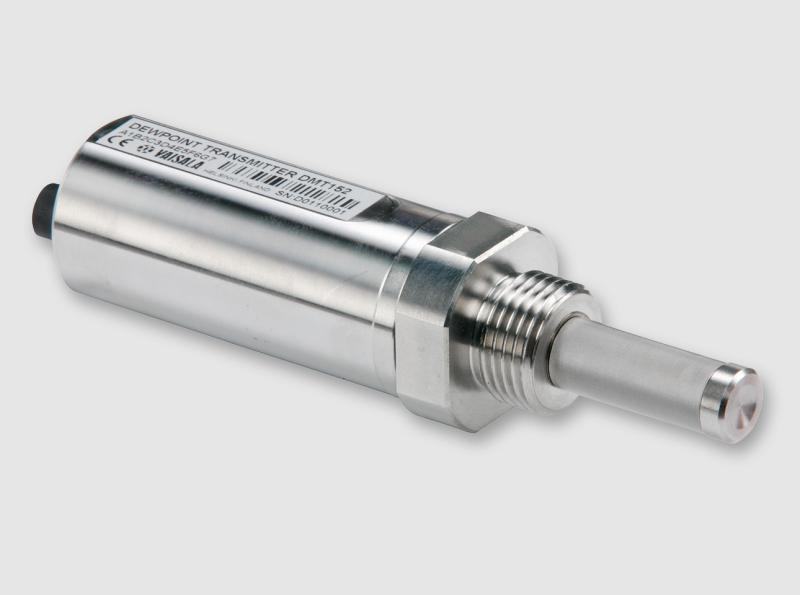
Please note that the DMT152 is being discontinued and should not be specified for new projects. Get to know the new DMT153 here.

What relative humidity, dew point, absolute humidity and mixing ratio are, how temperature and pressure distort the reading, and why dew point is…

How humidity behaves in real conditions, the three most common measurement problems, and two practical scenarios —heated air and compressed air—…

When to measure relative humidity vs. dew point, what high and low humidity demand, how temperature and pressure factor in, and when a warmed probe…

Cooling accounts for up to 40% of a data center's energy demand. This Vaisala guide explains how measurement accuracy cuts costs and risks, with a…
A specialist replies with the solution, the instrument and the service that fit.
Instruments to quote
No instruments yet. An enquiry can be sent anyway: a specialist answers.