


Miniature Dew Point Transmitters DMT143 & DMT143L (Long)
for OEM applications
Technical note
In ultra-dry environments, selecting the right measurement parameter is critical for process efficiency and product quality. While relative humidity (RH) sensors perform adequately at moderate humidity levels, their reliability diminishes rapidly as conditions become drier.
This is due to the non-linear relationship between dew point and RH: at RH below 5%, measurement uncertainty increases significantly, and below 1%, accurate RH measurement becomes nearly impossible.
In contrast, Vaisala’s dew point and frost point measurements maintain high accuracy and resolution even at extremely low moisture levels, supporting energy efficiency and product quality, making them the preferred choice for demanding applications such as battery dry rooms, semiconductor manufacturing, and industrial drying processes.
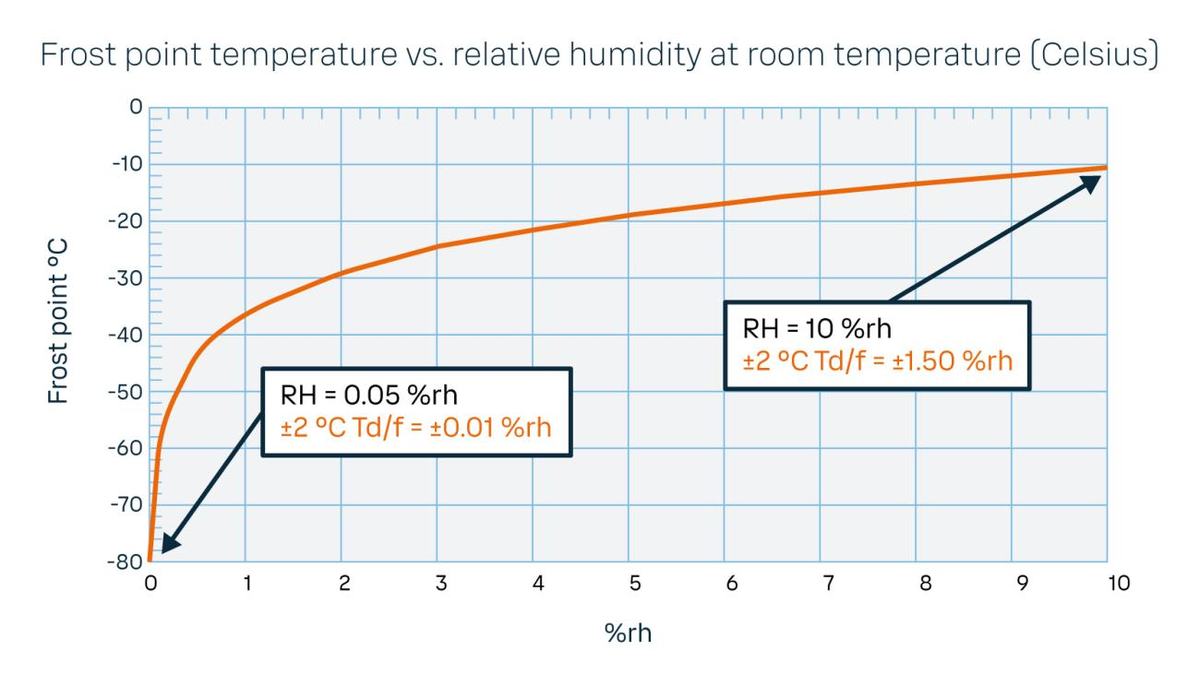
It is important to appreciate the fact that dew point is not the same as frost point. This is because dew point involves condensation (gas to liquid), whereas frost point involves a different phase change - deposition (gas to solid). The terms “dew point” and “frost point” are sometimes used inconsistently or without clear specification in industrial settings, which introduces ambiguity and measurement challenges because the frost point values and the theoretical dew point values which describe the same trace moisture condition are significantly different.
For sub-zero measurements, ‘frost point’ is the correct term, reflecting the phase change from gas directly to solid.
In short: Not without specialized equipment.
Water concentration measurements in ppm are less suited to ultra-dry conditions because they are unable to retain accuracy and precision at such low levels, especially as frost point drops below -60°C.
A move from -60°C to -80°C frost point, the absolute humidity in ppm reduces twenty-fold, which would be challenging to measure accurately in ppm. This limitation underscores the importance of using dew point or frost point sensors specifically engineered for low-humidity environments.
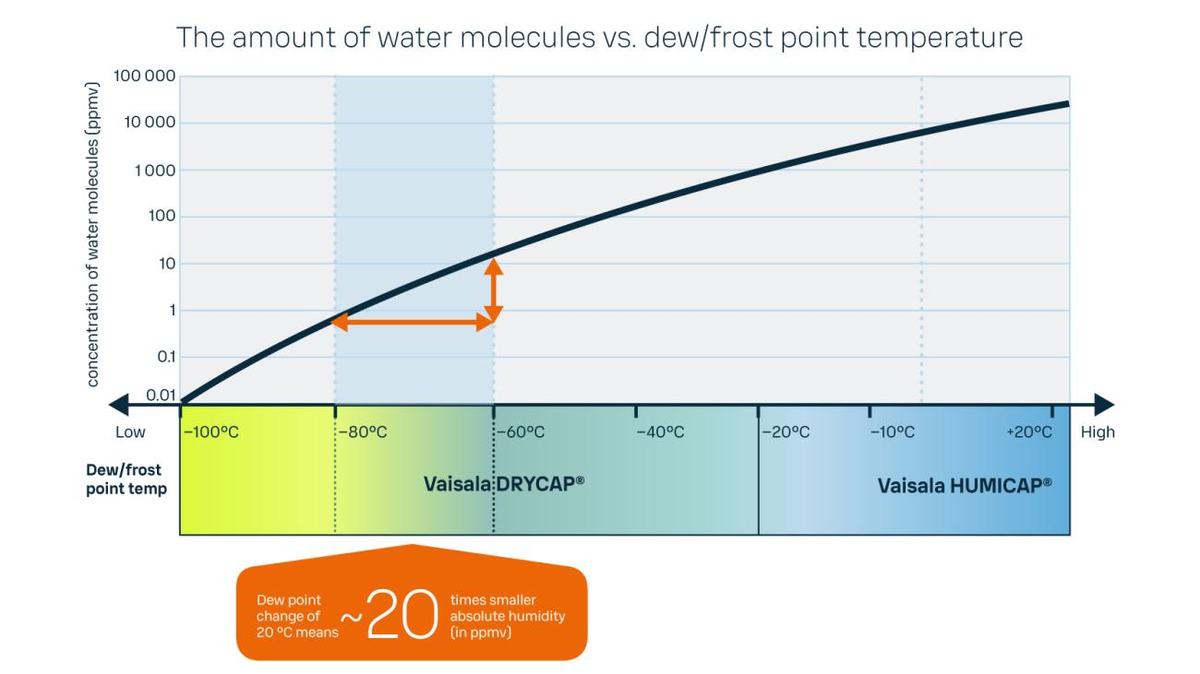
Vaisala offers two sensor families optimized for different humidity ranges. HUMICAP® sensors are designed for broad RH measurement (0–100 %rh), while DRYCAP® sensors excel in ultra-dry conditions (0–10 %rh) and low dew and frost points.
DRYCAP® technology incorporates advanced features such as auto-calibration and thin-film polymer capacitive sensing, ensuring stability and reliability in applications like compressed air systems, battery manufacturing, and semiconductor production.
While laboratory analyzers can deliver exceptional accuracy if diligently maintained and used only in stable laboratory conditions, their use in industrial environments is often impractical. Sample lines necessary to use laboratory instruments for industrial applications introduce risks of leaks, contamination, including moisture, temperature-induced fluctuations, and delayed response times.
Installing fast-response sensors which are reliable in a variety of industrial conditions directly at critical measurement points mitigates these challenges and ensures real-time, actionable data.
For robust, accurate measurements in ultra-dry environments, Vaisala recommends:
DMT143: Wide measurement range from -70 °C to +60 °C frost/dew point (DRYCAP®)
DMT152: Specialized for ultra-dry conditions, measuring from < -80 °C to -20 °C frost/dew point (DRYCAP®)
for OEM applications
for high humidities
For use up to zone 0 and 20

The latest addition to the Indigo family of transmitters and probes, the Indigo80 is a compact, handheld indicator and data logger. Ideal for field…

for refrigerant dryers
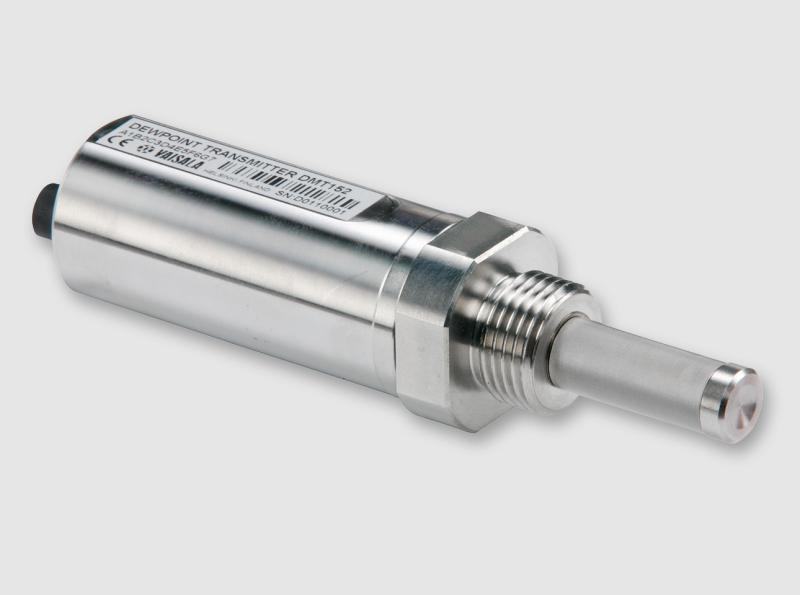
Please note that the DMT152 is being discontinued and should not be specified for new projects. Get to know the new DMT153 here.

What relative humidity, dew point, absolute humidity and mixing ratio are, how temperature and pressure distort the reading, and why dew point is…

How humidity behaves in real conditions, the three most common measurement problems, and two practical scenarios —heated air and compressed air—…

When to measure relative humidity vs. dew point, what high and low humidity demand, how temperature and pressure factor in, and when a warmed probe…

Cooling accounts for up to 40% of a data center's energy demand. This Vaisala guide explains how measurement accuracy cuts costs and risks, with a…
A specialist replies with the solution, the instrument and the service that fit.
Instruments to quote
No instruments yet. An enquiry can be sent anyway: a specialist answers.