

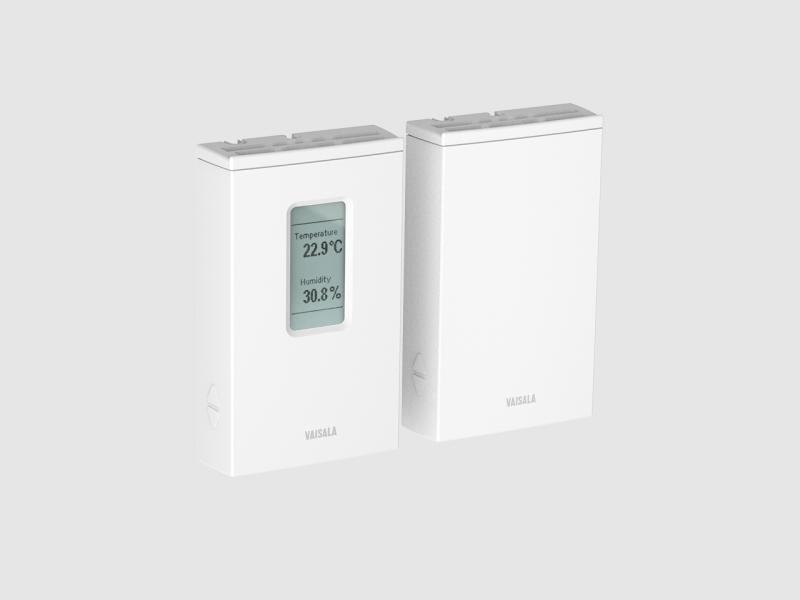
Humidity and Temperature Transmitter Series HMW90
±1.7%RH wall transmitters with a certificate for demanding HVAC
Technical note
Where human comfort is the main factor, for example in office buildings, RH is often a good choice for a control parameter. It allows flexibility in temperature settings without changing the RH control settings, allowing higher temperatures in summer and lower ones during winter, for example. It is also directly related to human comfort and many biological processes such as mold growth. A drawback is that very tight temperature and humidity control is difficult to achieve as temperature also affects relative humidity. These two controls may compete with each other, causing oscillation in the control loops.
The dew point temperature (Td) indicates at which temperature you will see the onset of condensation. A low dew point temperature indicates dry conditions while a high dew point indicates high humidity. The dew point cannot exceed the ambient temperature; when the dew point is the same as the ambient temperature, you have reached saturation and RH is 100%. The advantage of using dew point in HVAC controls is that it isn’t affected by changes in temperature, so you can control both temperature and humidity precisely and reliably. The control circuits are independent of one another, so changing the temperature does not change the dew point in the controlled space and vice versa. Dew point and temperature control are used in spaces with the highest requirements for stability, like labs, museums, and data centers.
The wet bulb temperature indicates the temperature to which a water surface can be cooled by evaporation. This cooling effect varies with the relative humidity of the ambient air. When the air is saturated with water there is no evaporation and no cooling. The wet bulb temperature is used to control cooling towers, which can provide low-cost cooling especially in hot and dry climates. If the humidity is too high and the wet bulb temperature approaches the ambient temperature, the cooling effect becomes too small and it no longer makes sense to run the cooling towers.
Enthalpy indicates how much energy needs to be expended to get to the measured state from a reference state, usually dry air at 0 °C; the most common unit is kJ/kg. If you know the enthalpy of return air and make-up air, you can use this information to decide whether to recondition the return air or replace it with outdoor air. This is not immediately evident just from temperature measurements as the humidity of the air impacts the enthalpy more than the temperature. Enthalpy is thus the recommended choice when your target is to maximize energy savings.
All of these humidity measurements can be calculated from RH and temperature. This can be done in your control system, but many modern humidity transmitters do the job for you.
Take a look at the Vaisala HMD62 duct humidity sensor that allows you to select the desired humidity output with a DIP switch. Also check our free online humidity calculator that makes parameter conversions easy!
±1.7%RH wall transmitters with a certificate for demanding HVAC

for refrigerant dryers

for OEM applications

for quick inspections and spot-checking

For high precision measurements in demanding HVAC applications
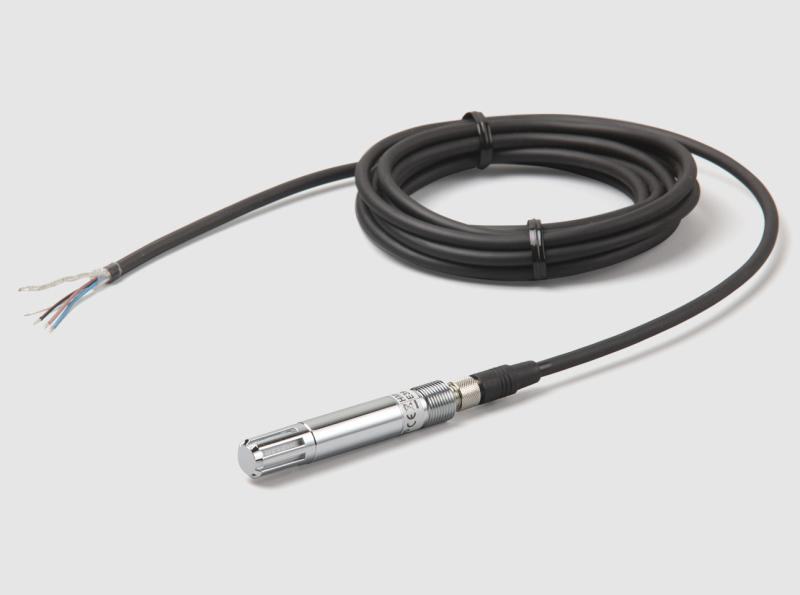
with ±1.5%RH accuracy for demanding volume applications

What relative humidity, dew point, absolute humidity and mixing ratio are, how temperature and pressure distort the reading, and why dew point is…

How humidity behaves in real conditions, the three most common measurement problems, and two practical scenarios —heated air and compressed air—…

When to measure relative humidity vs. dew point, what high and low humidity demand, how temperature and pressure factor in, and when a warmed probe…

Cooling accounts for up to 40% of a data center's energy demand. This Vaisala guide explains how measurement accuracy cuts costs and risks, with a…
A specialist replies with the solution, the instrument and the service that fit.
Instruments to quote
No instruments yet. An enquiry can be sent anyway: a specialist answers.