

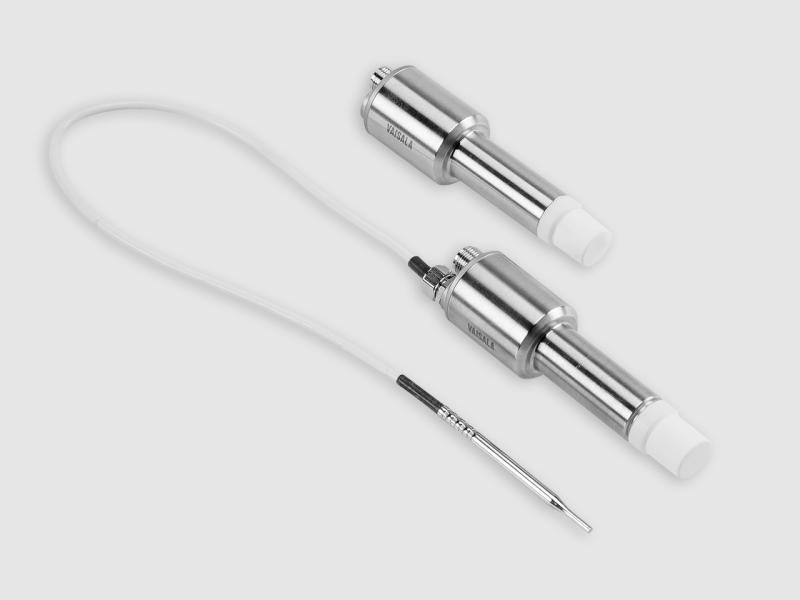
Vaporized Hydrogen Peroxide, Humidity and Temperature Measurement HPP270 Series
for bio-decontamination processes
Technical note
This blog is the first in a 4-part series where we describe how process parameters influence condensation and the maximum achievable concentration of hydrogen peroxide vapor during vH2O2 bio-decontamination applications.
In this series we propose four basic process parameter rules. But before we address the first parameter that affects condensation and the maximum achievable vH2O2 ppm, we will review two important values: relative humidity and relative saturation.
Because water (H2O) and hydrogen peroxide (H2O2) have similar molecular structures, both affect the condensation point of the air. However, relative humidity (RH) indicates only the level of water vapor in the air at a given temperature, whereas relative saturation indicates the level of water vapor as well as hydrogen peroxide vapor in the air. In air that contains hydrogen peroxide vapor, condensation will occur before 100% relative humidity. Therefore, the condensation point can reliably be anticipated with the relative saturation (RS) measurement.
When relative saturation reaches 100 %RS, the vapor mixture will condense. Relative humidity and relative saturation differ whenever there is vH2O2 present and the difference between RH and RS is further affected by the amount of vH2O2 present. Once condensation occurs (relative saturation has reached 100% RS), the ppm vH2O2 can no longer increase. In fact, H2O2 vapor concentration will often decrease as some vH2O2 will decompose into water and oxygen upon condensation. When this occurs, more vH2O2 must be injected to compensate.
If there is dripping condensation by the end of the decontamination phase, vH2O2 ppm readings may initially increase during aeration because the droplets release vH2O2 back into the air.
This brings us to the first rule: Lowering the initial level of humidity increases the amount of H2O2 vapor that can be used before condensation.
The graphs below illustrate that when relative humidity is higher at the onset of the conditioning phase (because de-humidification was not performed), condensation occurs sooner during decontamination. Therefore, the lower the relative humidity when conditioning begins, the higher the maximum achievable ppm vH2O2 before condensation occurs.
During the decontamination phase, some vH2O2 will decompose into water and oxygen. The amount of vH2O2 that decomposes will depend on conditions such as: materials, temperature, humidity, and air flow. The actual decomposition expected under certain conditions must be measured. In following graphs, we have assumed that 10% of vH2O2 has decomposed from its initial value and more H2O2 is vaporized to compensate.
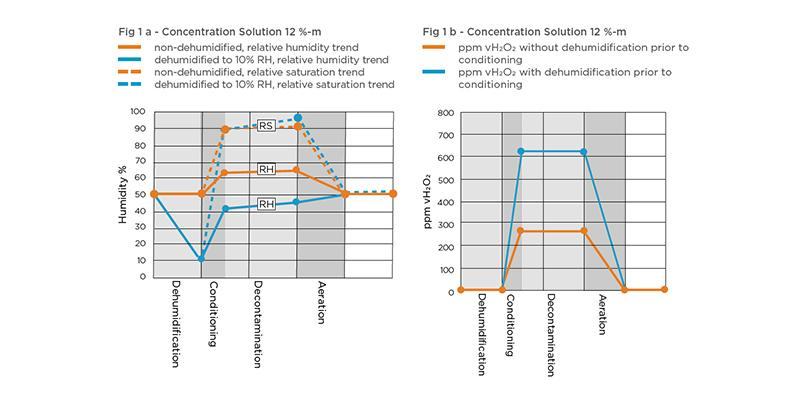
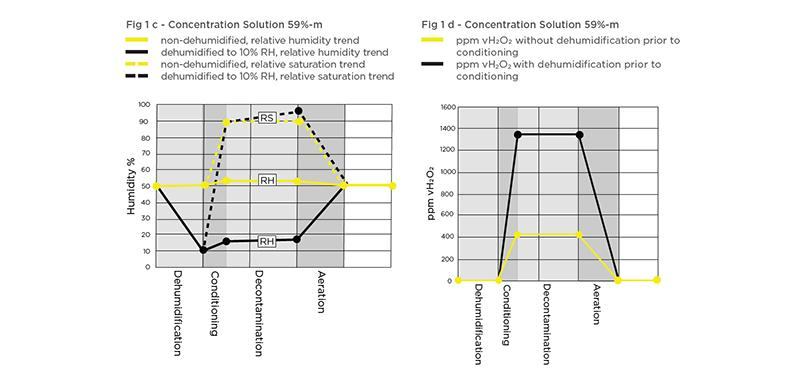
As shown, dehumidification prior to conditioning influences the maximum achievable ppm vH2O2. In figures 1a and 1b, the hydrogen peroxide solution used is 12%-m; figures 1c and 1d use a concentration solution of 59%-m. Figures 1a and 1b show two otherwise similar bio-decontamination cycles; orange lines indicate processes without dehumidification and a conditioning phase that begins with relative humidity at 50 %RH. The blue lines show processes where dehumidification was completed to 10 %RH prior to the conditioning phase.
Figure 1a and 1c show the effect of dehumidification on humidity percentage - indicated by relative humidity and relative saturation - during conditioning and dwell phases. Figure 1b and 1d show the effect of dehumidification on the maximum achievable hydrogen peroxide vapor during conditioning and dwell phases.
In our second blog in this series, we will illustrate how the H2O2 solution affects the amount of H2O2 vapor that can be used before condensation occurs.
To read the complete white paper upon which these blogs are based, visit this web page: “Considering Condensation: Influences in Hydrogen Peroxide Vapor Bio-decontamination”
for bio-decontamination processes

The latest addition to the Indigo family of transmitters and probes, the Indigo80 is a compact, handheld indicator and data logger. Ideal for field…

for quick inspections and spot-checking

For high precision measurements in demanding HVAC applications
for environmental chambers
with ±1.5%RH accuracy for demanding volume applications

What relative humidity, dew point, absolute humidity and mixing ratio are, how temperature and pressure distort the reading, and why dew point is…

How humidity behaves in real conditions, the three most common measurement problems, and two practical scenarios —heated air and compressed air—…

When to measure relative humidity vs. dew point, what high and low humidity demand, how temperature and pressure factor in, and when a warmed probe…

Cooling accounts for up to 40% of a data center's energy demand. This Vaisala guide explains how measurement accuracy cuts costs and risks, with a…
A specialist replies with the solution, the instrument and the service that fit.
Instruments to quote
No instruments yet. An enquiry can be sent anyway: a specialist answers.