

Humidity Fundamentals, Part 1: Key Concepts
What relative humidity, dew point, absolute humidity and mixing ratio are, how temperature and pressure distort the reading, and why dew point is…
Technical note
The food industry faces a double demand: producing more for a growing population, and producing it with fewer resources, less waste and a smaller carbon footprint. The answers now emerging — from vertical farming to alternative proteins — have something in common: they are all control-intensive processes, and therefore measurement-intensive ones.
This note walks through those trends from the angle that concerns us: what will need to be measured, and how demandingly. For the sector's current applications, see the Food, Beverage and Agroindustry landing.

Modern greenhouses and vertical farms move agriculture into a strictly controlled environment, where growth conditions are designed rather than hoped for. Temperature, humidity and CO2 are monitored continuously to achieve maximum yield per square meter with minimum water, energy and nutrients.
The same approach makes production more resilient: a crop that doesn't depend on the outside climate can be located near consumption, cut transport distance and sustain constant quality all year round.
A simple rule applies in the food industry: you get what you measure. Reducing an oven's energy consumption, a dryer's waste or a line's water use requires first knowing those variables accurately — and then controlling them continuously.
Reliable measurement is, in that sense, sustainability infrastructure: without traceable data there is no defensible optimization, neither for the operation nor for the footprint-reduction targets the industry is taking on.
Plant-based proteins already compete on the shelves, and behind them two deeper trends are advancing. Microbial fermentation — the same principle as brewing — uses microorganisms to convert simple raw materials, and even agricultural waste streams, into ingredients and food. And cellular agriculture aims further: producing dairy proteins without cows or eggs without chickens, by growing the cells that make them.
For instrumentation these processes are not exotic: they are bioreactors, and they demand the same kind of control as a fermentation room — temperature, CO2, humidity and stable, documented conditions. The starting point is familiar: we analyze it in the CO2 in fermentation and brewing note.
All these trends converge on the same demand: more variables measured, more accurately, at more points of the process, with records that can be defended — before a quality auditor today, and before a sustainability standard tomorrow.
That journey can already be seen today in CO2, which runs through the entire chain from the greenhouse to biogas: we map it in the CO2 across the food chain note.
This content is based on Vaisala's material on the future of the food industry and the role of measurement technology. AKRIBIS is an authorized Vaisala partner for distribution and technical support in the region — explore the full Vaisala instrumentation line.
What relative humidity, dew point, absolute humidity and mixing ratio are, how temperature and pressure distort the reading, and why dew point is…
How humidity behaves in real conditions, the three most common measurement problems, and two practical scenarios —heated air and compressed air—…
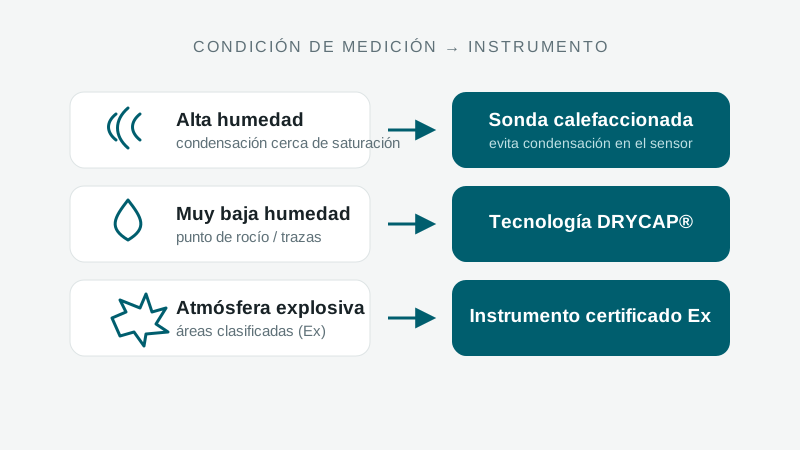
When to measure relative humidity vs. dew point, what high and low humidity demand, how temperature and pressure factor in, and when a warmed probe…

Cooling accounts for up to 40% of a data center's energy demand. This Vaisala guide explains how measurement accuracy cuts costs and risks, with a…
A specialist replies with the solution, the instrument and the service that fit.
Instruments to quote
No instruments yet. An enquiry can be sent anyway: a specialist answers.