

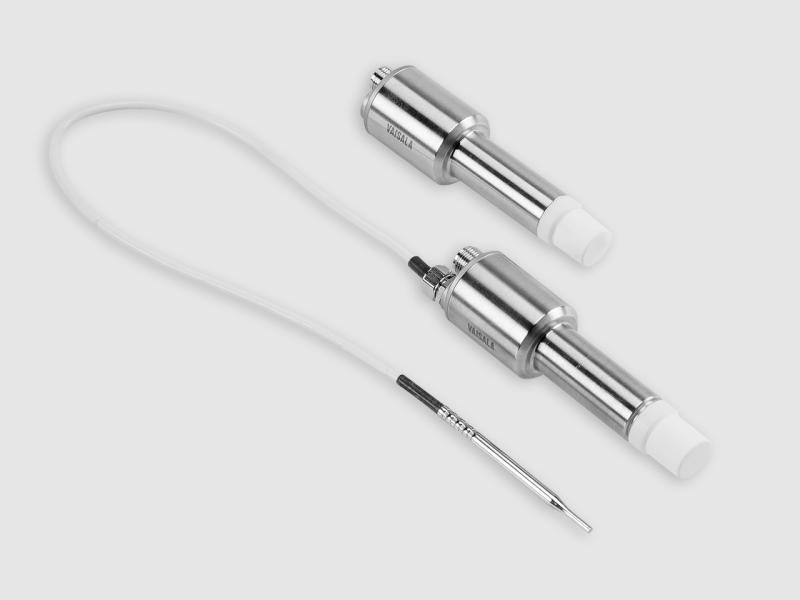
Vaporized Hydrogen Peroxide, Humidity and Temperature Measurement HPP270 Series
for bio-decontamination processes
Technical note
This blog is the fourth in a 4-part series where we describe how process parameters influence vaporized hydrogen peroxide bio-decontamination applications.
First blog: Humidity, condensation point, and maximum achievable vH2O2
Second blog: H2O2 Solution Concentration Ratio, Condensation Point & Maximum Achievable vH2O2
Third blog: Temperature, Condensation Point & Maximum Achievable vH2O2 ppm in Bio-decontamination
In this series, we propose four basic process parameter rules. This blog focuses on the 4th rule:
Increasing the H2O2 vapor concentration decreases the amount of water vapor the air can hold, and therefore, condensation occurs sooner.
In Figure 7 (from our white paper), we can see that increasing the H2O2 vapor concentration decreases the amount of water vapor the air can hold and condensation occurs sooner.
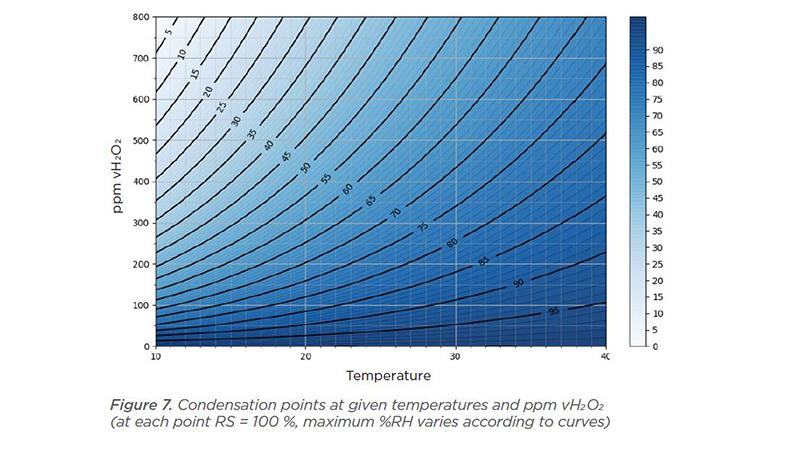
Each point in Figure 7 is a condensation point, meaning that Relative Saturation is 100 %. Temperature is on the x axis and ppm vH2O2 is on the y axis. The curve in the graphs shows the maximum relative humidity at a given temperature and concentration of ppm vH2O2.
As shown, at 20 °C and 300 ppm hydrogen peroxide, relative humidity will be 60% and relative saturation will be 100%. If we increase vH2O2 to 600 ppm at 20 °C, relative humidity is then 39 % and relative saturation is 100 %.
By increasing the air temperature to 40 °C with vH2O2 concentration at 300 ppm, relative humidity will be 87% and relative saturation will be 100%. The higher the temperature, the more water vapor the air can hold; relative humidity is increased.
To summarize our proposed rules for controlling condensation in vaporized hydrogen peroxide bio-decontamination applications:
Over this series of blogs (based on our white paper), we have demonstrated how an in-depth understanding of the relation between critical process parameters allows for the development of effective, repeatable vH2O2 bio-decontamination cycles.
Single-parameter measurement is often insufficient for monitoring and ineffective for process control. We have also shown why relative saturation is an important value in accurately predicting condensation. This is why Vaisala’s unique PEROXCAP® technology measures multiple parameters in a single sensing unit, including: hydrogen peroxide vapor ppm, temperature, dew point, vapor pressure, and humidity as both relative humidity and relative saturation.
Please leave a comment in the fields below, or contact us if you have any questions!
for bio-decontamination processes

The latest addition to the Indigo family of transmitters and probes, the Indigo80 is a compact, handheld indicator and data logger. Ideal for field…

for quick inspections and spot-checking

For high precision measurements in demanding HVAC applications
The Vaisala HUMICAP® Humidity and Temperature Probe HMP113 is a highly accurate and cost-effective humidity probe with a plastic enclosure. It has…
for general purpose humidity and temperature applications with exchangeable sensor

What relative humidity, dew point, absolute humidity and mixing ratio are, how temperature and pressure distort the reading, and why dew point is…

How humidity behaves in real conditions, the three most common measurement problems, and two practical scenarios —heated air and compressed air—…

When to measure relative humidity vs. dew point, what high and low humidity demand, how temperature and pressure factor in, and when a warmed probe…

Cooling accounts for up to 40% of a data center's energy demand. This Vaisala guide explains how measurement accuracy cuts costs and risks, with a…
A specialist replies with the solution, the instrument and the service that fit.
Instruments to quote
No instruments yet. An enquiry can be sent anyway: a specialist answers.